
Building a Company Culture Around Customer Feedback: The 2026 Strategy for Ethical Growth
A negative review isn't a threat to your business; it's the most honest piece of data you'll ever receive. Most business owners feel a heavy sense of dread when a feedback notification pings. You've likely felt the sting of disconnected departments where valuable insights simply vanish, or perhaps you're exhausted by the constant pressure of staying compliant with shifting FTC and Google rules. Building a company culture around customer feedback shouldn't be a source of stress or manual labor. It's about creating a natural rhythm where every voice helps your team grow.
You're about to learn how to transform raw customer insights into a self-sustaining culture of excellence. We'll show you how to move past the fear of public criticism by using ethical automation and compliant reputation management. We'll walk through the steps to implement a streamlined feedback loop that stays firmly within search engine rules. You'll see how the ActivCycle automation handles the heavy lifting, allowing your staff to focus on authentic service while your reputation grows on autopilot. By the end of this guide, you'll have a clear path to improved morale and long-term, ethical growth.
Key Takeaways
- Stop letting valuable customer insights get lost in management inboxes and bridge the "Feedback Gap" for your front-line staff.
- Discover how building a company culture around customer feedback empowers your team to make autonomous improvements using real-time data.
- Understand the 2026 regulatory landscape and why review gating poses a serious risk to your Google ranking.
- Learn to deploy ActivCycle automation to ensure every customer is heard at the right moment without adding to your team's workload.
- Move from a stressful, manual review process to an automated system that protects your reputation while staying compliant.
Why Most Businesses Fail to Operationalize Customer Insights
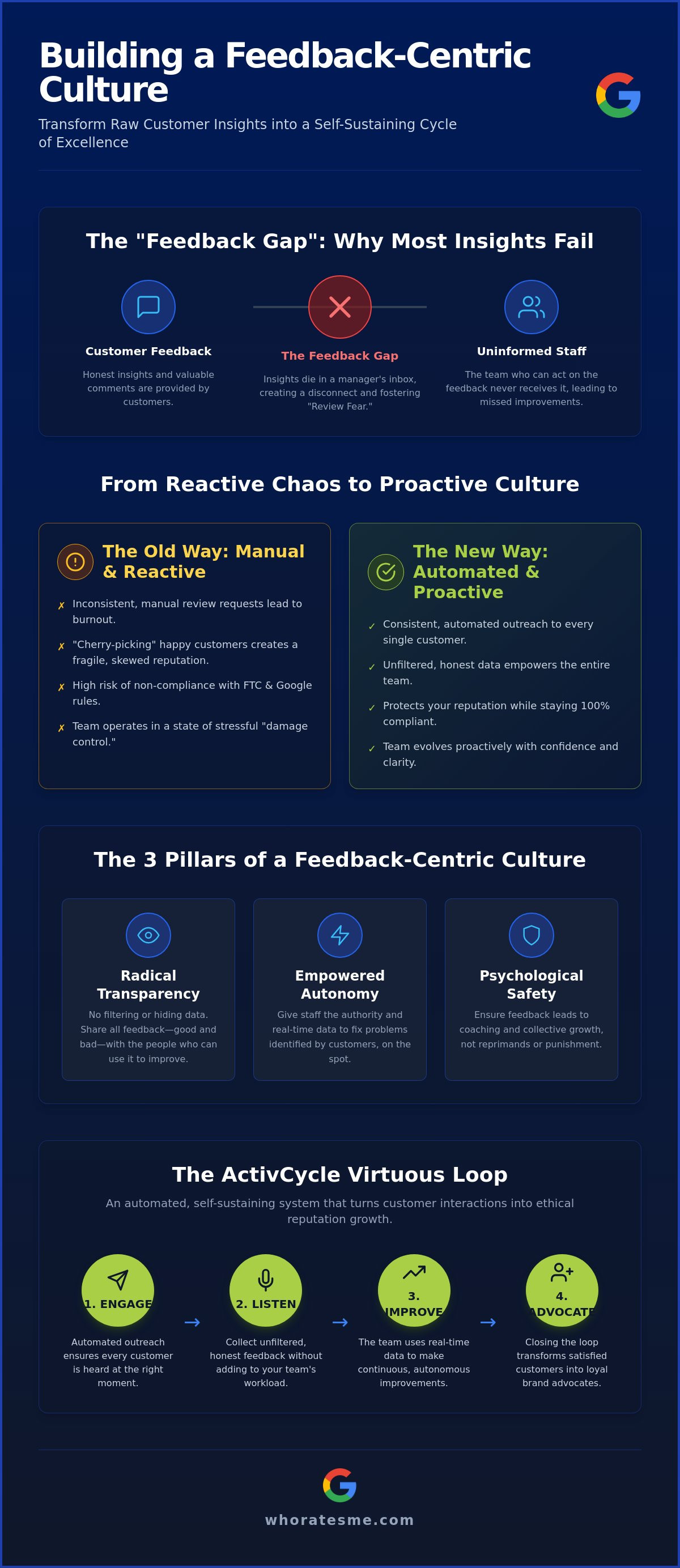
Most insights die in a manager’s inbox. It's a quiet tragedy that happens every day in businesses across the country. We call this the "Feedback Gap." When a customer leaves a thoughtful comment, it often gets stuck at the top of the hierarchy, never reaching the people who actually handle the day-to-day operations. Successfully building a company culture around customer feedback requires more than just a suggestion box; it needs a structural shift in how data moves through your organization. To truly understand this shift, we have to look at the foundations of Organizational culture; it's the shared values that dictate how a team handles both praise and criticism.
This gap creates a heavy emotional toll. When management only shares the "bad" news during performance reviews, staff begin to associate customer voices with punishment. This "review fear" breeds defensiveness. Instead of looking for ways to improve, employees look for ways to avoid being noticed. You lose the opportunity to tap into the "silent majority" of satisfied customers who would happily share their experiences if the process felt safe and natural for everyone involved. Ignoring those quiet, happy voices is a high cost to pay for a reactive strategy.
The Problem with Manual Feedback Collection
Relying on staff to manually request reviews is a recipe for inconsistency. People get busy. They forget. Or, more dangerously, they start "cherry-picking." They only ask the customers they know are happy, which creates a skewed, fragile version of your reputation. This practice is increasingly risky as Google and the FTC tighten their rules against selective filtering. Manual processes simply don't scale. As your business grows, the human effort required to maintain a steady feedback loop becomes a source of burnout rather than a tool for growth. You need a system that works even when your team is at their busiest.
From Defensive Reactions to Proactive Evolution
Most companies live in a state of permanent damage control. They wait for a fire to start and then scramble to put it out. This is reactive and exhausting. A better way exists. By building a company culture around customer feedback that is centralized and transparent, you transform every review into a free consulting session. A negative comment isn't a failure; it's a map to your next improvement. When your team has a clear, unfiltered view of customer sentiment, they stop reacting and start evolving. Control replaces chaos. Clarity replaces confusion. This evolution turns a stressful obligation into a source of quiet confidence for the entire organization.
The Anatomy of a Feedback-Centric Culture in 2026
A feedback-centric culture isn't just a buzzword. It's an environment where every team member is empowered by real-time customer data to make autonomous improvements. In 2026, transparency serves as the primary pillar of this structure. It means sharing both the wins and the "learning opportunities" across the entire team. When everyone sees the same information, the fear of the unknown disappears. This transparency requires psychological safety; staff must feel that a critique is a tool for growth, not a weapon for punishment. Successfully building a company culture around customer feedback starts when leadership treats every review as a shared learning asset rather than a private performance metric. This approach relies on three core values:
- Radical Transparency: No filtering or hiding data from the people who can use it.
- Empowered Autonomy: Giving staff the authority to fix problems identified by customers.
- Psychological Safety: Ensuring feedback leads to coaching, not reprimands.
Closing the loop is the final piece of the puzzle. It's not enough to change; you have to let the customer know their voice mattered. When a client sees their feedback led to actual change, they transform from a one-time buyer into a brand advocate. This creates a self-sustaining cycle of trust. Building a company culture around customer feedback creates a bridge between your internal operations and the external market. It ensures that the promises you make in your marketing are actually reflected in the service your customers receive every day.
Feedback as the Organizational Nervous System
Think of feedback as your business's nervous system. Real-time data flow prevents silos between departments. Sales knows what Support is hearing; Marketing knows what Operations is delivering. This is the "Quiet Innovator" approach. It's about subtle, continuous improvement rather than loud overhauls. Linking customer sentiment directly to team KPIs ensures everyone pulls in the same direction. You might consider how multi-platform management can simplify this process for your team.
Empowering Staff Through Positive Reinforcement
Successful cultures thrive on positive reinforcement. Celebrate specific mentions of staff names in reviews. It's a powerful motivator. Use this data to identify and replicate "superstar" behaviors across the company. When you show staff that automation supports their efforts, you build trust. They realize tools like ActivCycle aren't there to replace them; they highlight the excellent work they already do. This shift turns a stressful task into a source of pride.
Ethical Reputation Growth: Aligning Culture with Compliance
It's tempting to hide the rough edges. When a business owner sees a negative comment, the first instinct is often to make it disappear. This is called "Review Gating," and it's the single biggest threat to your cultural integrity. If your team sees that you only value a curated version of the truth, the psychological safety we've built together vanishes. Building a company culture around customer feedback requires total honesty. You can't build trust on a foundation of selective filtering. It's a short-term fix that leads to long-term instability.
The 2026 landscape is unforgiving for those who try to game the system. Both the FTC and Google have implemented advanced detection models to identify businesses that only solicit reviews from happy customers. These selective practices are now easily flagged by patterns in review velocity and sentiment. The penalties aren't just a slap on the wrist; they can include significant fines and the complete removal of your business profile. An "Ethics First" mindset isn't just about doing the right thing. It's about protecting your bottom line. Authenticity is far more profitable than a manufactured 5-star rating that savvy customers can see through in seconds.
You might be approached by "removal services" promising to scrub your history clean. Be careful. These services often use tactics that violate platform terms of service, putting your entire digital presence at risk. We don't believe in hiding the truth; we believe in managing it. A balanced profile that shows how you handle criticism is actually more persuasive than a perfect score. It shows you're a real business run by real people who care about getting it right.
Understanding Google-Compliant Practices
Building a sustainable reputation starts with a Google compliant review management strategy. This means you must ask every customer for their thoughts, regardless of how the transaction went. This isn't just a rule; it's a growth strategy. When you invite everyone to speak, you get a clear, unfiltered view of your operations. Constructive criticism helps you identify the small friction points that could eventually become major problems if left unchecked. A balanced profile builds a bridge of trust with potential clients.
Building Trust Through Non-Gated Platforms
Using a non-gated review platform is a bold statement of confidence. It tells your customers that you aren't afraid of the truth. This transparency fosters a level of genuine loyalty that a curated profile can never achieve. Customers appreciate honesty. They know that no business is perfect, so they look for how you respond when things go wrong. Building a company culture around customer feedback means embracing this openness. It's about maintaining compliance while still encouraging high-volume, authentic feedback that stays within the rules.
5 Steps to Automate Your Feedback Loop Without Losing the Human Touch
Automation often sounds cold. It feels like a wall between you and your clients. But when done right, it's actually the bridge that ensures no voice is ignored. Building a company culture around customer feedback requires a framework that doesn't rely on your team's memory during a lunch rush. It needs a reliable, quiet engine running in the background. By following these five steps, you can create a system that stays human while operating on autopilot.
- Step 1: Centralize your monitoring. Use a multi-platform dashboard to bring every voice into one room. You stop chasing notifications across five different sites and start seeing the big picture.
- Step 2: Deploy ActivCycle automation. This ensures that every client receives an invitation to share their experience at the perfect moment. Timing is the difference between a thoughtful response and an ignored email.
- Step 3: Establish a "Feedback Hour." Once a week, gather the team to review the high points and the hurdles. This is how you turn a digital metric into a shared mission.
- Step 4: Use the mobile app. Reducing response lag from days to minutes changes how customers perceive your dedication. On-the-go monitoring keeps you connected without being tethered to a desk.
- Step 5: Iterate based on data. If three people mention the same issue, it's not an outlier; it's a roadmap. Use these recurring themes to evolve your service.
This structured approach removes the anxiety of the unknown. When you have a clear process, building a company culture around customer feedback feels less like a chore and more like a competitive advantage. It allows your staff to focus on the person in front of them, knowing the reputation management is handled with integrity.
Implementing ActivCycle for Seamless Flow
Friction is the enemy of consistency. When you use customer feedback automation, you remove the burden from your staff's shoulders. They don't have to worry about the "right time" to ask or the "right way" to say it. The system handles the timing through triggers that feel personal and sincere. You can then monitor the health of your loop through automated reporting that shows exactly where your team is excelling and where they need support.
Managing Multi-Platform Feedback Effortlessly
For growing local services or national brands, keeping a consistent voice is difficult. Multi platform review management allows you to respond to Google, Yelp, and industry-specific sites from a single pane of glass. It ensures that whether a customer finds you on a major map or a niche directory, they see the same level of care. This consistency builds deep trust. Ready to put your reputation on autopilot? You can explore our Elevate plan to see how we simplify these steps for your business.
Scaling Your Vision: How WhoRatesMe Elevates Your Cultural Integrity
Scaling a business often feels like a loss of control. You worry that as your team expands, the personal touch that built your reputation will start to fade. It's a common fear. But growth doesn't have to mean a dilution of your values. By building a company culture around customer feedback with the right partner, you create a foundation that actually gets stronger as you grow. Our Elevate plan provides the necessary guardrails for ethical reputation growth, ensuring that your expansion is built on a bedrock of authentic customer experiences.
The transition from a manual, stressful process to an automated system is where the relief begins. You no longer have to chase staff for review requests or worry about whether a department is hiding negative insights. The "autopilot" nature of our platform handles the logistics, while you focus on the vision. This shift brings a profound sense of peace of mind. Knowing your customer feedback software is 100% compliant with the latest rules means you can sleep better at night. You aren't just surviving the 2026 landscape; you're mastering it.
Your next steps involve turning your centralized dashboard into a strategic growth engine. Every piece of data is a brick in the wall of your brand's authority. When you use these insights to refine your operations, you aren't just reacting to the market. You're leading it.
The Future of Your Reputation with WhoRatesMe
Leading a market requires more than just high scores. It requires a resilient strategy that survives algorithm shifts and regulatory changes. Ethical automation is your shield against these external pressures. When your feedback loop is honest and non-gated, you don't have to fear a Google update or an FTC audit. The Elevate plan is the definitive solution for ethical growth in 2026. It moves you past the exhausting cycle of "managing reviews" and into a future where your reputation is a self-sustaining asset.
Joining the Community of Quiet Innovators
In the 2026 SEO battle, businesses with high integrity are the ones winning the top spots. Search engines have become incredibly sophisticated at identifying and rewarding genuine human connection. We understand the emotional investment you've put into your business. You've worked hard to build something real, and you deserve a partner who seeks to protect that reputation with the same level of care. You don't need to be the loudest voice in the room to be the most successful. You just need to be the most reliable. Start building a company culture around customer feedback today and watch how clarity replaces chaos in your daily operations.
Your Path to Unshakeable Reputation Growth
Running a business is a constant marathon of emotional and physical investment. You've seen how the "Feedback Gap" can drain morale and how selective filtering can put your hard work at risk with search engines. The shift toward building a company culture around customer feedback isn't about adding more to your plate. It's about creating a system where clarity replaces chaos. By embracing transparency and empowering your team with real-time data, you replace the anxiety of public reviews with the quiet confidence of a leader in total control.
You don't have to navigate these complex regulatory changes by yourself. Our platform provides the guardrails you need for sustainable success. By utilizing ActivCycle Automation and maintaining a 100% Google Compliant strategy, we help you secure your digital presence without the stress of manual requests. We believe in No Review Gating because authenticity is the only currency that lasts. Elevate your reputation ethically with the WhoRatesMe Google-compliant plan and start your journey toward a self-sustaining culture of excellence today. You've built something remarkable. It's time to let that truth drive your growth.
Frequently Asked Questions
What is the best way to encourage a culture of feedback among employees?
The best way to encourage a feedback culture is to lead with transparency and psychological safety. You must show your team that feedback is a tool for growth, not a weapon for reprimand. Start by sharing positive reviews during team meetings to celebrate individual efforts. When negative insights arrive, treat them as a collective problem to solve rather than a single person's failure. This approach builds trust and encourages everyone to participate in the process.
How does customer feedback automation help build a company culture?
Customer feedback automation helps build a company culture by removing the friction and emotional weight of manual requests. When the process is automated, it becomes a natural part of the business rhythm rather than a stressful chore for your staff. This consistency ensures that the data flow is steady. It allows your team to focus on providing excellent service while the system handles the logistics of gathering insights, leading to a more focused and less burnt-out workforce.
Is it ethical to automate review requests to my customers?
Automating review requests is entirely ethical as long as you invite every customer to share their experience. The ethical line is crossed when businesses use automation to only target happy customers. By using a system that sends requests to everyone, you maintain total transparency. This honesty is central to building a company culture around customer feedback. It shows that you value the truth over a manufactured reputation, which resonates with both your team and your clients.
What are the risks of review gating for my business reputation?
Review gating carries the risk of severe penalties from search engines and regulatory bodies like the FTC. Google's algorithms are increasingly sophisticated at detecting selective filtering. If flagged, your business could face profile suspension or permanent removal. Beyond legal risks, gating destroys internal trust. If your team sees you hiding the truth, they'll stop taking feedback seriously. Authenticity is a much safer and more profitable long-term strategy for any local service-based company.
How do I handle negative feedback without discouraging my team?
You handle negative feedback by reframing it as a learning opportunity rather than a personal failure. Start by acknowledging the effort the team member put in before discussing the specific issue mentioned by the customer. Use the data to identify systemic problems rather than blaming individuals. When you treat a critique as a free consulting session, your team feels supported. This shift in perspective turns a potentially discouraging moment into a stabilizing force for improvement.
Can building a feedback culture actually improve my SEO rankings?
Building a company culture around customer feedback directly improves your SEO rankings by increasing review velocity and authenticity. Search engines prioritize businesses that show a steady, natural flow of recent activity. A culture that encourages honest responses leads to a higher volume of authentic comments. These service-related details help Google understand your business better. Higher engagement and transparency signals to algorithms that your company is a reliable choice for local searchers, leading to better visibility.
How much time does it take to manage an automated feedback system?
Managing an automated feedback system takes very little time once the initial setup is complete. Most business owners spend less than an hour a week reviewing their centralized dashboard. The automation handles the heavy lifting of sending requests and monitoring multiple platforms. You can use a mobile app to check insights on the go, which reduces response lag. This autopilot approach allows you to stay in total control of your reputation without sacrificing your schedule.
What is the difference between review management and building a feedback culture?
Review management is the technical task of monitoring and responding to comments, while building a feedback culture is a deeper organizational mindset. Management is about the task, but culture is about the mindset. A culture-first approach means every team member understands how their work impacts the customer experience. It moves the focus from just getting five stars to actually improving the business. One is a reactive chore; the other is a proactive strategy for ethical growth.
