Categorizing Customer Feedback for Insights: 2026 Guide
In 2026, research reveals that only three out of ten customers provide direct feedback to their service providers. When those rare comments finally arrive, they often feel like a burden instead of the gift they should be. You're likely staring at a mountain of raw reviews and support tickets, wondering how to categorize customer feedback for actionable insights without losing your entire week to manual data sifting. It's exhausting to feel "Franken-stacked" with tools that don't talk to each other. We know the anxiety that comes with negative feedback and the time-poverty that stops you from truly listening to your community.
This guide will show you how to transform that chaos into a clear roadmap for growth while staying fully compliant with the latest Google and FTC transparency standards. We'll walk through a rhythmic process to build a streamlined feedback loop that uses quiet automation to do the heavy lifting. You'll learn to move from being overwhelmed to being in total control of your brand narrative. By the end, you'll have a system that offers an unfiltered view of your business, allowing you to improve your ratings through authentic service improvements rather than guesswork.
Key Takeaways
- Move beyond simple star ratings to uncover the root causes of customer sentiment; this turns overwhelming noise into a clear path forward.
- Master how to categorize customer feedback for actionable insights by using a four-pillar framework focused on service quality and product performance.
- Streamline your daily workflow by centralizing multi-platform data into a single dashboard to reclaim time and reduce tool fatigue.
- Protect your long-term reputation by avoiding the "gating trap" and ensuring your feedback collection remains fully compliant with 2026 Google and FTC standards.
- Use high-impact categorization to close the feedback loop, allowing you to train your team and refine processes based on authentic customer truth.
The Foundation of Feedback Analysis: Why Categorization is Your Competitive Edge
Running a local service business is often a balancing act between doing the work and managing the reputation that follows it. Feedback categorization is the process of labeling qualitative data to identify recurring themes. It's the bridge between raw data and a clear roadmap. When you master how to categorize customer feedback for actionable insights, you transform a chaotic pile of comments into a strategic advantage. It's about moving from noise to clarity.
Raw reviews often feel like static. One person mentions price; another mentions a specific staff member. Without a system, this information remains fragmented. Organization creates a stabilizing force. It allows you to see the root causes behind your customer satisfaction levels. This isn't just a technical task; it's an emotional one. Organized data significantly reduces the stress of facing negative comments. When a complaint is categorized into a specific bucket, it becomes a problem to solve rather than a personal failure. This perspective allows you to maintain your integrity and respond with sincerity.
There is a direct financial impact to this level of organization. Google's local search algorithms favor businesses that demonstrate consistent quality and active engagement. By using categorized insights to close service gaps, you improve your ratings naturally. This leads to higher conversion rates as potential clients see a brand that is in total control of its narrative. You aren't just collecting stars; you're building a legacy of trust.
Moving Beyond Star Ratings to Root Causes
A 5-star review without context is a missed opportunity for growth. It tells you that you succeeded, but it doesn't explain how to repeat that success. Star ratings can also mask "phantom problems." These are minor issues that don't quite ruin a customer's day but might stop them from recommending you to a neighbor. Sentiment analysis helps you dig deeper. It uncovers the emotional journey of your clients. It reveals whether they felt respected, rushed, or reassured. Understanding these nuances is the only way to move beyond surface-level metrics to the heart of why people choose your business.
The 'Quiet Innovator' Approach to Data Management
Automation serves as a silent partner in your business. It handles the repetitive work of sorting and tagging. This "Quiet Innovator" approach, utilizing systems like ActivCycle automation, can reduce the time-cost of manual data sifting by roughly 80%. When you aren't buried in spreadsheets, you have the mental space to lead your team. A streamlined feedback loop links technical processes to positive human outcomes. Your staff feels supported because they receive clear, categorized feedback. Your customers feel heard because you address their specific concerns. It's a synchronized system that creates a sense of order in a busy service environment.
Building Your Categorization Framework: The 4 Pillars of Actionable Data
A messy inbox is a thief of time. It steals focus from your team and clouds your vision of the future. By implementing a four-pillar framework, you regain that lost territory and find the order you've been seeking. Understanding how to categorize customer feedback for actionable insights isn't just a management task; it's an act of protection for your brand's integrity. These pillars act as filters. They catch the valuable nuggets of truth while letting the emotional noise drain away.
Pillar 1: Service and Staff Performance
Your team is the face of your business. Tagging feedback by staff name or role allows you to identify your "Quiet Heroes." These are the people who consistently provide excellent service but rarely seek the spotlight. It also helps you spot service gaps before they become recurring negative themes. If three different customers mention a "rushed" feeling on Tuesdays, you've found a training opportunity, not a permanent flaw. Addressing these gaps early ensures that your team feels supported and your service remains authentic.
Pillar 2: Operational Bottlenecks and Friction
Sometimes the problem isn't the person; it's the process. Categorizing feedback about the "path to purchase" reveals where customers get stuck. Are they struggling with a clunky booking link? Is the payment portal slow on mobile devices? Identifying technical glitches in the booking or payment process allows you to remove the hurdles that stop a lead from becoming a loyalist. When you streamline this transition, you create a sense of ease that customers naturally appreciate.
Beyond the "how" of service, we must also look at the "what." Identifying specific issues with the goods or services delivered helps you refine your core offering. This is where Transforming unstructured data into actionable insights becomes vital. By tagging feedback as "Frustrated," "Delighted," or "Neutral," you can prioritize your responses. A frustrated customer needs a quick, sincere response to restore their trust, while a delighted one offers a chance to celebrate a win. Prioritizing these emotional shifts helps you maintain a calm, professional presence even during busy seasons.
Mastering how to categorize customer feedback for actionable insights ensures that you aren't just reacting to the loudest voice in the room. Instead, you're making steady, methodical improvements that lead to natural growth. Managing these moving parts becomes much simpler with multi-review platform management, which keeps your data organized and your mind clear. This structured approach allows you to focus on the success of your users while we handle the heavy lifting of organization.
A Step-by-Step Guide to Processing and Organizing Raw Feedback
Managing a business is hard enough without the constant ping of notifications from five different apps. It feels fragmented. To truly master how to categorize customer feedback for actionable insights, you need a methodical path from raw text to clear strategy. This isn't just about sorting; it's about making your life easier. A structured process allows you to breathe and focus on what you do best: serving your community. Follow these five steps to turn chaos into a roadmap.
- Step 1: Centralize your data. Use a multi platform review management dashboard to pull every comment into one view.
- Step 2: Apply high-level 'Bucket' tags. Group comments into broad categories like Product, Service, Price, or Ease of Use.
- Step 3: Drill down into 'Sub-tags'. Within your 'Service' bucket, add specific labels like 'Wait Time' or 'Staff Professionalism' for deeper clarity.
- Step 4: Cross-reference with sentiment. Look at which categories trigger the most frustration to determine your immediate priorities.
- Step 5: Review trends monthly. Measure the impact of your operational changes by watching how your tag volumes shift over time.
Centralizing Multi-Platform Feedback
Data that lives in silos is dangerous. Managing Google and Yelp separately often leads to missed patterns that could save your reputation. When information is scattered, you lose the "360-degree view" needed for authentic growth. Using a mobile app for on-the-go monitoring ensures you never feel disconnected from your customers. It replaces the "Franken-stack" headache with a single, stabilizing force. This centralized approach allows you to spot a recurring issue in one city or branch before it spreads across your entire national footprint.
The Art of Effective Tagging
A tagging taxonomy should be a mirror of your industry's specific needs. However, many startups fall into the trap of "tag bloat" by creating too many categories. Fewer, more meaningful tags are always better for maintaining order. You might consider using automated categorization to handle the initial heavy lifting, which allows your team to focus on the human side of the data. Sentiment tagging serves as the vital bridge between cold data and genuine empathy. When you understand the emotion behind the words, you can respond with the sincerity your customers deserve. This disciplined approach ensures that how to categorize customer feedback for actionable insights becomes a natural part of your business rhythm rather than a daunting chore.
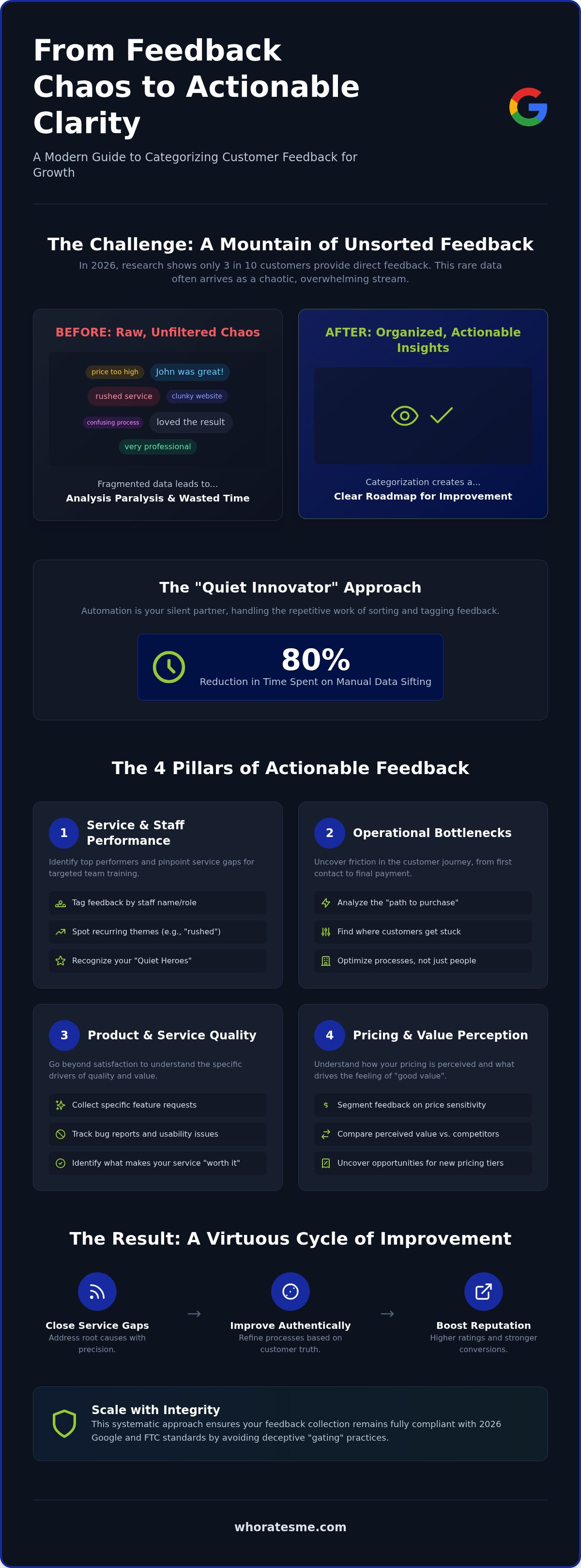
From Data to Decisions: Transforming Categories into Business Growth
Organizing data is a vital first step, but the real transformation happens when you turn those labels into actions. Knowing how to categorize customer feedback for actionable insights is only as valuable as the operational changes you implement next. It's about moving from a clear view to a clear path. Identifying "High-Impact" categories allows you to see which changes will move the needle on your rating fastest. If "staff speed" is a recurring tag in your negative reviews, solving that specific bottleneck can trigger a natural wave of positive feedback.
Prioritizing Actions Based on Category Frequency
You don't have to fix every minor issue at once to see a major difference. The Pareto Principle of feedback suggests that 20% of your operational issues usually cause 80% of your negative reviews. It's a relief to realize that a few focused adjustments can clear the majority of your reputational hurdles. Differentiate between a "one-off" complaint from a bad day and a systemic operational failure. Systemic failures are where you should allocate your resources. These are the categories that directly impact customer lifetime value and long-term loyalty.
Negative categories aren't just hurdles; they're marketing opportunities in disguise. A "You spoke, we listened" campaign shows your community that you value truth over perfection. It builds a narrative of authenticity that resonates with modern consumers. On the flip side, use your positive categories to build social proof. If your "Ease of Use" category is overflowing with praise, make that the centerpiece of your marketing. It's about being real rather than being flawless.
Closed-Loop Feedback Strategies
Closing the loop is the final step in creating a synchronized business. Respond to categorized feedback with the voice of a "Trusted Ally" who understands the customer's investment. This isn't about high-pressure sales; it's about sincere resolution. You should constantly update your review management strategy based on the new insights your tags provide. Ensure every piece of feedback results in a documented improvement. This methodical approach ensures your business stays grounded and successful. If you're ready to take control of your reputation, our review management solutions can help you build a loop that works on autopilot.
Scaling with Integrity: Using Automated Categorization to Stay Google-Compliant
Protecting your reputation shouldn't mean hiding from the truth. It's natural to feel a pang of anxiety when a negative comment appears. You've poured your heart into your business; you want the world to see the best version of it. However, the "Gating Trap" is a dangerous shortcut. Categorizing feedback specifically to suppress or hide negative reviews is a recipe for disaster. In 2026, both Google and the FTC have intensified their focus on review transparency. Selective filtering doesn't just risk your local rankings; it risks your brand's fundamental safety.
The key to sustainable growth lies in customer feedback automation. This technology ensures you collect all voices, not just the happy ones. When you understand how to categorize customer feedback for actionable insights, you realize that negative comments are often your most valuable teachers. They highlight the specific service gaps that, once closed, lead to natural 5-star experiences. This is the "Quiet Innovator" approach: using data to improve, not just to decorate. It creates a stabilizing force in a chaotic environment.
The Ethics of Feedback Analysis
There is a vital difference between filtering for insights and filtering for ratings. One builds a better business; the other builds a house of cards. Transparency builds more trust with modern consumers than a "perfect" 5.0 rating ever could. People look for authenticity. They want to see how you handle mistakes. Staying on the right side of the Consumer Review Fairness Act isn't just about legal compliance. It's about respecting the human connection you have with your community. Choosing truth over perfection is always the safer long-term bet.
Leveraging ActivCycle for Compliant Growth
The ActivCycle advantage lies in its ability to remove human bias from the categorization process. Automated loops organize authentic service comments without the temptation to cherry-pick. This system syncs your categorization with real-time service improvements. When a bottleneck is identified, you fix it. When a team member excels, you celebrate them. Positioning your business as a leader in authenticity through google compliant review management ensures you stay grounded. You aren't just surviving the noise. You're orchestrating a symphony of honest, sustainable growth that Google rewards and customers trust.
Taking Control of Your Brand Narrative
You've seen how moving beyond simple star ratings allows you to uncover the root causes of customer sentiment. By focusing on the four pillars of data and maintaining strict compliance, you protect your business from the risks of selective filtering. Mastering how to categorize customer feedback for actionable insights is the difference between reacting to chaos and leading with quiet confidence. It's about building a legacy of trust through authentic service improvements that resonate with your community.
We're here to be your trusted ally in this journey. Our ActivCycle automation provides 24/7 feedback loops that handle the heavy lifting of organization while you focus on leading your team. With our centralized mobile app, you can monitor your national brand reputation from any location. This is all managed through strictly non-gated, FTC-compliant technology that values truth over perfection.
Elevate your reputation ethically with our Google-compliant plan today. You have the vision to turn every customer voice into a clear, synchronized roadmap for growth.
Frequently Asked Questions
What is the best way to categorize customer feedback for a small business?
The most effective approach is to focus on a four-pillar framework: Service Quality, Product/Offering, Sentiment, and Operational Friction. Small businesses often feel overwhelmed by raw data; keeping categories broad at first prevents the stress of "tag bloat." Once you understand how to categorize customer feedback for actionable insights, you can drill down into specific sub-tags like "wait times." This steady approach ensures you remain in control without losing hours to manual sifting.
Can AI accurately categorize customer sentiment in 2026?
Yes, AI usage in customer experience has reached 73% as of 2026, and modern sentiment analysis tools are highly nuanced. These systems can now detect subtle shifts in emotional tone across large volumes of text. They identify whether a customer feels delighted, frustrated, or neutral with high precision. This "Quiet Innovator" technology allows you to prioritize responses based on emotional urgency, ensuring your most stressed customers receive immediate, empathetic care.
How often should I review my feedback categories for actionable insights?
You should perform a high-level review of your feedback trends at least once a month. This methodical rhythm allows you to measure the impact of operational changes you've implemented. If you've recently updated your booking process, a monthly check will reveal if "friction" tags are decreasing. Frequent reviews ensure your business stays synchronized with customer needs, allowing for steady, natural growth rather than frantic, last-minute fixes.
Is it illegal to only show positive customer feedback on my website?
Yes, selective filtering or "review gating" is a violation of FTC guidelines and the Consumer Review Fairness Act. In 2026, transparency is non-negotiable for brand safety. Displaying only positive reviews is considered deceptive by regulators and can lead to significant civil penalties. Authenticity builds more trust than a perfect rating. Showing a mix of feedback proves you value truth and are committed to real service improvements.
What is the difference between feedback categorization and sentiment analysis?
Categorization involves labeling feedback based on the "what," while sentiment analysis focuses on the "how." For example, a comment about a slow repair is categorized under "Service Speed." Sentiment analysis then identifies the "Frustration" behind that comment. Combining both is essential for how to categorize customer feedback for actionable insights. Categorization tells you which part of the business to fix; sentiment analysis tells you how much it's hurting the customer relationship.
How do I handle feedback that doesn't fit into any of my existing categories?
Use a "Miscellaneous" or "General" bucket to temporarily hold outliers while you monitor for new patterns. If you notice a recurring theme within this bucket, it's time to create a new category. This keeps your taxonomy organized without forcing data into irrelevant labels. It's a process of natural growth. By staying flexible, you ensure your feedback loop remains an unfiltered and accurate mirror of your current business reality.
Can automated feedback categorization help me stay Google-compliant?
Automation helps maintain compliance by removing human bias and ensuring every voice is collected. Systems like ActivCycle automation are designed to follow strictly non-gated protocols. They organize feedback without the temptation to hide negative comments. This protects your brand from the "Gating Trap" that Google and the FTC actively penalize. High-integrity automation ensures your reputation grows naturally through service excellence rather than through prohibited filtering.
What tools are needed to consolidate reviews from multiple platforms for analysis?
You need a centralized dashboard that supports multi-platform management and a dedicated mobile app for real-time monitoring. These tools eliminate the "Franken-stack" headache of logging into separate accounts for Google, Yelp, and industry-specific sites. A unified view allows you to spot systemic issues across your entire footprint. This synchronization provides a calm, stabilizing force, giving you total control over your brand narrative without the stress of fragmented data.
