Creating a Customer Feedback Loop: The 2026 Guide to Sustainable Growth
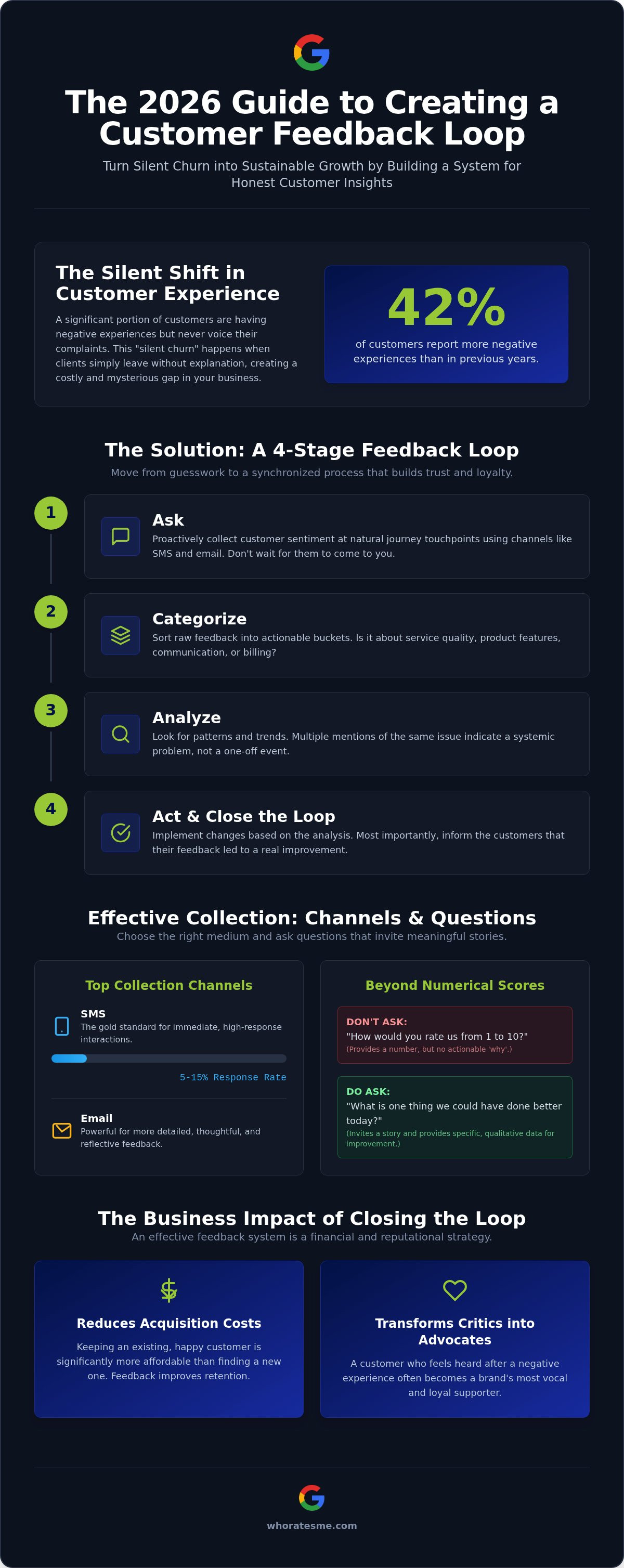
Recent data shows that 42% of customers are reporting more negative experiences than in previous years, even when they say they're generally happy. This silent shift is enough to keep any business owner awake. You pour your heart into your service, yet customers sometimes slip away without a word. If you're tired of the manual grind, creating a customer feedback loop is the only way to catch these issues before they turn into departures.
We understand the pressure of protecting your reputation while trying to grow. It's hard to stay consistent when you're overwhelmed by daily operations. In this 2026 guide, you'll learn how to build an automated, ethical system that captures honest insights and improves your operations. We'll show you how to use tools like ActivCycle automation to stabilize your growth and generate a steady stream of authentic reviews. By the end, you'll have a clear path to higher retention and total control over your business's future.
Key Takeaways
- Identify the natural touchpoints in your customer journey to stop "silent churn" before clients leave without a word.
- Master the structural steps for creating a customer feedback loop that flows naturally through integrated SMS and email channels.
- Learn to utilize "Inner Loop" and "Outer Loop" responses to rescue fragile customer relationships and refine your internal operations.
- Stay ahead of FTC and Google regulations by building an ethical system that prioritizes transparency over risky tactics like review gating.
- Discover how ActivCycle automation removes the emotional exhaustion of manual requests, putting your reputation growth on a steady, reliable autopilot.
What is a Customer Feedback Loop and Why Does it Matter in 2026?
Running a business is a deeply personal journey. You invest your time, energy, and reputation into every interaction. However, many owners face a quiet, draining challenge: silent churn. This happens when customers simply stop showing up without ever telling you why. It's a missed opportunity that feels like a mystery. By creating a customer feedback loop, you turn that silence into a conversation. A feedback loop is a continuous cycle of gathering, analyzing, and acting on customer input. It's the bridge between what you think you're delivering and what your customers actually experience.
In 2026, the market has shifted. People no longer chase the illusion of perfection. Instead, they look for authentic, unfiltered transparency. They want to know that if something goes wrong, you'll be there to fix it. This is the "Trusted Ally" relationship. It's a partnership built on integrity. When you're real with your customers, they reward you with their loyalty. They don't expect you to be flawless; they expect you to be sincere.
The Four Essential Stages of the Loop
Building a reliable system requires a methodical approach. It's about moving from guesswork to a synchronized process. Most effective Customer feedback management (CFM) strategies follow these four steps:
- Ask: Don't wait for the phone to ring. Proactively collect sentiment through SMS, email, or in-person requests at natural touchpoints.
- Categorize: Sort your data into actionable buckets. Is the feedback about service quality, product features, or your billing process?
- Analyze: Look for patterns. If several people mention a delay in the same week, it’s not a coincidence; it's a systemic issue.
- Act: This is the most critical part. Implement the change and, most importantly, tell the customer you did it.
The Business Impact of Closing the Circle
Closing the loop isn't just a courtesy. It's a financial strategy. It significantly reduces customer acquisition costs because keeping an existing client is far more affordable than finding a new one. There is also a powerful psychological shift that happens when a customer feels heard. A critic who receives a thoughtful, action-oriented response often transforms into a vocal advocate. They see that you value their voice. Creating a customer feedback loop ensures that every piece of criticism becomes a building block for your reputation. The feedback loop is the heartbeat of modern customer-centric growth.
Step-by-Step: Building Your Feedback Infrastructure
Setting up a new system can feel like adding more weight to an already heavy pack. You're focused on quality, and the thought of managing another technical layer is daunting. However, creating a customer feedback loop is about building a bridge, not a barrier. It starts with mapping your customer journey to find the moments where a conversation feels natural. These touchpoints are the foundation of your growth. If you ask for input when the experience is still fresh, you'll capture the truth before it fades.
Choosing Your Collection Channels
Not all channels are created equal. In 2026, SMS has become the gold standard for quick, high-response interactions, often seeing rates between 5% and 15%. It's immediate. Email remains a powerful tool for more detailed, reflective feedback. The secret is timing. If you ask too early, the customer hasn't fully experienced the value. If you ask too late, the details are lost. You need a rhythm that respects their time. Making it accessible means they can respond in two taps or less. If you need a hand setting this up, exploring multi-platform management can simplify the process.
Beyond NPS: Gathering Meaningful Insights
A numerical score like the Net Promoter Score is a start, but it's not the whole story. It's a snapshot, not a conversation. To truly understand your business, you need qualitative data. This comes from asking open-ended questions. Instead of "Rate us 1 to 10," try asking, "What is one thing we could have done better today?" This simple shift invites a story. These stories are the most valuable assets you have for training your team. They highlight exactly where your service standards are shining and where they might be flickering. When you categorize these stories into buckets like service quality or communication, you turn raw data into a clear plan for improvement. This organization ensures that valuable insights don't just sit in an inbox; they drive change.
Closing the Loop: Turning Data Into Action
Collecting insights is only half the battle. If you gather feedback but never act on it, your customers will eventually stop sharing their thoughts. They need to know their voice matters. Creating a customer feedback loop requires a commitment to follow-through. This is where you transform raw data into a tangible sense of order and progress. By closing the circle, you prove to your community that you aren't just listening; you're evolving. This process is divided into two distinct but synchronized paths: the Inner Loop and the Outer Loop.
The Inner Loop: Personal Customer Recovery
Negative feedback can feel like a personal setback. It's an emotional moment for any business owner who cares deeply about their work. However, these moments are actually your greatest opportunities for retention. When you respond with genuine empathy rather than a defensive script, you shift the power dynamic from conflict to collaboration. Use a rhythmic approach to your communication. Start by acknowledging the pain they experienced. Follow this immediately with the relief of a concrete solution. This "problem-and-relief" flow reassures the customer that you are a stabilizing force. A sincere follow-up can turn a frustrated critic into a loyalist who feels a deeper connection to your brand because you stood by them when things weren't perfect.
The Outer Loop: Systemic Business Growth
While the Inner Loop handles individual hearts, the Outer Loop repairs the engine of your business. This strategy involves stepping back to identify trends across different service teams or locations. If multiple customers mention the same friction point, it's a sign of a systemic issue. Fixing these patterns is how you achieve sustainable growth. Once you've implemented a high-level change, tell your entire customer base about it. Share these updates in your newsletter or on social media. It shows transparency and integrity. For those looking to integrate these actions into a broader plan, check out the definitive online reputation management strategy for 2026. Creating a customer feedback loop that feeds into your public social proof builds long-term trust. It moves your business from a state of constant reaction to one of calm, deliberate improvement.
Ethical Amplification: Why Compliance is Your Competitive Edge
Integrity is the bedrock of a lasting business. When you are creating a customer feedback loop, it's tempting to want to show only your best side. You've worked hard. You want your public profile to reflect that effort. But there is a hidden danger in trying to curate perfection. In 2026, transparency is no longer a technical requirement; it's a core brand value that separates the leaders from the rest. A compliant loop doesn't just keep you out of trouble. It yields better SEO results and attracts higher-quality leads who value honesty over hype.
The Dangers of Review Gating
Many businesses fall into the trap of "review gating." This is the practice of asking for internal feedback first and only inviting the happy customers to post publicly. It feels safe. It's actually a violation of Google's terms and the Consumer Review Fairness Act. The FTC has made it clear: you cannot suppress or hide negative experiences. If Google detects a pattern of selective filtering, they may remove your reviews or suspend your profile. This is a heavy price to pay for a temporary boost. To grow naturally, you must invite every customer to share their story. You can stay compliant by using an Elevate Google-compliant plan that manages requests ethically and transparently.
Building Social Proof Through Authenticity
Perfection is often a red flag for modern consumers. A "perfect" 5.0-star rating can actually trigger skepticism in a savvy buyer. Data shows that 72% of consumers will not make a purchase until they have read reviews. A 4.8-star rating with a mix of honest feedback is far more believable. It shows you are real. It shows you are human. When you encourage customers to share their unfiltered experiences on third-party platforms, you build unshakeable trust. This social proof is what converts a browser into a buyer. For more on how to approach this, see the definitive guide to non-gated review platforms. Creating a customer feedback loop that embraces the good and the bad shows that you have nothing to hide. It positions you as a mentor who values truth over a flawless facade. This authenticity is your greatest competitive advantage in a crowded market.
Automating the Rhythm with ActivCycle
The daily pressure of running a service-based business can leave you feeling drained. You know that creating a customer feedback loop is vital for growth, but finding the time to ask every client for their thoughts feels impossible. This is where many owners hit a wall. Manual collection is inconsistent. It's time-consuming. Most importantly, it leads to emotional exhaustion. You shouldn't have to choose between providing excellent service and managing your reputation. ActivCycle automation acts as the stabilizing force your business needs, turning a chaotic manual process into a calm, predictable rhythm. It allows you to step back from the grind and watch your reputation grow on its own.
ActivCycle: Feedback on Autopilot
Automation doesn't mean losing the human touch. It means protecting your time so you can focus on the people who matter most. ActivCycle triggers requests at the exact moment your customer is most likely to respond. This ensures every voice is heard without adding a single task to your team's to-do list. The system integrates into your existing workflows, moving in synchronization with your daily operations. By removing the friction of manual requests, you create a more professional experience for your clients. They see a business that is organized, attentive, and ready to listen. You get the insights you need to scale without the grind. It's the silent mentor that protects your brand while you focus on the work you love.
The Elevate Plan: Compliance Built-In
Managing your reputation across multiple platforms can feel like a full-time job. Between Google, industry-specific sites, and social media, it's easy to lose track of the conversation. The mobile app provides a clear, unfiltered view of customer sentiment directly from your pocket. You can monitor your feedback loop while on the move, ensuring you never miss a beat. The Elevate Google-compliant plan is built specifically to protect you. It handles the complexities of platform regulations so you don't have to worry about accidental violations. You can manage everything from a single, centralized dashboard, keeping your growth steady and your integrity intact. This centralized view gives you total control over your public image. See how ActivCycle can automate your growth and transform your business into a self-sustaining success story. You've worked hard to build your business; now, let your reputation work just as hard for you.
Build a Legacy of Trust and Growth
Running a business is a marathon, not a sprint. You've seen how the right infrastructure can transform silent churn into vocal advocacy. By creating a customer feedback loop, you move from a state of constant reaction to one of total control. You now have the roadmap to build an ethical system that values truth over curated perfection. It's about honesty. It's about longevity.
You don't have to carry the burden of manual collection alone. With ActivCycle automation, your feedback cycle runs on effortless autopilot. You can maintain 100% compliance with the Elevate Google-compliant plan, protecting your reputation while you grow. Everything you need is accessible through a centralized mobile app for real-time monitoring. This is the stabilization your business deserves.
It's time to let your business reach its full potential without the manual grind. Start building your ethical feedback loop with WhoRatesMe today. You have the vision; we have the system to help you sustain it. Your future of steady, authentic growth is ready when you are.
Frequently Asked Questions
What is the difference between a feedback loop and a simple survey?
A survey is a one-way data collection tool, while a feedback loop is a continuous process of asking, analyzing, and acting. A survey is a snapshot in time. A loop is a living system that ensures customer voices lead to actual operational changes. It's about closing the circle so the customer knows their input mattered. This transformation from data to action is what defines a successful loop.
How often should I ask customers for feedback?
Consistency is key, but you should avoid overwhelming your audience. The best practice is to trigger a request at a natural touchpoint, such as immediately after a service is completed or a product is delivered. For repeat clients, once every few months is often sufficient to capture their evolving sentiment. Timing your requests ensures the experience is fresh in their minds without feeling like a burden to their busy schedule.
Is review gating illegal, or just against Google’s rules?
Review gating is both a violation of Google’s terms and a practice scrutinized by the FTC under the Consumer Review Fairness Act. It involves filtering out negative feedback before inviting public reviews. This lack of transparency can lead to profile suspensions or legal penalties. Using an ethical, 100% Google-compliant Elevate plan ensures you grow your reputation without the risk of deceptive practices or platform bans. It's the safest path to long-term credibility.
How do I handle negative feedback within my loop?
View negative feedback as a gift of clarity rather than a personal attack. Start by acknowledging the customer's pain and providing a clear path to a solution. This problem-and-relief approach stabilizes the relationship and proves you're listening. By resolving the issue privately and then showing the public how you've improved, you demonstrate integrity. It's about being a trusted ally who values truth over a flawless facade for your business.
Can I automate my feedback loop without sounding robotic?
Yes, automation can feel deeply personal when you focus on human-centric language. ActivCycle automation triggers requests at the optimal moment, but the message itself should be warm and sincere. Use the customer's name and reference the specific service they received. When automation handles the heavy lifting, you have more emotional energy to engage personally with the insights that come back. It keeps your business scaling while maintaining the human connection your clients value.
What metrics should I track to see if my feedback loop is working?
Focus on your response rate, the sentiment of qualitative comments, and your overall retention rate. If your response rate is between 5% and 15%, your timing is likely correct. Tracking how many silent customers you've re-engaged is another powerful indicator. These metrics show if creating a customer feedback loop is actually driving the sustainable growth you're looking for. It moves you from guesswork to a data-driven understanding of your operations.
Do I need special software to create a customer feedback loop?
While you can start manually, software provides the consistency needed for long-term success. ActivCycle automation removes the emotional exhaustion of asking for reviews every day. It ensures that no customer is missed and that data is organized for easy analysis. A centralized dashboard and mobile app allow you to monitor sentiment on the go, keeping you in total control of your reputation. It's a small investment that offers a stabilizing force for your brand.
How does a feedback loop help with SEO?
A healthy loop generates a steady stream of fresh, authentic content that search engines value. When customers leave detailed comments about your specific services, it signals relevance to Google. Creating a customer feedback loop also improves your click-through rates by building a higher, more credible star rating. This organic social proof tells search algorithms that your business is active, reliable, and trusted by real people across the country. It's a natural way to boost visibility.
