
Handling a 1-Star Review: A Practical Response Plan
A one-star review can feel like a verdict on all the hard work behind your business. It’s natural to want to reply immediately, especially if the comments seem unfair. But knowing what to do after receiving a 1-star review starts with a pause, not a public argument.
A calm, measured response can help protect trust while giving you room to understand what happened. You don’t have to choose between ignoring the review and reporting it straight away. First, gather the facts. Then decide whether the review describes a real customer experience, raises a concern you can address, or appears to violate the platform’s policies.
This practical response plan covers the first steps: reviewing the details, deciding whether to reply or report, and addressing any genuine service issue. You’ll also learn how to invite future feedback ethically, without filtering out criticism or compromising review integrity. The goal isn’t to make every review positive. It’s to show customers that you listen, respond professionally, and use honest feedback to improve.
Key Takeaways
- For what to do after receiving a 1-star review, start with a calm triage process: save the review, alert the right person, and set a time to assess it.
- Separate the reviewer’s account from verifiable facts by checking relevant records and speaking with staff involved.
- Choose whether to reply, follow up privately, or report based on what you can confirm and whether the review appears to violate platform policy.
- Turn a valid complaint into a clear follow-up: investigate, address the issue where appropriate, and document what the team can learn.
- Invite feedback consistently from customers without filtering by expected sentiment, so your review process stays authentic and useful.
What to Do First After Receiving a 1-Star Review
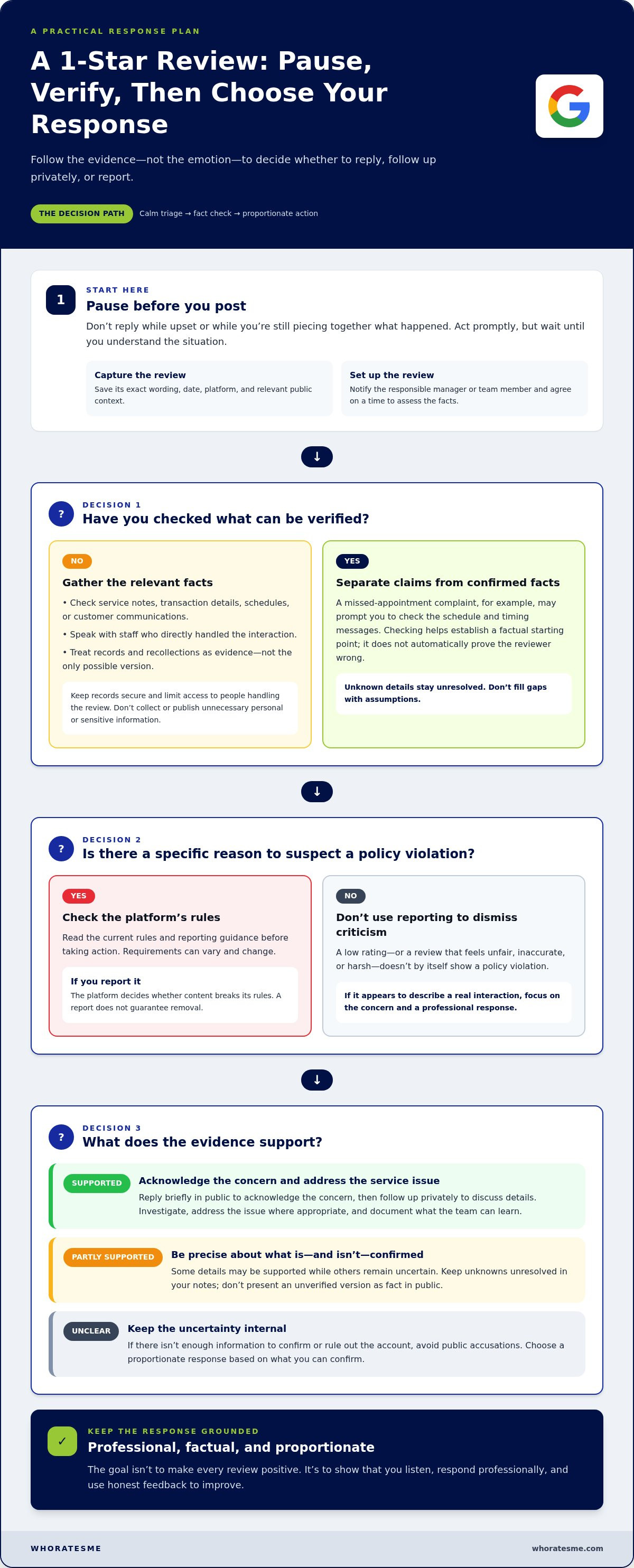
A one-star rating can feel personal, especially when you believe your team worked hard to help. Still, your first step doesn’t have to be a public reply. A measured pause gives you room to understand the complaint and choose a useful next move. If you’re wondering what to do after receiving a 1-star review, start with a simple triage process.
- Pause. Don’t reply while you’re upset or still piecing together what happened.
- Capture the review. Save its exact wording, date, platform, and relevant public context.
- Notify the right person. Share it with the manager or team member responsible for investigating customer feedback.
- Set a review deadline. Agree on when you’ll check the facts and decide whether to reply, follow up privately, or take another appropriate action.
This is part of Online reputation management: responding to feedback in a way that reflects your values and supports trust. Act promptly, but don’t post until you understand the situation.
How long should you wait before responding?
If you’re angry or hurt, take a short cooling-off period before drafting anything public. Then review the complaint promptly while relevant details are still accessible. Set an internal response target that fits your team’s workflow instead of relying on a universal deadline. A rushed or argumentative reply can shift attention from the customer’s experience to the business’s defensiveness.
What should you record before taking action?
Keep a clear record so your team can check the account accurately. Save the review’s exact wording, date, platform, and relevant public context. Securely gather records that may help, such as service notes, transaction details, appointment schedules, or customer communications. Limit access to people handling the review, and don’t collect or publish unnecessary personal or sensitive information.
Use the record to distinguish what the reviewer says from what your business can verify. For example, a complaint about a missed appointment may prompt you to check the schedule and messages about timing. That doesn’t prove the reviewer is wrong; it gives your team a factual starting point. Once your review deadline arrives, you’ll be better prepared to choose a proportionate response.
How to Verify a 1-Star Review Before You Respond
Before deciding how to respond, separate the reviewer’s account from what your business can independently confirm. A review may describe a genuine service failure, a partial misunderstanding, or an experience your records don’t clarify. Verification isn’t about proving the customer wrong. It’s about understanding what happened well enough to respond fairly.
Compare the review’s details with relevant records, then speak with staff who directly handled the interaction. If a reviewer says an appointment was missed, for example, check the schedule and related service notes or messages. Ask the staff involved for their recollection, but don’t treat it as the only version of events. Records can be incomplete, and memories can differ.
How do you assess whether the complaint is legitimate?
Look for a service breakdown, a communication gap, unmet expectations, or a reasonable misunderstanding. Use a simple internal classification while you investigate:
- Substantiated: Available information supports the main concern.
- Partly substantiated: Some details are supported, while others remain uncertain.
- Unclear: There isn’t enough information to confirm or rule out the account.
- Potentially policy-violating: There’s a specific reason to believe the content may breach the platform’s rules.
Mark unknown details as unresolved. Don’t fill gaps with assumptions or present an unverified version as fact in public. A low rating or disagreement with the reviewer doesn’t, by itself, show that the review violates a platform policy.
When should you consider reporting a review?
Consider reporting a review only when you can identify a possible violation of the platform’s current rules. Read the platform’s rules and reporting guidance before acting, since requirements can vary and change. A complaint that feels unfair, inaccurate, or harsh may still describe a real customer’s opinion or experience. Reporting isn’t a shortcut for resolving criticism you dislike.
Platforms decide whether reported content breaks their rules, so don’t assume a report will lead to removal. If the review appears to describe a real interaction, focus on addressing the concern and preparing a professional response. If the facts remain uncertain, keep that uncertainty in your internal notes rather than making a public accusation.
Consistent records across platforms can help your team spot patterns and keep investigations organized. Centralized review management can support that process, while the assessment and response remain grounded in the facts of each experience.
Should You Reply, Contact the Reviewer, or Report the Review?
Once you’ve checked what you can, choose a response that fits the evidence. What to do after receiving a 1-star review isn’t always answered by one action: a public reply, private follow-up, and platform report serve different purposes. Use this comparison to decide where to start.
| Situation | Best next step |
|---|---|
| Verified service issue | Reply briefly in public to acknowledge the concern, then follow up privately to discuss the details and next steps. |
| Unclear account | Acknowledge the feedback without disputing specifics. Invite the reviewer to connect through an appropriate private channel. |
| Rating-only review | Respond courteously without guessing why the customer was dissatisfied. Offer a way to share more detail privately. |
| Suspected policy violation | Review the platform’s current rules and report the content through its process if there’s a specific potential violation. Handle any service concern separately. |
A report isn’t a substitute for service recovery, and a low rating alone isn’t evidence of a policy violation. Keep those decisions separate: address a genuine customer concern on its merits, and use platform reporting only for content that may breach the platform’s rules.
What makes a public response calm and useful?
Write for the reviewer and for future readers who don’t know the internal context. Acknowledge the concern, use a sincere and specific tone, and offer a practical next step. Keep private details out of the reply, and don’t rebut every point or speculate about the customer’s motives.
For example: “Thank you for sharing this. We’re sorry the experience didn’t meet expectations. We’d like to understand what happened and discuss it with you directly. Please contact us through our usual customer service channel.” Adjust the wording to fit the situation. Don’t imply that an issue has been resolved before it has.
When is a private follow-up more appropriate?
Move details about an account, transaction, schedule, or personal circumstances to a suitable direct channel. This lets your team investigate without exposing customer information publicly. Keep the conversation focused on understanding and resolving the concern. Don’t pressure the reviewer to edit, remove, or change their rating, and keep any resolution discussion separate from future review requests.
Consistent monitoring across platforms can help your team keep these actions organized. Multi-platform review management offers a clearer view of feedback, so each concern can receive an appropriate response.
How to Turn a Valid Complaint Into a Useful Follow-Up
A verified complaint needs more than a thoughtful public reply. It needs a clear owner and a follow-through process, so the customer knows what to expect and your team can learn from what happened. A practical sequence is to acknowledge the concern, investigate the cause, resolve it where appropriate, document the agreed action, and review internally what could prevent a repeat.
Assign one person to coordinate the follow-up, even if other team members help investigate. Record the issue, who owns the next step, what was agreed, and whether that action was completed. Keep customer-specific details in appropriate internal records, not public replies or broad staff notes. If the reviewer doesn’t update their rating, that doesn’t erase the value of making a sincere effort to address a valid problem.
How should you follow up after addressing the issue?
If direct contact is suitable, confirm the next step privately through an appropriate channel. Be clear about what the business can do and avoid promises you can’t keep. Afterward, note whether the agreed action was completed, such as correcting a scheduling error or clarifying information that was missed. Don’t make a refund, other resolution, or compensation conditional on changing or removing a review.
For a broader framework for monitoring feedback and maintaining a consistent response process, read this online reputation management strategy.
How can one complaint improve future service?
Look for a process gap the team can address instead of focusing on whether the reviewer was difficult. For example, if the investigation finds that appointment changes weren’t communicated clearly, review how those updates are sent and whether staff know who is responsible. One complaint doesn’t prove there’s a widespread problem, but it can point to a useful question for the team to examine.
Share the relevant lesson with staff using privacy-conscious documentation. Keep the discussion focused on the process, such as “confirm schedule changes through the agreed channel,” rather than including unnecessary personal details about the customer. Organizing feedback this way can help teams identify recurring themes without treating every complaint as identical. For practical ideas on managing feedback in an organized, ethical way, explore the customer feedback software guide.
Knowing what to do after receiving a 1-star review includes closing the loop internally, not just replying online. Centralized review management can help organize feedback across platforms and keep follow-up visible to your team.
How Ethical Review Management Helps After a 1-Star Review
A one-star review is a signal to investigate, not a reason to manipulate your overall rating. After responding and following up, look at how your business collects feedback over time. A consistent, transparent process helps you hear from customers with different experiences, not only those you expect to leave positive comments.
What does an ethical feedback process look like?
Invite feedback consistently from customers, without screening people based on satisfaction or asking only those who seem happy to post. Let customers describe their genuine experience in their own words. Keep responses respectful, and don’t offer rewards or make service recovery conditional on a review or rating change. Platform rules can differ, so read current guidance before choosing how to request feedback.
This approach treats criticism as part of an honest picture of customer feedback. A low rating may point to an issue worth addressing, while other reviews can provide additional context. Neither should be filtered out to create a more favorable impression. For a closer look at policy-conscious practices, read this Google-compliant review management guide.
How can centralized monitoring make follow-up easier?
Feedback spread across platforms can be harder for a team to notice and organize. A shared dashboard and mobile app can bring reviews into a more centralized view, helping staff track which comments need a response and which concerns may call for internal follow-up. This doesn’t decide what a review means; it gives people a clearer way to keep track of feedback and act thoughtfully.
WhoRatesMe’s Elevate plan provides a Google-compliant approach to review management. Its ActivCycle automation supports feedback workflows without selectively filtering customers by sentiment. Automation can help keep a process consistent, but it shouldn’t create praise, pressure customers, or shape which genuine experiences are seen. The purpose is to make it easier to learn from authentic feedback over time, including criticism.
That’s the steady answer to what to do after receiving a 1-star review: assess it fairly, address any real service issue, and keep inviting honest feedback through a consistent process. Explore WhoRatesMe’s review management approach.
Build Trust With a Steady Review Response Process
A one-star review can be upsetting, but it doesn’t have to set the tone for your next move. Pause, check the facts, and choose a proportionate response. If the complaint is valid, follow through on a practical resolution and use what you learn to improve the customer experience. Report a review only when there’s a specific reason to believe it violates the platform’s rules.
That’s a more useful answer to what to do after receiving a 1-star review than trying to control the rating. Invite feedback consistently, welcome honest comments, and keep follow-up organized across platforms. WhoRatesMe’s Elevate plan is designed around Google-compliant review management, while ActivCycle supports feedback workflows without review gating. A centralized dashboard and dedicated mobile app help teams monitor reviews across platforms.
WhoRatesMe helps businesses manage reviews ethically with Elevate, ActivCycle automation, multi-platform management, and a dedicated mobile app. Explore WhoRatesMe’s review management approach.
Frequently Asked Questions
Should I respond to a 1-star review immediately?
If you’re deciding what to do after receiving a 1-star review, pause before replying. Take enough time to manage your emotions and verify key facts, then respond in a timely, considered way. There’s no universal response deadline for every business or platform. A calm, concise acknowledgment is more helpful than a rushed public argument. Keep customer, account, and transaction details private in your response.
Can I get a 1-star review removed?
A platform may remove a review if it determines that the content violates its current policies. A low rating, disagreement, or criticism alone doesn’t guarantee removal. If you suspect a specific violation, check the platform’s current reporting rules and submit a factual report through its process. Include relevant context, not assumptions. The platform makes the decision, and reporting a review is separate from resolving a genuine service concern.
What should I say in response to a 1-star review?
Acknowledge the concern in a calm tone and offer an appropriate next step, such as a private conversation. Don’t argue point by point or include personal, account, or transaction details in public. If the reviewer’s account is unclear, avoid presenting assumptions as facts. Write for future readers as well as the reviewer, and keep the reply understandable without internal context. Don’t ask the customer to change or delete the rating.
Should I reply to a 1-star review with no written comment?
A brief, neutral reply can show prospective customers that you monitor feedback, even when the reviewer hasn’t explained their rating. Don’t guess why the customer was dissatisfied or challenge them to justify the score. Instead, thank them for sharing their feedback and invite them to provide more detail through an appropriate private channel. Keep identifying, account, and transaction information out of the public response.
What should I do if a 1-star review seems fake or is about another business?
Document the review, check available records, and compare its content with the platform’s current policies. If you find a specific reason to suspect a policy violation, report it through the platform’s process. Don’t publicly accuse the reviewer or claim the review is fake without evidence. You can keep any public response measured and factual, but the platform decides whether the content violates its rules and should be removed.
Can I ask a customer to change their 1-star review after resolving the issue?
You can follow up to address the service issue, but don’t pressure the customer to alter or remove their review. Keep the resolution separate from the rating and let the customer decide whether to update their account of the experience. Don’t make compensation or a service remedy conditional on a rating change. Before making any review-related request, check the current rules of the platform where the review was posted.
How can I recover my business reputation after a 1-star review?
Start by addressing any substantiated issue, responding professionally, and using what you learn to improve service. Over time, invite feedback consistently from customers rather than selecting only those you expect to be positive. This helps build an authentic picture of customer experiences without suppressing criticism. No ethical process can guarantee a particular rating or recovery timeline, but steady follow-through gives customers a clearer view of how your business listens and responds.
