
How Many Reviews for Credibility in 2026?
What if the difference between a new customer and a missed opportunity isn't your skill, but a single digit on a screen? It is a heavy weight to carry. You put your heart into every job. Yet, you might still find yourself wondering: how many reviews do I need to be credible in this shifting 2026 market? The landscape has changed. With the FTC tightening regulations and Google's algorithm prioritizing recent activity, the old approach to feedback simply isn't enough.
It's natural to feel overwhelmed by the task of asking for feedback, especially when a single negative comment feels like it outweighs a dozen positive ones. We understand that pressure. You deserve a reputation that reflects your hard work, not one that feels fragile. This article provides the clarity you've been looking for. We will reveal the specific benchmarks your industry requires to build unshakeable trust and stay fully compliant. You'll discover how to grow your presence naturally. We'll look at the numbers needed to dominate the local map-pack and how to maintain a steady flow of feedback without ever feeling pushy.
Key Takeaways
- Learn why 10 reviews is the entry point and how reaching the 40 to 50 review "trust threshold" transforms your business into a credible local leader.
- Discover the definitive answer to how many reviews do I need to be credible across different industries, from local contractors to professional services.
- Understand why volume is only the start and how search engines now prioritize patterns of authenticity and detailed customer feedback.
- Stay protected from 2026 FTC regulations by learning how to avoid the "compliance trap" of review gating and selective filtering.
- Find out how to use ActivCycle automation to build a steady, hands-free stream of reviews that reflects the true quality of your work.
How Many Reviews for Credibility? 2026 Benchmarks
You pour your heart into your work. Yet, a silent barrier often stands between you and a potential client: the review count. Credibility isn't just a number. It's the psychological tipping point where a prospect stops researching your competitors and starts buying from you. If you've wondered, "how many reviews do I need to be credible," you are looking for that specific moment when your reputation begins to do the selling for you.
This biological trigger is known as Social proof. It's a natural instinct to follow the actions of others to ensure we're making a safe choice. In 2026, consumers are more skeptical than ever. They don't just want to see that you're good; they want to see that you're consistently reliable. While reaching a 5.0 rating might seem like the goal, it often raises red flags. Most shoppers find a 4.7 to 4.9 rating more authentic because it suggests a real business dealing with real people.
The Magic Number: Minimums vs. Optimal Ranges
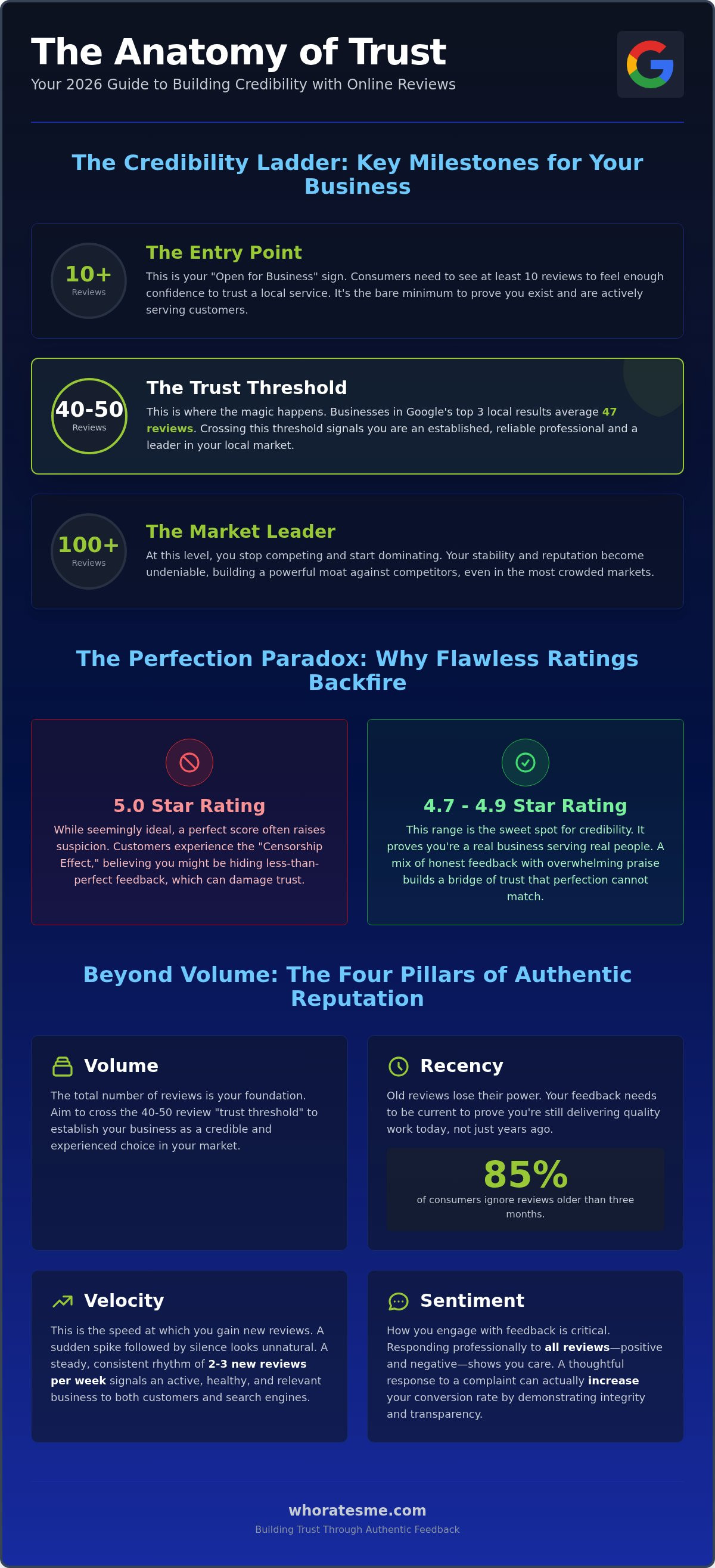
Think of 10 reviews as your "open for business" sign. Below this number, your profile looks brand new or, worse, neglected. Research shows that most consumers need to see at least 10 reviews before they feel enough confidence to trust a local service. It's the bare minimum to prove you exist.
The real shift happens when you reach the 40 to 50 review range. This is the "trust threshold." Data indicates that businesses ranking in Google's top three local results average about 47 reviews. Crossing this mark signals that you aren't just a flash in the pan. You're an established professional. Once you move toward 100 or more, you stop competing and start leading. At this level, your stability is undeniable, even in the most crowded markets.
Why 'Perfection' is a Credibility Killer
A wall of perfect 5-star praise can actually backfire. Consumers often suffer from the "Censorship Effect." They actively seek out three or four-star reviews to find the unvarnished truth about your service. They want to see how you handle a mistake or a difficult day. A mix of honest, detailed feedback builds a bridge of trust that curated perfection simply cannot match.
When your profile shows a few minor critiques alongside overwhelming praise, it proves you're not hiding anything. It shows transparency. If you're still asking how many reviews do I need to be credible, remember that the quality of the conversation matters as much as the count. Being real is more important than being flawless for long-term conversion.
The Four Pillars of Trust: Why Volume is Only the Beginning
Reaching the trust threshold we discussed earlier is a vital first step. But volume alone can be misleading. If you're still asking "how many reviews do I need to be credible," the answer involves looking beyond the total count. Both search algorithms and human customers look for patterns in your data. They want to see a living history of your work, not just a static number from three years ago. A sudden burst of feedback followed by months of silence looks unnatural. It raises questions about authenticity.
A balanced review management strategy focuses on four distinct pillars: volume, recency, velocity, and sentiment. This approach aligns with OECD research on consumer trust, which highlights how transparency and the absence of deceptive practices are essential for building real authority. Steady, natural growth always beats a sudden, suspicious spike in numbers. It positions you as a reliable, consistent force in your market.
Recency and Velocity: Is Your Business Still Relevant?
Review velocity refers to the speed at which you gain new feedback. It's a pulse check for your business. In 2026, 85% of consumers ignore reviews that are older than three months. They want to know how you're performing right now. A business with 500 reviews from 2022 feels like a ghost town compared to a competitor with 40 reviews, four of which arrived this month. A steady rhythm of two or three new comments each week keeps your profile fresh. It signals to search engines that you're active, relevant, and deserving of a top spot in local results.
Sentiment and Response: The Human Element
The way you handle feedback tells a story about your integrity. It's not just about what the customer says; it's about how you show up in the conversation. Responding to reviews is a powerful tool for both trust and visibility. When you naturally include keywords in your replies, it helps search engines understand your services better. Even a negative review can be a gift. A professional, calm response to a complaint can actually increase your conversion rates. It shows potential clients that you don't disappear when things get difficult. You stay. You solve the problem. You care. This level of sincerity is what truly builds an unshakeable reputation. For those looking to simplify this process, our team at WhoRatesMe helps you manage these interactions with quiet confidence.
Industry Benchmarks: What Your Customers Actually Expect
The stakes of a purchase change everything. If you're selling a five dollar coffee, the risk to the buyer is low. If you're fixing a roof or managing a retirement fund, the risk is life-altering. This is why the answer to how many reviews do I need to be credible isn't a single number. It's a sliding scale based on the weight of the decision. According to recent online review trends, consumers are looking for different signals depending on what they're buying. They aren't just counting stars anymore. They're looking for evidence that you can handle their specific situation.
High-Consideration vs. Low-Consideration Purchases
Trust thresholds vary wildly between industries. A local pizza shop might only need 10 reviews to prove they're a safe bet for Friday night dinner. However, a financial advisor or a custom home builder might need 50 or more before a prospect feels comfortable picking up the phone. For high-consideration purchases, photos and videos have become the gold standard in 2026. Seeing a real person's home after a renovation or a video testimonial provides a layer of proof that text alone cannot match. It's about depth. Comprehensive multi platform review management helps capture these diverse signals across the sites where your customers actually spend their time.
Service-Based Businesses vs. Retail
Retail businesses often thrive on volume. They need hundreds of reviews focusing on product quality and shipping speed. For service-based companies like contractors or lawyers, the rules are different. Your customers aren't looking for a fast service as much as they're looking for a reliable one. They want story-based reviews. A comment that describes how you showed up on time and cleaned up after the job is worth more than ten "great service" blurbs. You need enough feedback to show a consistent pattern of behavior over time.
To find your target, look at your three closest local competitors. You don't need to have the most reviews in the city. You simply need a more authentic profile than your direct peers. If they have 100 reviews but haven't received a new one in six months, your 40 recent, detailed reviews will carry more weight. It's a relief to realize that you don't have to win a numbers game. You just have to be the most real option available. When you focus on quality over sheer quantity, the question of how many reviews do I need to be credible becomes much easier to manage.
Building Credibility Ethically: Avoiding the Compliance Trap
"What if I get a bad review?" It is the single biggest fear we hear from business owners. This anxiety is understandable. You've invested years into your reputation, and the thought of a single unhappy customer tarnishing it feels unfair. However, this fear often leads to the "compliance trap." When businesses try to control the narrative too tightly, they risk everything they've built. If you are asking how many reviews do I need to be credible, the answer must include a commitment to total transparency. In 2026, honesty isn't just a moral choice. It's a survival strategy.
The Federal Trade Commission (FTC) and Google have significantly increased enforcement against deceptive practices. Trying to "filter" your feedback might seem like a shortcut to a better score, but it is a direct violation of policy. We believe that being real is far more valuable than being flawless. Transparency is your greatest competitive advantage. It builds a bridge of trust that no amount of curated praise can replicate. For a deeper look at the rules, see our guide on google compliant review management.
The Dangers of Review Gating
Review gating is the practice of "surveying" a customer before deciding whether to ask for a public review. If they're happy, they get a link to Google. If they're upset, they're sent to a private feedback form. In 2026, this is a dangerous game. Google's algorithms have become highly sensitive to these patterns. If your profile lacks the natural variety of a real business, you risk having your entire profile de-indexed. This practice also violates FTC guidelines regarding review transparency. Choosing a non-gated review platform ensures that your growth is safe, sustainable, and fully compliant with modern standards.
The 'Realness' Dividend
There is a hidden benefit to negative feedback. It provides a "realness dividend." When a prospect sees a three-star review followed by a professional, empathetic response from the owner, their trust in you actually increases. They see that you own your mistakes. They see that you fix problems publicly. This humanizes your brand. It proves that you're a real person running a real company, not a faceless entity hiding behind a wall of fake 5-star blurbs. When you stop worrying about how many reviews do I need to be credible and start focusing on authentic connection, your reputation becomes bulletproof. It no longer relies on a single platform's algorithm, but on the genuine community you've built.
Ready to grow your reputation the right way? Explore our Elevate Google-compliant plan and start building trust that lasts.
Scaling Your Reputation with ActivCycle Automation
Running a business is demanding. Between managing crews, handling billing, and delivering quality work, finding the time to manually chase every client for a review feels nearly impossible. It's often the last thing on your mind at the end of a long day. Yet, as we've explored, consistency is what separates a credible leader from a struggling competitor. If you've been wondering how many reviews do I need to be credible, the real answer involves building a system that doesn't rely on your memory or your limited free time.
This is where ActivCycle automation changes the game. It serves as an ethical engine for your reputation, ensuring that your review velocity remains steady without adding another task to your plate. Our Elevate Google-compliant plan is designed to grow your presence while keeping you safe from the compliance traps and FTC regulations we discussed earlier. You can manage the entire process from a single mobile app. This gives you total control and a clear view of your feedback, whether you're on a job site or heading home for the evening.
Putting Your Feedback on Autopilot
Asking for feedback can sometimes feel awkward. There's often a natural hesitation to "bother" a customer after the job is finished. By implementing customer feedback automation, you remove that emotional friction entirely. The request becomes a professional, expected part of your service cycle. ActivCycle offers a "set and forget" solution for busy owners who want growth without the stress of manual follow-ups. This systematic approach ensures that no customer is ever missed, allowing you to capture the authentic voice of every person you serve.
Your Next Steps to Credibility
You don't need to reach 100 reviews overnight to see a difference in your lead flow. Credibility is built through steady, honest progress. If you start today, a simple 30-day plan can move you from a low-trust profile to a recognized industry leader. The key is to stop worrying about how many reviews do I need to be credible and start focusing on the rhythm of your reputation.
- Days 1-7: Connect your platforms to the mobile app and activate your automated sequences.
- Days 8-21: Watch as the ActivCycle engine begins to gather recent, high-quality feedback from your current projects.
- Days 22-30: Respond to new reviews with sincerity to show prospects that you are active and engaged.
The most important step is simply to begin. Waiting for the "perfect" moment often means missing out on the momentum your hard work has already earned. You've already done the difficult part by providing excellent service. Now, it's time to let your online reputation reflect that reality. Learn how our Elevate plan can scale your credibility ethically and put your business on the path to unshakeable trust.
Your Path to Unshakeable Trust
Building a reputation that converts strangers into loyal customers doesn't have to be a source of stress. We have explored how credibility is less about reaching a final destination and more about maintaining a steady, honest pulse. If you began this guide asking how many reviews do I need to be credible, you now have the specific industry benchmarks and ethical strategies to lead your market. Real trust is built through consistency, recency, and the courage to be authentic rather than perfect.
You have already done the hard work of building a great business. Now, let us help you protect it. Scale your business credibility with our Elevate Google-compliant plan. Our ActivCycle automation eliminates the manual work of asking for feedback. Our platform is 100% compliant with FTC and Google transparency guidelines. You can manage your entire reputation across multiple platforms from one simple mobile app. This allows you to stay in total control without losing focus on your daily operations.
Your dedication deserves to be recognized. By choosing a transparent, automated path, you ensure that your online presence finally reflects the excellence you deliver on every job. We are here to support you as you turn your hard-earned feedback into your greatest competitive advantage.
Frequently Asked Questions
Is 50 reviews enough to rank on the first page of Google?
Reaching 50 reviews is a significant milestone. It places you right in the competitive range for Google's local map-pack, where the average top performer has 47 reviews. While it isn't a guaranteed ticket to the top, it signals to the algorithm that you're an established player. Your ranking also depends on how recently those reviews arrived. A steady flow of feedback is often more impactful than a high total count from last year.
Can I get in trouble for asking only my happiest customers for reviews?
Yes, you can face significant risks. This practice is known as review gating. It violates Google's policies and 2026 FTC guidelines. If you selectively filter who can leave feedback, you risk having your entire profile suspended. It's much safer to invite all customers to share their experiences. A transparent profile with a few honest critiques is always more credible than a filtered one that looks too perfect to be true.
What happens if my review count stops growing for a few months?
Your visibility will likely decline. Consumers prioritize recency. Most shoppers ignore feedback that is older than 90 days. If your growth stalls, you lose the "Review Velocity" that Google uses to determine relevance. It's better to get two new reviews every week than fifty all at once. Consistency proves that your business is still active and providing high-quality service to your community today.
Do I need reviews on more than one platform to be credible?
Yes, a multi-platform presence is essential. Buyers rarely rely on just one source. They might start on Google but check Facebook or a specialized industry site before making a final decision. Managing these various platforms can feel overwhelming. However, a synchronized reputation across the web ensures that no matter where a prospect looks, they see a consistent and trustworthy reflection of your hard work and dedication.
How much do online reviews actually impact my bottom-line revenue?
The impact is direct and measurable. Reviews are the primary factor in a customer's decision to trust a local business. If you're asking how many reviews do I need to be credible, the first goal is usually ten. Reaching this entry point allows prospects to feel safe enough to contact you. Beyond that, every increase in your star rating or review volume can lead to a noticeable boost in your lead conversion rates.
Is it better to have 100 5-star reviews or 500 4.5-star reviews?
The 500 4.5-star reviews are far more powerful. A perfect 5.0 rating often looks suspicious to modern consumers. They want to see how you handle a mistake. A high volume of reviews with a natural rating between 4.7 and 4.9 is the gold standard. It suggests a busy, authentic company. This range provides the depth and realness that people need to feel confident when they are ready to make a purchase.
Can I delete a negative review if it's unfair or inaccurate?
You cannot delete a review simply because it's negative. Platforms like Google only remove content that violates specific terms, such as spam or harassment. The solution is to respond with quiet confidence. State the facts calmly and offer to make it right. This public display of integrity often carries more weight with future customers than the original complaint ever did. It shows you're a professional who stands by your work.
How often should I be responding to the reviews I receive?
You should respond to every review as quickly as possible. Consistently engaging with your feedback is a signal to search engines that your business is active. It's also a chance to show your human side to potential clients. Aiming to reply within 24 to 48 hours is ideal. This practice transforms a static comment into a meaningful conversation, which significantly strengthens your online credibility and search visibility over time.
