
How Property Managers Can Get Resident Reviews: Ethical Strategies for 2026
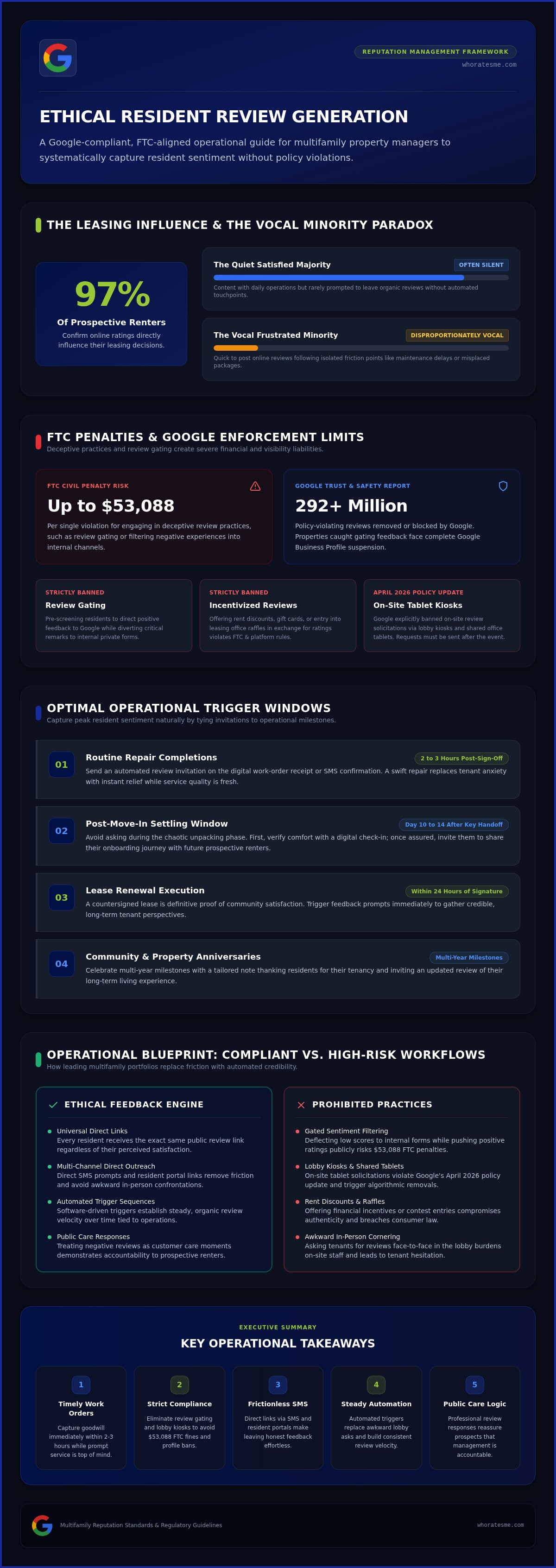
Roughly 97% of renters say online ratings directly influence their leasing decisions, yet the residents most vocal online are usually the few dealing with a maintenance delay or a misplaced package. It feels exhausting when your community's quiet, satisfied majority stays silent. If your team is wrestling with how property managers can get resident reviews without cornering tenants in the lobby or risking hefty FTC penalties, you aren't alone. Asking in person feels awkward for on-site staff, and Google's recent policies make practices like on-site tablet solicitations a serious liability.
You shouldn't have to gamble with compliance just to protect your community's online reputation. In this guide, you'll discover proven, Google-compliant workflows to consistently generate authentic resident reviews across your multifamily properties without policy violations. We will examine how to time automated feedback requests around routine operational touchpoints, manage multiple review platforms efficiently, and build organic credibility that prospective renters can trust.
Key Takeaways
- Timing review requests immediately after successful work orders captures authentic resident goodwill while the experience is fresh.
- Understanding how property managers can get resident reviews ethically requires eliminating review gating and on-site kiosks to stay fully compliant with FTC and Google guidelines.
- Using direct SMS prompts and portal links removes resident friction, making it simple for satisfied tenants to leave honest feedback.
- Setting up automated feedback triggers eliminates awkward in-person requests and establishes a steady, organic review velocity over time.
- Treating critical public reviews as professional customer care moments reassures prospective renters that your management team is responsive and accountable.
Identify the Moments of Highest Resident Satisfaction
Most community managers ask for feedback at random intervals, often blasting generic email blasts to an entire property. That approach rarely works. Sustainable online reputation management relies on capturing organic sentiment when a resident's appreciation naturally peaks. When you tie requests directly to positive operational milestones, asking feels like a natural conversation rather than an imposition. Understanding how property managers can get resident reviews starts with mapping these high-satisfaction events across the tenant lifecycle.
The Maintenance Resolution Follow-Up
Few events impact daily living more than maintenance. A swift repair transforms mild tenant anxiety into immediate relief. Make it standard practice to send an automated review invitation within two hours of a verified ticket completion. Include a direct link on the digital receipt or text confirmation. This prompts tenants to share their experience while the prompt service is fresh in their minds, creating authentic service-focused testimonials.
The Positive Move-In Onboarding Window
The first few days in a new home are chaotic. Avoid asking for feedback while residents are still unpacking boxes and managing utility setups. Instead, initiate contact approximately 10 to 14 days after key handoff. First, verify their home condition satisfaction with a quick digital check-in. Once their comfort is assured, provide a direct prompt inviting them to share their onboarding experience with future community prospects.
The Lease Renewal and Milestone Celebration
A signed renewal is concrete proof of resident satisfaction. When a resident commits to another year, they have already validated your community's value. Capitalize on this decision by setting feedback invitations to trigger right after digital lease signatures or during community anniversaries. This strategy produces detailed, long-term perspectives that carry immense weight with prospective renters.
To successfully capture goodwill across your portfolio, align your invitations with these proven operational triggers:
- Routine repair completions: Send prompts within two to three hours of ticket sign-off.
- Post-move-in settling: Reach out between day 10 and day 14 once living routines stabilize.
- Lease renewal execution: Trigger an invite within 24 hours of countersigning the new agreement.
- Property anniversaries: Celebrate multi-year milestones with a note thanking them for their tenancy and inviting an update.
Focusing on these touchpoints answers how property managers can get resident reviews organically, converting standard daily operations into consistent reputation growth.
Master Google Compliance and Avoid Costly FTC Penalties
Generating authentic feedback requires strict adherence to consumer protection rules. Some software vendors still suggest pre-screening residents with a private question, routing happy tenants to Google while deflecting unhappy residents to an internal form. This deceptive practice is known as review gating, and it carries massive financial and operational consequences. Operating in strict alignment with official FTC guidelines protects your community's digital presence from catastrophic enforcement actions.
Why Review Gating Puts Your Properties at Risk
The Federal Trade Commission penalizes deceptive review practices with civil fines reaching up to $53,088 per violation. When platforms selectively filter who can publish public ratings, they intentionally mislead future renters. Google also takes severe algorithmic action. In its 2025 Trust and Safety report, Google revealed it removed or blocked over 292 million policy-violating reviews. Properties caught gating feedback risk having their entire Google Business Profile suspended, wiping out years of hard work overnight.
The Ethics of Incentivization in Multifamily Living
Dangling rent discounts, gift cards, or entry into a leasing office raffle in exchange for ratings violates both FTC rules and search engine policies. Regulators view incentivized reviews as inherently untruthful. Additionally, Google's April 2026 policy update explicitly banned on-site review solicitations via lobby kiosks and shared office tablets. Requests must be sent after the experience, inviting honest, uncoerced commentary.
To keep your portfolio safe, ensure every team member adheres to these core compliance principles:
- Universal access: Give every resident the exact same public review link, regardless of their sentiment.
- Zero incentives: Never exchange concessions, cash, or prize entries for resident feedback.
- Off-site delivery: Send requests digitally after service interactions rather than demanding reviews on lobby tablets.
- Neutral invitations: Ask open questions without instructing tenants on what star rating to leave.
Mastering how property managers can get resident reviews safely means choosing transparency over shortcuts. When you adopt a transparent framework like the Elevate Google-compliant plan, you gain total peace of mind knowing your community's reputation is built on genuine resident experiences without legal risk.
Remove Review Friction with Multi-Channel Outreach
Even your happiest residents rarely go out of their way to search for your property on Google. Friction is the enemy of feedback. If sharing a perspective takes five confusing clicks, busy tenants simply close the tab. Modern renters prioritize convenience above all else, a point reinforced by findings in the NMHC and Grace Hill Renter Preferences Survey Report. Solving how property managers can get resident reviews consistently requires meeting community members directly on their preferred communication channels.
Leveraging SMS Messaging for Rapid Engagement
Text messages consistently outperform email for quick operational responses. A warm SMS that arrives with a direct link allows a resident to open a review profile, tap a rating, and type two sentences in under 60 seconds. Keep the tone friendly, brief, and authentic. Personalize the sender name so the text feels like an honest note from the on-site staff rather than an unfeeling corporate broadcast.
Physical Signage and On-Site Touchpoints
Physical environments offer natural opportunities for passive prompts, provided they remain completely uncoerced. Avoid placing tablets in front of people in the leasing office. Instead, position clean, branded signs with scannable QR codes in communal areas where people naturally linger. These self-directed touchpoints allow residents to scan and write on their own personal devices whenever they have free downtime.
Distribute review opportunities thoughtfully across these physical and digital locations:
- Automated locker banks: Place discrete QR codes on package pickup screens or nearby staging tables.
- Resident portal dashboards: Embed an open review link right beside rent payment confirmations.
- Community amenities: Add subtle signage near the resident coffee bar or co-working lounge.
- Elevator notice boards: Feature digital or printed rotation cards inviting honest community feedback.
The goal isn't to inundate residents with endless pings. It's about placing frictionless pathways right where life happens. By simplifying these avenues, you uncover practical answers for how property managers can get resident reviews without nagging or pressuring tenants during their personal routines.
Automate Review Requests with an Ethical Feedback Engine
Expecting on-site leasing teams to manually text or email residents after every single interaction rarely works. Between lease signings, vendor meetings, and resident inquiries, manual outreach inevitably gets forgotten. This inconsistency creates sporadic review bursts followed by months of silence, an erratic pattern that search algorithms often view with suspicion. When considering how property managers can get resident reviews on a dependable schedule, the answer lies in building automated, touchpoint-driven feedback loops that operate quietly in the background.
Hands-Off Consistency Through Smart Workflows
Routine service resolutions provide the perfect trigger. When a technician closes a work ticket, tools like ActivCycle automation can dispatch a compliant feedback invitation right away. Because the system operates autonomously, your review velocity stays steady week after week. This consistent stream of authentic feedback signals active community management to search algorithms while sparing your staff from awkward solicitations.
Consolidating Multi-Platform Portals on One Dashboard
Resident sentiment rarely concentrates on a single site. Feedback scatters across Google, Yelp, and specialized apartment listing platforms, making reputation tracking chaotic. Logging into multiple portals every morning wastes valuable time and causes delayed responses. Centralizing these channels through multi-review platform management equips your team with a single, clear view. Paired with a dedicated mobile app, managers can monitor incoming feedback and track trends directly from their phones.
Automating your feedback architecture delivers tangible operational advantages:
- Eliminates administrative burden: Staff focus on property operations while automated loops handle post-service outreach.
- Maintains healthy review velocity: Continuous, drip-fed submissions look natural to search algorithms and prospective renters.
- Enables real-time awareness: Centralized notifications ensure critical comments receive immediate operational attention.
Take control of your portfolio's online reputation without adding to your team's daily workload. Streamline your resident feedback loops by exploring the Elevate Google-compliant plan today.
Transform Negative Feedback into Resident Retention
A critical one-star review feels like an immediate punch to the gut. It's completely understandable to feel defensive, especially when your team works hard every single day to keep properties running smoothly. Yet trying to hide or panic over every critique misses a major marketing reality. Critical comments are high-visibility moments to demonstrate real accountability. Prospective renters don't expect a flawless community; they want to see how management acts when things go wrong.
De-escalating Public Grievances with Empathy
Always acknowledge resident frustration promptly without arguing fine print in public view. Quoting lease clauses or debating repair timelines online makes a property look combative. Instead, validate the tenant's inconvenience, keep the tone calm, and offer an immediate offline channel to resolve the matter. A direct invitation to call the community director or visit the front office moves heated arguments out of public search results.
Winning Prospective Renters Through Public Professionalism
Prospective tenants study management replies closely. An articulate, polite response proves that real humans monitor issues and take operational failures seriously. Once a dispute is successfully resolved in person, a resident often feels grateful. That renewed goodwill creates a natural opening to follow up privately and invite them to update their initial review to reflect the completed resolution.
When negative feedback appears, follow this four-step de-escalation framework:
- Respond within 24 hours: Fast replies demonstrate proactive oversight to prospective apartment hunters.
- Lead with empathy: Validate their experience without admitting legal fault or assigning blame to staff.
- Transition offline immediately: Provide a direct phone number and office contact to handle details privately.
- Close the loop: Resolve the operational issue, then check back to verify the resident is genuinely satisfied.
Handling public friction with poise directly impacts how property managers can get resident reviews that build lasting trust. Every thoughtful reply serves as an open testament to your commitment to quality community care.
Elevate Your Community Reputation with Confident Automation
A thriving online reputation doesn't require awkward manual requests or risky shortcuts. By capturing resident goodwill right after resolved work orders, maintaining transparent compliance without review gating, and eliminating submission friction, your communities can consistently showcase the attentive care your team provides every day. Solving how property managers can get resident reviews comes down to building dependable, ethical operational habits that work quietly in the background.
You can remove the administrative stress and guesswork entirely. Built with 100% Google- and FTC-compliant workflows, ActivCycle automation handles touchpoint-driven feedback loops without placing extra demands on your on-site leasing staff. Paired with centralized multi-platform monitoring and mobile app support, your team stays informed and responsive across every channel. Take the next step toward effortless, authentic reputation growth: Discover how the Elevate Google-compliant plan automates resident reviews and safeguards your community's long-term occupancy.
Frequently Asked Questions
How quickly should property managers send a review request after maintenance is finished?
Send the invitation within two to three hours of ticket completion. Prompt delivery ensures the resident's appreciation is fresh while the relief of a fixed issue is top of mind. Dispatching a quick SMS or digital receipt link during this window delivers significantly higher completion rates than waiting for weekly or monthly follow-up batches.
Can property managers offer rent discounts or gift cards for resident reviews?
No, offering rent credits, gift cards, or raffle entries in exchange for reviews is strictly prohibited. The FTC classifies compensated ratings as deceptive trade practices, subjecting violators to civil penalties up to $53,088 per violation. Google will also delete entire review profiles caught buying feedback. Requests must always invite unbiased, honest commentary without transactional compensation.
What is review gating, and why is it risky for multifamily properties?
Review gating means pre-screening tenant satisfaction and only routing pleased residents to public rating sites while redirecting unhappy tenants to private forms. Both Google and the FTC ban this practice. If algorithms detect sentiment filtering, your property risks losing its Google Business Profile, forfeiting all legitimate reviews, and facing public enforcement actions.
Which review platforms matter most for apartment communities and property managers?
Google Business Profile is the most critical platform because it determines local map rankings and provides immediate visibility during organic searches. Specialized rental portals like Apartments.com and general directories like Yelp are also important secondary channels. Mastering how property managers can get resident reviews across each of these networks requires centralized monitoring to keep responses timely and consistent.
How can leasing teams encourage residents to mention specific staff members in reviews?
They shouldn't solicit staff names directly. Under Google's April 2026 policy update, businesses are prohibited from asking customers to mention specific employees by name. Instead, encourage your on-site team to focus entirely on exceptional, personalized service. When residents receive outstanding support during maintenance or move-in, they will naturally highlight helpful staff members on their own.
What should a property manager do if a resident leaves a completely fake negative review?
Start by verifying your resident records. If the reviewer never lived at your community, post a calm, professional reply stating you have no record of their tenancy and provide direct office contact details. Next, report the review to the hosting platform for removal. Meanwhile, understanding how property managers can get resident reviews systematically ensures steady authentic feedback naturally dilutes an occasional rogue post.
