How Review Recency Impacts Customer Choice: The 2026 Freshness Factor
Did you know that 32% of consumers today only consider reviews written within the last two weeks? It's a startling shift in digital behavior. For years, we've focused on building a massive mountain of feedback, believing that a high total count was the ultimate shield for our reputation. But in 2026, that mountain can start to feel like a relic. Understanding how review recency impacts customer choice is no longer a luxury; it's a vital survival skill for local service businesses.
You might have hundreds of five-star ratings, yet still feel the sting of a quiet phone. It's frustrating to watch competitors with fewer reviews win the lead just because their feedback is fresh. We understand the pressure of trying to stay relevant while managing the daily grind. It feels like the goalposts are always moving. We're here to help you regain that sense of control and clarity.
In this article, you'll discover why the age of your customer feedback now carries more weight than your total rating. We will show you how to maintain a steady pulse of trust without the manual stress. You'll learn the ROI of recency, how to automate the request process ethically, and how to use fresh social proof to turn more browsers into loyal clients.
Key Takeaways
- Identify the 'Trust Decay' threshold where old five-star ratings stop helping and start raising red flags for skeptical buyers.
- Master how review recency impacts customer choice by aligning your digital presence with the modern 'recency bias' that favors today’s performance over yesterday’s accolades.
- Uncover the hidden link between review velocity and your Local Pack rankings to ensure your business stays visible to high-intent local searchers.
- Learn to replace stressful, manual review requests with a steady 'Review Ecosystem' that runs on autopilot to prevent feedback gaps.
- Discover how ActivCycle automation creates a consistent pulse of social proof, giving you the quiet confidence that your reputation is always up to date.
Understanding Review Recency: Why 'Old Trust' No Longer Converts
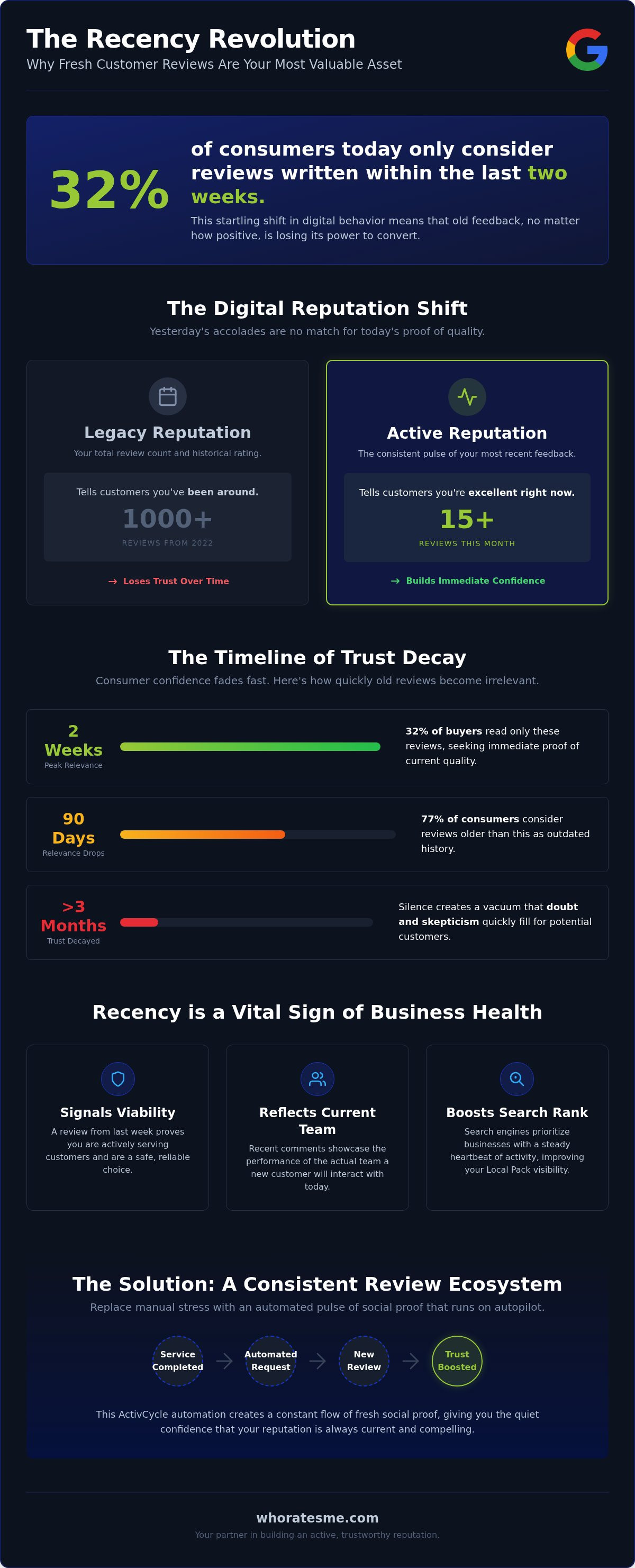
Review recency is the chronological relevance of your customer feedback. It is the bridge between the reputation you built years ago and the service you provide this morning. You have likely spent years working hard to earn every five-star rating on your profile. It's a source of pride. However, a customer looking at your business in 2026 views a review from 2022 as a time capsule rather than a recommendation. This is the reality of "Trust Decay." It is the gradual loss of confidence that occurs when your evidence of quality is dated. In a fast-moving market, consumers assume that management changes, staff turnover, or simple complacency can alter a business in just a few months.
There is a clear distinction between your Legacy Reputation and your Active Reputation. Your Legacy Reputation is your total review count. It tells the world you have been around for a long time. Your Active Reputation is your recent pulse. It tells the world you're still excellent right now. This modern form of Social proof acts as a proxy for your current operational quality. When you understand how review recency impacts customer choice, you stop viewing feedback as a trophy to be shelved and start seeing it as a living conversation with your market.
The 2026 Standard for 'Recent' Content
Consumer skepticism has reached a point where "three months old" is the new cutoff for relevance. Research shows that 77% of consumers expect to see reviews left within the last 90 days. If your most recent feedback is older than that, a potential lead may wonder if you're still in business. The window is even tighter for high-intent decision making. About 32% of consumers only read reviews written within the previous two weeks. They aren't looking for your history; they are looking for a reason to trust you today. Active Reputation is the primary driver of 2026 consumer choice.
Recency as a Signal of Business Health
Fresh reviews provide a sense of order and clarity for the buyer. They serve as a vital sign of your business health in several ways:
- Operational Status: A review from last week proves you are still solvent and actively serving customers.
- Staff Performance: Recent comments reflect the current team members your customer will actually interact with.
- Search Visibility: Search engines prioritize businesses with a steady heartbeat of activity. A consistent flow of new data signals that your business is relevant and deserving of a top spot.
Learning how review recency impacts customer choice helps you bridge the gap between your past success and your future leads. It replaces the anxiety of a declining lead volume with the quiet confidence of a business that stays in sync with its customers.
The Psychology of the Freshness Factor: Why Recency Trumps Volume
Human brains are naturally wired to prioritize what is happening right now. It is a fundamental survival instinct. We look for current signals to ensure our choices are safe and relevant. This is why how review recency impacts customer choice is such a powerful psychological lever. When a consumer sees a review from three years ago, their brain classifies it as historical data. It might be interesting, but it is not actionable. They want to know if your service is excellent today, not if it was excellent before the world changed. Freshness provides a sense of security that volume alone cannot replicate.
Consumers use recency as a primary tool for risk mitigation. There is a deep-seated fear that a business has gone downhill since its last wave of praise. Perhaps the original owner sold the company, or the best technicians moved on. If your last feedback is months old, that silence creates a vacuum that doubt quickly fills. Fresh reviews act as a continuous confirmation of quality. They reassure the buyer that your standards have not slipped and that you remain a reliable choice in a chaotic market.
Volume vs. Recency: The Consumer Trade-off
While a high total count provides a foundation of authority, it rarely provides the final nudge needed to convert a high-intent lead. Consider the Social Proof Paradox. A business with 1,000 reviews from 2021 often feels less authentic than a competitor with 15 reviews from the last month. The older reviews feel like a static accomplishment. The newer ones feel like a living endorsement. About half of consumers now consider the recency of reviews to be just as important as the star rating itself. If you want to see where you stand, you can monitor your reputation in real-time to ensure no gaps are forming in your feedback loop.
- Established but Stale: High volume, low frequency. This suggests a legacy brand that may be coasting on past success.
- New and Active: Lower volume, high frequency. This suggests a vibrant, growing business that is deeply engaged with its current clients.
The Role of Recency in Overcoming Skepticism
Modern buyers are increasingly skeptical of legacy reviews. With rising concerns over AI-generated content and purchased ratings, old feedback is often viewed with caution. Fresh reviews provide a vibe check. They offer current details about pricing, safety protocols, or the friendliness of your current staff. These specific, timely details are much harder to fake. Current data shows that 20% of consumers believe only reviews from the last two weeks are truly relevant. This tight window means that yesterday's praise is already losing its power to persuade.
Even a recent negative review that is handled with integrity can be more persuasive than a positive one from five years ago. It shows that you are active, listening, and committed to transparency. This level of engagement proves that you value truth over perfection. It builds a bridge of trust that static, outdated praise simply cannot match. Freshness is the ultimate proof of a healthy, honest business.
The Business Impact: How Stale Reviews Deter High-Intent Leads
Your phone stops ringing. You check your ads, your website, and your rankings. Everything seems to be in order. Yet, the leads aren't converting like they used to. This is the "Invisible Bounce." It happens when a high-intent customer finds your profile, sees a high star rating, but notices your last review was written six months ago. They leave without a word. You don't see this loss in your basic analytics, but your bottom line feels it. This silent departure occurs because 77% of consumers expect reviews to be less than three months old. When you understand how review recency impacts customer choice, you realize that a stagnant profile is a leaking bucket for your marketing budget.
Reputation stagnation is particularly dangerous in high-ticket service industries. If you are a lawyer, a medical professional, or an HVAC contractor, your customers are making high-stakes decisions. They are not just looking for a "good" business; they are looking for a business that is excellent right now. Trust decay happens rapidly when thousands of dollars are on the line. A customer will often choose a competitor with a 4.4-star rating and five reviews from this month over a 4.9-star business whose last praise came from a different era. Freshness is the silent closer in the sales funnel.
The Shelf-Life of Trust by Industry
Every business has a unique "Recency Threshold." A local cafe might need a daily stream of feedback because food quality and service can change with every shift. A roofing company or a kitchen remodeler has a longer shelf-life; they may only need one or two fresh reviews a month to remain competitive. The key is to identify the gap between your current feedback loop and your customers' expectations. If your competitors are posting weekly updates while you are posting quarterly, you are suffering from a Recency Gap that actively pushes leads toward your rivals.
SEO and the 'Review Velocity' Metric
Google views your business through the lens of "Review Velocity." This is the consistent rate at which you acquire new feedback. A steady heartbeat of reviews signals to search engines that your business is active, reliable, and a "safe" recommendation for users. This is why review velocity is a powerful, proximity-neutral ranking factor in the Local Pack. You must avoid "Review Spiking." This happens when a business gets fifty reviews in a single week after a year of silence. To an algorithm, this looks like a manual manipulation. To a human, it looks forced. True authority comes from a natural, automated flow of authentic comments that proves your value day after day. This steady synchronization is how review recency impacts customer choice at the search level, ensuring you stay visible to the people who need you most.
Strategies for Maintaining a Consistent Review Pulse Ethically
Running a business is demanding. You focus on the work, and sometimes the follow-up falls through the cracks. Many owners try to fix this with a "Review Campaign," but these bursts of activity don't solve the long-term problem. Manual requests are inconsistent. They rely on memory and timing, both of which are in short supply during a busy week. To truly understand how review recency impacts customer choice, you need a shift in perspective. You need an ecosystem, not a campaign. This means moving toward google compliant review management. It is about creating a quiet, stabilizing force that maintains your reputation while you focus on your clients. It replaces the frantic "review chase" with a methodical, steady flow of trust.
Implementing an 'Always-On' Feedback Loop
An "Always-On" loop catches customers at the peak of their satisfaction. It integrates directly into your daily operations. Whether it's a text message sent after a service call or a QR code on a physical invoice, the goal is ease. You want to make it simple for them to help you. A multi-channel strategy works best. SMS reaches people on the move, while email provides a professional touchpoint for follow-up. Using dedicated customer feedback software allows you to synchronize these efforts. It removes the stress of "forgetting to ask." It ensures that your recency never dips, providing that fresh social proof that modern buyers demand. This automation creates a sense of order in what can often be a chaotic part of business management.
Staying Compliant with 2026 FTC and Google Guidelines
Compliance is often seen as a burden, but it's actually a safeguard for your business. The 2026 regulatory landscape is clear: review gating is prohibited. If you try to selectively filter your feedback, you risk heavy fines and profile suspension. Gating also hurts your recency by limiting the number of requests you send. A "Transparency First" model is much more effective. It shows that you are confident in your work. You invite all customers to speak their truth. This honesty resonates with buyers who are tired of polished, fake-looking profiles. They can tell when a profile is too perfect. Real growth comes from being real. Ethical acquisition is the only way to ensure permanent, non-removable social proof. You can start building your automated review ecosystem to ensure your business remains a trusted leader in your industry.
Closing the Recency Gap with ActivCycle Automation
Maintaining a steady stream of feedback is difficult when you're busy running the day-to-day operations. You intend to ask every customer for their thoughts. You know it matters. But then the next job starts, the phone rings, and the opportunity slips away. This is where ActivCycle automation steps in. It acts as the engine behind a steady heartbeat for your reputation. By removing the human error and the natural forgetfulness that causes recency gaps, you ensure that your business never looks like it has gone quiet. This is precisely how review recency impacts customer choice in a competitive market. It proves you are active, reliable, and delivering value every single day.
For national brands or businesses with multiple locations, staying on top of every platform can feel like a full-time job. It is easy to feel lost in the details. A centralized multi platform review management dashboard provides the clarity you need. It brings all your feedback into one unfiltered view, allowing for perfect synchronization across your entire organization. Your team can even use our mobile app for real-time monitoring on the go. It empowers them to see the human connection behind the data, turning feedback into a source of motivation rather than a chore.
The Elevate Plan: Compliance as a Competitive Advantage
The Elevate Google-compliant plan is built for those who value integrity over shortcuts. It ensures that every review you earn meets Google's 2026 quality standards without using risky tactics like gating. We take a "Quiet Innovator" approach. We don't believe in hype or high-pressure sales. Instead, we focus on steady, authentic growth that protects your reputation for the long term. This transition moves you from being overwhelmed by your digital presence to having total control over your brand's digital pulse. You can finally rest easy knowing your social proof is always current.
Next Steps: Auditing Your Current Recency
It is time to see where you stand. Take a moment to check your "Last 30 Days" review count. Now, look at your top three competitors. If they have more recent activity, they are likely winning the high-intent leads you are missing. Understanding how review recency impacts customer choice means recognizing that "old trust" isn't enough to stay ahead. This is the moment to transition to customer feedback automation. It is a simple, stabilizing step that protects your hard-earned reputation while freeing you to focus on what you do best.
Ready to automate your reputation? See how our Elevate plan keeps your reviews fresh and compliant.
Secure Your Reputation with a Steady Pulse
Your hard-earned reputation is one of your most valuable assets. It represents years of late nights and dedicated service. But in 2026, yesterday's praise can't carry today's business. We've explored how trust decay and the "invisible bounce" can quiet your phones even when your star rating is high. Understanding how review recency impacts customer choice is the first step toward reclaiming your lead volume. It's about moving from a static history to an active, living endorsement.
You don't have to carry this burden alone. Our Elevate plan provides ActivCycle automation for 24/7 reputation monitoring, ensuring your feedback loop never stalls. You get the peace of mind that comes with FTC and Google-compliant ethical acquisition. With a centralized dashboard for multi-platform management, you can see your growth clearly and without the stress of manual tracking.
Start your journey toward a fresh, compliant reputation with the Elevate plan. You have built something great. We're here to help you protect it and ensure your business remains a trusted choice for years to come.
Frequently Asked Questions
How often should my business get new reviews to stay relevant?
You should aim for a steady stream rather than a burst of activity. While a roofer might only need one or two a month, a high-volume service business should aim for weekly updates. 77% of consumers expect feedback to be less than three months old. Maintaining this pace ensures you stay within the "Recency Threshold" of your industry. It prevents the silence that allows doubt to creep into a potential customer's mind.
Does Google prioritize recent reviews over high star ratings?
Google uses review velocity as a key ranking factor for the Local Pack. While a high star rating is essential, a steady flow of new reviews signals that your business is active and reliable. This is how review recency impacts customer choice at the search level. Fresh data helps the algorithm feel confident in recommending you to local users. It prioritizes businesses that show a consistent heartbeat of customer engagement.
What is the difference between review volume and review velocity?
Review volume is your total lifetime count, while review velocity is the speed at which you acquire new ones. Think of volume as your history and velocity as your current reputation. In 2026, consumers value the "Active Reputation" represented by velocity. A high volume from years ago can't compete with a steady stream of recent, authentic comments. Velocity proves you are still delivering the same quality that built your legacy.
Can old reviews actually hurt my business's conversion rate?
Stale reviews create a "Recency Gap" that often leads to an invisible bounce. When a lead sees that your last praise was from six months ago, they worry your standards have slipped. About 32% of modern buyers only consider reviews written in the last two weeks. If your feedback is old, you're likely losing high-intent leads to competitors who have fresher proof of their current operational quality and staff performance.
Is it better to have 100 old reviews or 10 new ones?
For immediate conversion, ten new reviews carry more weight than one hundred old ones. Legacy reviews provide a foundation of authority, but fresh feedback provides the final nudge needed to close a sale. Buyers want to know what the experience is like right now. Seeing how review recency impacts customer choice helps you realize that a smaller, active profile often outperforms a massive, stagnant one in high-stakes decision making.
How can I get more reviews without violating Google's anti-gating policies?
The best way to stay compliant is to invite every customer to share their honest experience. You should avoid any form of selective filtering or gating, as these practices risk your entire profile. Focus on building an "Always-On" feedback loop that integrates with your natural customer journey. By using ethical automation, you maintain a consistent pulse without the pressure of manual requests or the legal risks of deceptive practices.
What happens if I stop getting reviews for a few months?
A gap in your feedback loop leads to trust decay and a potential drop in local rankings. If you stop getting reviews, you lose the "Freshness Factor" that high-intent buyers look for. This silence creates a vacuum where customers assume your business has changed or closed. Your competitors will quickly fill that space. Consistent acquisition is the only way to protect your hard-earned reputation from becoming a historical relic.
Can automation help maintain review recency without sounding robotic?
Effective automation feels like a natural part of your service rather than a generic script. It works by timing the request to reach the customer when their satisfaction is highest. By standardizing the process, you remove the human error of forgetting to ask. This keeps your profile current and authentic. It allows you to maintain a steady pulse of trust without adding more manual tasks to your already busy daily schedule.
