
How to Benchmark Online Reputation: 2026 Ethical Metrics
By 2026, the traditional five star rating will be the least important number on your dashboard. It's exhausting to watch your competitors' numbers climb while you're left wondering which data points actually move the needle for your business. You've likely felt that familiar sting of anxiety when a single negative comment appears, worrying it might undo months of hard work. Understanding how to benchmark online reputation shouldn't feel like a guessing game played in the dark.
You deserve a way to measure your standing that feels honest and sustainable, rather than forced or fragile. You're looking for clarity, not just more data. This guide will show you how to measure your brand’s digital standing accurately and ethically to drive sustainable growth. We'll provide a clear framework for identifying specific areas for improvement, giving you the peace of mind that comes from knowing your growth is both compliant and authentic. By the end, you'll have a roadmap to transform from feeling overwhelmed to being in total control of your digital presence.
Key Takeaways
- Stop relying on surface-level star ratings. You'll learn why modern consumers value the "why" behind the feedback more than a perfect score.
- Master the specific steps of how to benchmark online reputation against your true industry rivals. This helps you see exactly where you stand in the digital landscape.
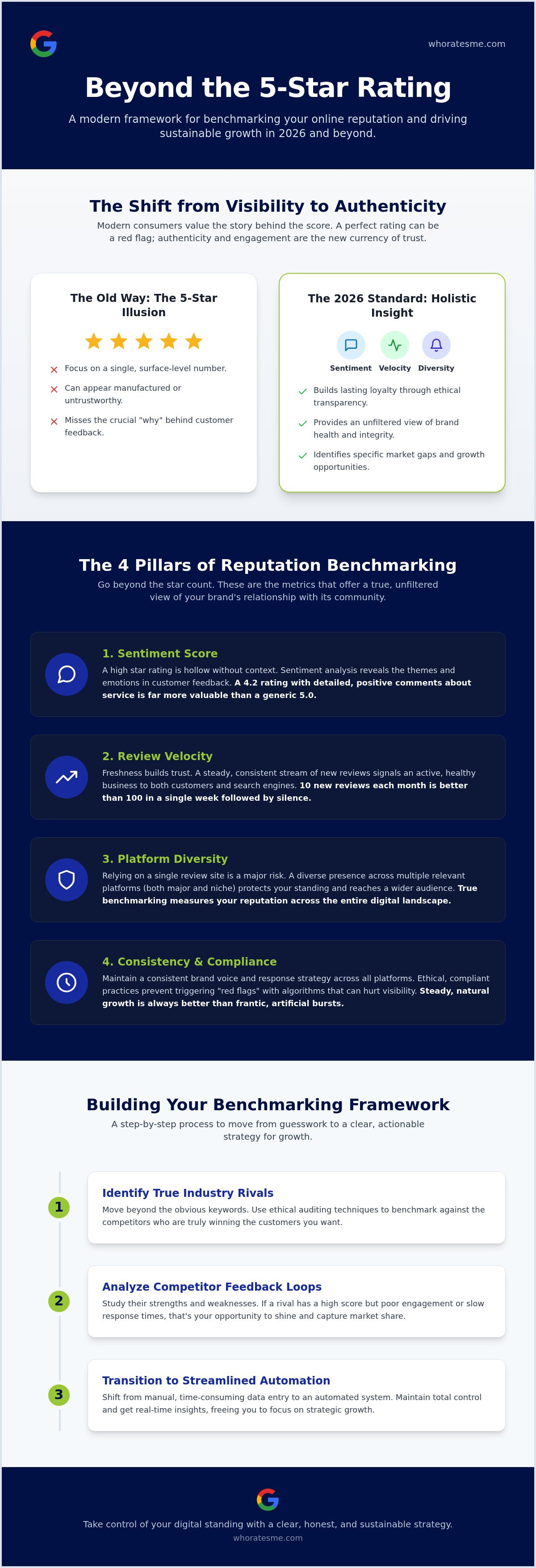
- Build a framework based on the four pillars of reputation: sentiment, velocity, diversity, and consistency. These metrics offer an unfiltered view of your brand's health.
- Use ethical auditing techniques to study competitor feedback loops. You can identify their strengths and weaknesses without resorting to aggressive tactics.
- Transition from manual data entry to streamlined automation. This shift allows you to maintain total control over your digital standing while freeing up your time.
Beyond the Star Rating: Why You Need to Benchmark Online Reputation in 2026
A perfect five star rating used to be the ultimate goal. Today, it's often a source of skepticism. Savvy consumers in 2026 look for the story behind the number. They want to see the texture of real human experiences. If your profile looks too polished, it might actually drive people away. Learning how to benchmark online reputation requires you to look deeper than the surface. You need to understand the emotional "why" behind every comment left by your customers.
This deeper analysis helps you identify "invisible" lost revenue. You might see high traffic to your profile but low conversion rates. This often happens because of poor digital sentiment that isn't reflected in the star count. Maybe your reviews are all three years old. Perhaps the recent comments mention a recurring issue you haven't addressed. Reputation management is no longer just about fixing mistakes; it's about maintaining a pulse on your brand's health and integrity.
The Shift from Visibility to Authenticity
Being found is a start. It isn't enough to win the modern customer. In a saturated market, ethical transparency is what builds lasting loyalty. Benchmarking reveals if your brand feels real or manufactured. Consumers can sense when a feedback loop is forced. They value honesty over perfection. When you measure your standing, you aren't just looking for praise. You're looking for an unfiltered view of how you serve your community and where you can grow.
Reputation as a Competitive Advantage
Most business owners view reputation as a defensive task. It feels like something you have to "deal with" to avoid trouble. Flip that perspective. Benchmarking is a tool for proactive growth. It allows you to identify specific market gaps where your competitors are failing. If a rival has a high score but ignores customer questions, that's your opportunity to shine through better engagement and sincerity.
This process should be rhythmic, not a one-time audit. It's about movement and synchronization with your market's needs. Setting a baseline with a comprehensive review management strategy gives you a clear starting point. It provides the order and clarity you need to move forward. You don't have to be the loudest voice in the room to be the most trusted one. By measuring the right metrics, you can ensure your growth is both steady and ethical.
The 4 Pillars of Reputation Benchmarking: Metrics That Matter
Identifying the right data points is the first step toward clarity. When you're learning how to benchmark online reputation, it's easy to get lost in complex spreadsheets. We focus on four specific pillars: sentiment, velocity, diversity, and compliance. These aren't just numbers; they represent the heartbeat of your business's relationship with its community. By measuring these, you move away from guesswork and toward a grounded, organized strategy.
Sentiment vs. Star Count
A high star rating is a nice starting point, but it doesn't tell the whole story. A 4.2 rating supported by detailed praise regarding your team's empathy often carries more weight than a generic 5.0 rating with one-word comments. Consumers in 2026 look for specific themes like service quality and reliability. You can extract these themes to see your "Sentiment Score" compared to industry averages. This helps you identify if your brand's voice is resonating or if there's a disconnect between your promise and their experience.
The Importance of Review Velocity
Freshness is vital for trust. Receiving 10 reviews every month is significantly better for your standing than getting 100 reviews in a single week and then going silent for a year. This consistency, known as review velocity, tells both search engines and potential clients that you're active and consistently providing good service. Sudden spikes often look artificial to modern algorithms. Benchmarking your consistency ensures you don't trigger "red flags" that could hurt your local visibility. It's about steady, natural growth rather than frantic bursts of activity.
Platform diversity is equally important. Relying solely on one site is a significant risk. If that platform changes its rules or your profile faces an issue, your entire digital standing could vanish. True benchmarking involves looking at your presence across multiple niche and major platforms. This creates a stable, unfiltered view of your reputation that isn't dependent on a single company's whims. If you're feeling overwhelmed by managing multiple sites, a trusted ally in reputation management can help you synchronize your efforts.
Compliance: The "Hidden" Metric
Integrity is your most valuable asset. In 2026, regulatory bodies like the FTC have tightened rules around review transparency and prohibited practices like review gating. You must audit your methods to ensure your feedback loop is automated but ethical. Compliance is the foundation of long-term reputation ROI. By keeping your processes transparent and honest, you protect your business from future penalties. Mastering how to benchmark online reputation across these pillars ensures you're building a brand that is both successful and respected.
Competitive Analysis: How to Measure Your Standing Against Industry Rivals
It's natural to feel a bit of anxiety when you see a competitor's review count climbing. You might wonder if they've found a secret formula you're missing. But benchmarking isn't about copying them; it's about finding where they're leaving their customers behind. Knowing how to benchmark online reputation against your true rivals helps you see the gaps in the market that you're uniquely qualified to fill. This process brings a sense of order to the competitive chaos. It allows you to stop reacting to every move they make and start leading with quiet confidence.
Identifying Your Reputation Competitors
Your physical neighbors aren't always your digital rivals. An online reputation peer is any business that shares your customer demographics and appears alongside you in search results. You should map this competitive landscape across major platforms to see who truly dominates the conversation. Look for businesses that have a similar volume of feedback. This gives you a realistic baseline for comparison. By focusing on these specific peers, you get an unfiltered view of the standards your customers expect. It helps you understand what "good" looks like in your specific niche.
Gap Analysis: Where Rivals Fall Short
This is where you find your "Unique Trust Proposition." You can use a "Secret Shopper" approach by auditing the feedback loops of your competitors. Don't just look at their high scores. Look at their negative reviews. These comments are a goldmine of information about what the market is missing. If you see a pattern of complaints about a rival's lack of communication, you can emphasize your own transparency and responsiveness.
- Do they ignore negative feedback, or do they respond with empathy?
- Are their responses generic and cold, or do they feel personal?
- Is there a recurring complaint about their service quality that you've already solved?
Benchmarking your response times against theirs is another powerful move. If the industry average response time is 48 hours and you respond in four, you've already won a significant advantage. Turning these competitor "pains" into your brand "gains" allows you to position yourself as the more reliable, human choice. It's a steady way to build a reputation that rivals can't easily replicate.
Measuring your share-of-voice helps you see who dominates the digital conversation. It's not just about volume; it's about the quality of the mentions. If a rival has a high volume but low sentiment, they're visible but not trusted. You can use real-time monitoring to stay synchronized with these market shifts. This allows you to move from being overwhelmed by competition to being in total control of your market position. You'll find peace of mind knowing that your growth is built on a foundation of genuine service rather than just louder marketing.
Building Your Benchmarking Framework: A Step-by-Step Process
Creating a system from scratch often feels daunting. You see your business data scattered across various sites, and it's hard to know where to begin. It's time to bring that information home. Learning how to benchmark online reputation starts with a clear, repeatable process. This framework moves you from feeling scattered to feeling in command. By following these steps, you build a foundation of order and clarity that supports your long-term success.
Phase 1: The Reputation Audit
Gathering links to every platform where your business is mentioned is the heavy lifting. You might find profiles you didn't even know existed. This is where you see the unfiltered truth of your digital presence. Whether you use a simple spreadsheet for manual tracking or a dedicated dashboard, the goal is the same: total visibility. You'll quickly see which platforms are thriving and which have been neglected for months. An audit is the first step toward regaining control.
Once your data is centralized, you can establish your baseline metrics. Look closely at your current review velocity, sentiment scores, and platform diversity. These are the pillars that define your standing. Next, conduct a compliance audit to ensure your feedback loops meet 2026 standards. Checking for risks like review gating or selective filtering protects your brand from future penalties. Ensuring zero-risk growth is the only way to protect your hard-earned legacy.
Phase 2: Setting Realistic Goals
Setting goals can feel like a high-pressure task. It doesn't have to be. Avoid the urge to fix every issue in a single week. This approach often leads to inconsistent results and burnout. Instead, adopt the "1% Better" rule for monthly reputation growth. Small, steady improvements are more sustainable than frantic bursts of activity. Focus your energy on the platforms that drive the most customer conversions first. This ensures your efforts translate directly into business success and peace of mind.
Set incremental growth targets based on the competitor gaps you've already identified. If a rival has a high rating but slow response times, make your responsiveness a key benchmarking goal. Finally, implement multi platform review management to maintain the standards you've set. This ensures your reputation stays synchronized across the web without requiring constant manual effort. If you're ready to start your journey with a trusted ally for ethical reputation growth, now is the perfect time to take that first step toward total control.
Future-Proofing Your Reputation with Ethical Benchmarking and Automation
Managing your digital standing manually is a heavy burden. It often feels like a second job you never applied for. As your business grows, the time required to track every mention becomes overwhelming. This is where the transition from manual work to a "Trusted Ally" becomes essential. You need a way to keep your pulse on the market without sacrificing your focus on daily operations. Understanding how to benchmark online reputation at scale requires a shift in the tools you use to measure success.
The ActivCycle automation handles the heavy lifting of data collection for you. It gathers insights from multiple platforms, ensuring your benchmarks are always current and accurate. This allows you to step back from the spreadsheets and focus on the human side of your business. By using the Elevate Google-compliant plan, you can drive growth without the risk of falling foul of 2026 regulations. It's about building a legacy on a foundation of integrity and sincere customer connection.
The Role of Ethical Automation
Automation shouldn't mean losing the human touch; it should protect it. Transparent systems eliminate the dangerous temptation of review gating. In this new environment, authenticity is your strongest currency. Automation ensures a steady, rhythmic stream of authentic, service-related feedback from real customers. This builds unshakeable credibility. It tells the world that your business is reliable and honest. You aren't just gathering data; you're creating a feedback loop that respects the customer's voice while providing you with the order and clarity you need to improve.
Your Next Steps to Reputation Mastery
Mastery is about moving from passive monitoring to active leadership. It's a journey that begins with a single, grounded step. Your first 30 days of benchmarking should focus on establishing your baseline and identifying the most impactful competitor gaps. A centralized dashboard simplifies these multi-platform comparisons: it turns a mountain of complex data into a clear path forward. You no longer have to guess where you stand. The information is laid out in an unfiltered, organized view.
Transitioning to mastery is easier with the right tools in your pocket. Real-time mobile app alerts keep you synchronized with your community, allowing you to respond with empathy the moment feedback arrives. We invite you to experience the peace of mind that comes with a compliant, automated strategy. You've worked hard to build your business. Now, let an ethical framework protect it. By following these steps, you move from being overwhelmed by the digital noise to being in total control of your brand's future.
Taking Command of Your Digital Future
Building a brand that lasts requires more than just chasing stars. It's about understanding the human sentiment behind the screen and staying synchronized with your industry's standards. You've learned how to benchmark online reputation by looking at velocity, diversity, and compliance. These metrics provide the clarity you need to stop guessing and start growing with total confidence. By identifying where your rivals fall short, you can position your business as the most reliable choice in your market.
Real growth doesn't have to be a source of stress. You can elevate your brand with the WhoRatesMe Google-compliant plan today. Our system provides Google-compliant automation via ActivCycle and a multi-platform dashboard to keep you in control. There's no gating and no removal; we focus on authentic growth that honors your hard work. Our mobile app ensures you have real-time monitoring at your fingertips. This is the order and clarity your business deserves.
You've already done the hard work of building a great business. Now, let an ethical framework protect it. You're ready to move from being overwhelmed to being in complete control of your digital legacy. Your community is waiting to hear your real story.
Frequently Asked Questions
How often should I benchmark my online reputation?
Monthly benchmarking provides the best balance between catching trends and avoiding daily stress. Checking your data once every 30 days allows you to see the impact of your service changes without reacting to every single comment. It's a rhythmic process that ensures you stay synchronized with your market. This steady approach gives you the order and clarity needed to make informed decisions for your brand's future.
What is a good sentiment score for a service-based business?
A good sentiment score for a service-based business is typically 80% or higher. This means that four out of five customers are highlighting positive emotional experiences with your team. While a perfect 100% can look manufactured to modern consumers, a score in the high eighties shows you're real and reliable. Understanding how to benchmark online reputation involves looking at these emotional themes rather than just the raw star count.
Is it ethical to look at competitor reviews for benchmarking?
It is completely ethical to analyze competitor reviews because they are public records of customer experiences. You aren't invading privacy; you're studying the market to find where others are failing their clients. This research helps you identify your own "Unique Trust Proposition." By seeing what customers complain about elsewhere, you can refine your own services to provide the relief and quality that those people are searching for.
What are the risks of using non-compliant reputation management tools?
Non-compliant tools carry severe risks like permanent bans from platforms like Google or heavy fines from the FTC. Practices like review gating or selective filtering are strictly prohibited in 2026. These shortcuts might offer temporary gains, but they eventually lead to a loss of credibility and revenue. Using a transparent, ethical system ensures your growth is sustainable and your reputation remains unshakeable in a regulated digital landscape.
Can I benchmark my reputation for free?
You can benchmark your reputation for free by manually gathering data from various review sites into a spreadsheet. This audit is a great first step toward regaining control of your digital presence. However, manual tracking becomes difficult to scale as your business grows. While the initial audit costs nothing but your time, many owners eventually transition to automated systems to ensure their data remains accurate and easy to manage.
What is the difference between reputation monitoring and benchmarking?
Reputation monitoring is the act of watching for new feedback in real-time to respond quickly. Benchmarking is a deeper analysis that compares your performance over time against specific industry rivals. Monitoring tells you what happened today; benchmarking tells you if your overall strategy is actually working. Both are essential, but benchmarking is what provides the roadmap for long-term improvement and competitive advantage in your niche.
How does review velocity affect my search engine ranking?
Review velocity is a powerful signal that tells search engines your business is active and relevant. A steady stream of new feedback suggests you're consistently serving customers, which can improve your local visibility. Sudden spikes followed by long silences often look suspicious to algorithms. Learning how to benchmark online reputation helps you maintain a consistent pace, ensuring your search engine rankings reflect the actual health and movement of your business.
