
How to Calculate the ROI of Reputation Management in 2026
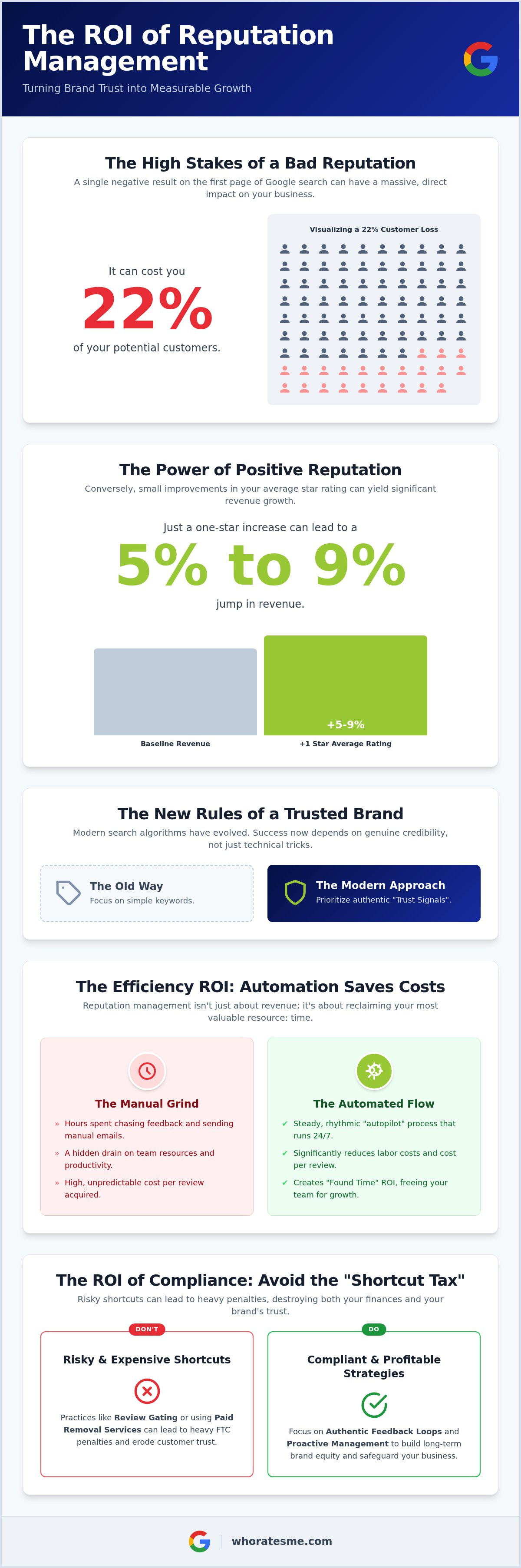
A single negative result on the first page of Google can cost a business 22% of its potential customers. It's a startling figure that highlights the high stakes of your online presence. You likely already know that trust is your most valuable currency, but figuring out how to calculate roi of reputation management often feels like a guessing game. You spend hours manually managing reviews and worrying about FTC compliance, all while wondering if those gold stars are actually moving the needle for your revenue. It's a heavy burden to carry when you're just trying to grow with integrity.
We're here to help you find clarity in the data. This guide will teach you the frameworks needed to turn abstract sentiment into measurable, high-return growth. We'll show you how a one-star increase can lead to a 5% to 9% jump in revenue. This provides the logical justification you need for smarter automation. By the end of this article, you'll have a clear roadmap to increase conversion rates through trust and a formula that proves your reputation is your most reliable business asset.
Key Takeaways
- Modern search algorithms now prioritize authentic trust signals, making it essential to shift your focus from simple keywords to genuine brand credibility.
- Use our three pillar framework to learn how to calculate roi of reputation management by connecting your star ratings to actual revenue growth and lower acquisition costs.
- ActivCycle automation helps you reclaim valuable time, turning the manual struggle of review management into a streamlined, cost saving process.
- Safeguard your business from heavy penalties by choosing compliant strategies over risky shortcuts like review gating or paid removal services.
- Start measuring what matters by auditing your current reputation and setting up clear tracking for conversions that begin with a customer's trust.
Why Measuring Reputation ROI is Different in 2026
Running a business in 2026 feels different. Search engines don't just count keywords anymore; they measure the weight of your word. Modern algorithms now prioritize "Trust Signals" above almost everything else. This means your reputation isn't just a social asset. It's a technical one. Learning how to calculate roi of reputation management requires looking past the surface level of star counts and focusing on how trust impacts your bottom line.
We define Reputation ROI as the measurable financial return on building and protecting brand trust. In the past, many owners viewed reviews as "vanity metrics." A high star count felt good, but it didn't always feel like money. Today, the focus has shifted to conversion metrics and pipeline velocity. It's about how quickly a prospect turns into a customer because they already believe in your quality. We call this the "Trusted Ally" approach. It balances efficient automation with the sincere, human feedback your customers provide.
The Lagged Effect of Brand Trust
Trust takes time to build. It's understandable to feel frustrated when a 0.5-star increase doesn't show up in your bank account by Monday morning. Reputation works like a flywheel. It starts slow, but once it gains momentum, it's hard to stop. However, the opposite is also true. "Reputation Decay" is a real threat for those who take a passive approach. If you stop nurturing your online presence, your visibility slides. The cost of doing nothing is often higher than the investment in growth. Reputation ROI is the delta between trust-driven revenue and the cost of trust-acquisition.
Reputation as a Conversion Catalyst
Every review is a silent salesperson. They shorten your sales cycle by answering objections before a lead even speaks to your team. In high-competition markets, consumers face "Decision Fatigue." They're overwhelmed by choices. A solid reputation acts as a shortcut, allowing them to choose you with confidence and less stress. Modern Reputation management has evolved from simple PR into a data-driven science that reduces this friction. By integrating your strategy with customer feedback software, you gain the visibility needed to see these patterns clearly. You can finally see how your authentic service-related comments translate into faster, more reliable growth. It's not just about being liked. It's about being the clear, logical choice in a crowded market.
The Efficiency ROI: Saving Costs Through ActivCycle Automation
Managing a brand's reputation often feels like a second full-time job. You or your team likely spend hours chasing feedback, sending manual emails, and following up on missed opportunities. This manual burden is a hidden drain on your resources. When looking at how to calculate roi of reputation management, you must account for these labor hours. Every hour spent on administrative tasks is an hour not spent on growing your business or serving your clients.
ActivCycle automation changes this equation. It creates a steady, rhythmic process that operates in the background. Instead of a frantic scramble for reviews, you get a methodical flow. This "autopilot" approach significantly reduces the cost per review acquired. Research into the financial impact of corporate reputation shows that a company's actual behavior and operational efficiency are key drivers of performance. By automating the feedback loop, you ensure your team's behavior stays focused on high-value tasks while the software handles the repetitive work.
Quantifying Labor Savings
To see the real value, you need to look at the numbers. Start by tracking exactly how much time your team spends on manual review requests each month. Once you have that number, compare it to the monthly cost of an automated feedback loop. The final step is calculating your "Found Time" ROI. This is the value of the marketing projects your team can finally finish because they aren't stuck in a feedback loop. Using tools like ActivCycle automation allows you to scale your reputation without scaling your payroll.
The Mobile App Advantage
Speed is your best defense against PR damage. Our mobile app reduces response friction by providing on-the-go monitoring and real-time alerts. This prevents a single negative comment from snowballing into a larger crisis. It also empowers your field teams. They can capture authentic service-related comments the moment a job is completed. This immediate connection ensures the feedback is fresh and sincere. It turns every service call into a potential trust signal, creating a more successful and simplified future for your brand.
The Three-Pillar Framework for Reputation ROI Calculation
Measuring the value of your brand's integrity can feel like trying to catch mist. It's there, but it's hard to hold. To truly understand how to calculate roi of reputation management, you need a grounded structure. We use a three pillar framework that looks at the whole picture. This includes revenue growth, cost reduction, and risk mitigation. A successful online reputation management strategy balances these three areas to create a stable foundation for your business. It moves you from guessing about your impact to knowing your worth.
The three pillars provide a 360 degree view of your business health. Pillar 1 focuses on revenue growth, specifically through increased click through rates and conversion. Pillar 2 centers on cost reduction, looking at lower acquisition costs and the labor hours saved through automation. Pillar 3 is risk mitigation. This is your insurance policy. It helps you avoid the "Shortcut Tax" of non-compliant practices and reduces customer churn by addressing feedback early. Balancing these ensures you aren't just chasing stars, but building a measurable business asset.
The Revenue Formula
To quantify your growth, we use a simple formula: (Incremental Traffic x Conversion Rate Increase) x Average Order Value. Research shows that conversion rates can increase by 15% to 35% when a business score improves from below 4 stars to above 4.5 stars. Additionally, a one star increase in a Google rating can lead to a 5% to 9% increase in revenue for local businesses. You can track this "Reputation Lift" in your Google Business Profile insights. Look for the direct correlation between your review velocity and your direct calls or website visits. It's the most honest way to see your growth in real time.
The CAC Reduction Model
Ads are getting more expensive every year. Cold leads from paid search require a lot of convincing, which drives up your costs. Warm leads from reviews are different; they arrive at your digital doorstep with pre-built trust. This lowers your customer acquisition cost (CAC) significantly. When your reputation is strong, you need less ad spend to hit the same sales targets. There's also the "Trust Tax" to consider. A poor reputation actually increases your cost per click (CPC). Users are less likely to click on a low rated business, which forces you to bid higher for the same visibility. Trust is the lubricant that makes your marketing engine run smoother. It turns a friction filled sales process into a natural, steady flow of new business.
The ROI of Compliance: Avoiding the "Shortcut Tax"
Seeking a quick fix for a few bad reviews is a natural impulse. You care deeply about your business, and seeing a negative comment can feel like a personal blow. However, the path of "review removal" services is often a dead end. These providers typically charge high fees for incredibly low success rates. It's a "Shortcut Tax" that drains your budget without fixing the root cause of the feedback. When you're looking at how to calculate roi of reputation management, you must account for the catastrophic cost of non-compliance. A strategy that risks your entire digital presence is a liability, not an investment.
Regulatory bodies are watching closer than ever in 2026. Violating the Consumer Review Fairness Act or facing substantial FTC fines can result in financial ruin. It isn't just about a slap on the wrist; it's about the survival of your brand. Our Elevate Google-compliant plan is designed to offer a "Safety ROI" by ensuring your growth is built on a legal, stable foundation. We prioritize integrity because it's the only way to ensure your business remains a stabilizing force in your industry. Protecting your future starts with a commitment to the truth. You can secure your brand’s longevity today with the Elevate Google-compliant plan.
The High Price of Review Gating
Selective filtering might seem like a safe bet today, but it's a massive risk for tomorrow. Search engines are now highly sensitive to manipulation and "review gating." Once an algorithm detects that you're only asking happy customers for feedback, your organic visibility can vanish overnight. Using non-gated review platforms is the only way to protect your long term rankings. The cost of an "Algorithm Penalty" is a hidden negative ROI that most businesses never fully recover from. True authority comes from transparency, not from hiding the voices you don't like.
Ethical Growth vs. Temporary Spikes
Authenticity wins the long game. Modern customers can sense a curated, "too perfect" list of reviews. They value seeing how you handle challenges and resolve issues. This creates the "Trust Rebound" effect. Responding to a negative review professionally often increases conversion rates more than a simple five star rating alone. It proves you are real and that you actually listen. Ethical growth is the only way to avoid the "reputation reset" caused by platform bans. By embracing every piece of feedback, you build a resilient brand that stands the test of time.
Next Steps: Implementing a Measurable Reputation Strategy
Moving from the theory of trust to the reality of revenue requires a clear, methodical plan. It is natural to feel a bit overwhelmed by the data. You have seen the frameworks and understood the risks of the "Shortcut Tax." Now, it's time to build your own engine for growth. Understanding how to calculate roi of reputation management becomes much easier when you have a clean starting point. By establishing a baseline and centralizing your feedback, you move from a reactive state to one of total control.
The first step is moving your data out of silos. A multi platform review management dashboard allows you to see every trust signal in one place. This centralized view is essential for tracking "Reputation-Assisted Conversions" in your CRM. When you can see that a lead read five reviews before clicking your ad, you begin to see reputation as a profit center. It is no longer an abstract cost. It is a measurable driver of your bottom line.
The 30-Day Reputation Audit
We recommend starting with a "Pre-Elevate" audit to identify your current "Trust Gaps." This process involves three steady steps. First, benchmark your conversion rates against industry standards for your current star rating. Next, identify where your national search presence lacks authentic feedback. Finally, establish a reporting cadence for your stakeholders. This audit provides the quiet confidence you need to justify your 2026 budget. It turns a chaotic environment into an organized roadmap for success.
Choosing a Compliant Partner
Scale should never come at the expense of your integrity. Choosing a partner is about finding a "Trusted Ally" who values the truth as much as you do. The WhoRatesMe Elevate plan is designed for national brands that seek ethical growth without the risks of gating or black-hat removal tactics. We focus on natural synchronization between your service quality and your online voice. This approach protects your brand from future "reputation resets" and ensures your growth is permanent. Ready to see the numbers for yourself? Explore the Elevate Google-compliant plan today.
Secure Your Brand’s Financial Future
Building a business is a deeply personal investment. You've worked hard to create something meaningful, and your online reputation should reflect that effort. Throughout this guide, we've explored how to calculate roi of reputation management by looking at conversion multipliers, labor savings, and risk avoidance. It's clear that trust isn't just a feeling. It's the engine that drives your revenue and protects your most valuable resource: your time.
By choosing a path of integrity and automation, you move from feeling overwhelmed to being in total control. Our ActivCycle automation saves average businesses 10+ hours per week, allowing you to focus on your customers instead of your dashboard. Our Elevate plan is 100% compliant with the latest Google and FTC review policies. It offers a centralized dashboard for unified national brand oversight, ensuring your growth is as safe as it is significant.
You don't have to face the chaos of review management alone. A more successful, simplified future is within reach. Maximize your ROI with our Elevate Google-compliant plan and start turning your brand's trust into a measurable asset today. You've built something great; let's make sure the world sees it clearly.
Frequently Asked Questions
What is the standard formula for reputation management ROI?
The standard formula for reputation management ROI is: ROI = (Projected Additional Revenue - Investment) / Investment. This calculation allows you to see the clear financial return on your efforts. You should include revenue from increased conversion rates and cost savings from manual labor. It's a straightforward way to turn abstract trust into a hard business metric. This clarity helps you feel in control of your marketing spend and provides a sense of order.
How much does review gating cost a business in penalties?
Review gating is a high risk strategy that can lead to significant financial penalties from the FTC. In 2026, regulatory bodies have increased their oversight of non-compliant practices. Beyond direct fines, search engines often impose an Algorithm Penalty that can wipe out your organic visibility. This loss of traffic is often more expensive than the fine itself. Choosing a compliant path is the only way to protect your long term stability and peace of mind.
Can I calculate ROI if I only have a few reviews?
You can definitely calculate ROI even with a small number of reviews. In fact, the jump from zero reviews to a handful often provides the most significant increase in conversion velocity. Every new piece of authentic feedback acts as a trust signal for your next customer. It is about building a foundation. You are measuring the transition from being invisible to being a trusted option in your local market.
How does reputation management affect Customer Acquisition Cost (CAC)?
Reputation management lowers your Customer Acquisition Cost by increasing the efficiency of your existing ads. When prospects see high ratings and sincere comments, they're more likely to convert. This reduces the amount of cold ad spend needed to generate a lead. It's a natural synchronization of your marketing efforts. You aren't just buying traffic; you're ensuring that the traffic you buy actually trusts you. This leads to a simplified and more successful future.
Is automated feedback collection more cost-effective than manual requests?
Automated feedback collection is significantly more cost-effective than manual requests. Manual outreach often costs a business 10 or more hours of labor per week. ActivCycle automation handles these rhythmic tasks in the background. This saves your team from the daily pressure of chasing reviews. It allows them to focus on high value growth projects instead. The Found Time alone often pays for the software investment, providing a sense of relief and total control.
What metrics should I track in my reputation dashboard?
Your reputation dashboard should track several key metrics to provide a clear view of your performance. These include:
- Review Velocity: The frequency of new feedback.
- Conversion Rate Lift: The increase in leads as your score improves.
- Response Time: How quickly you engage with customers.
- Click-Through Rate: The impact of stars on search visibility.
How long does it take to see a positive ROI from reputation management?
Most businesses begin to see a positive ROI within three to six months. Reputation is a lagged causation. It takes time for search algorithms to recognize your new trust signals and for consumers to notice your improved score. However, once the momentum builds, the return becomes steady and predictable. It's a long term investment in your brand's integrity. Patience in the beginning leads to total control and a clear view of your success in the future.
Does the Consumer Review Fairness Act impact my ROI calculations?
The Consumer Review Fairness Act has a direct impact on how you manage feedback and calculate ROI. It prohibits gag clauses that prevent customers from posting honest reviews. Violating this act can lead to legal action and significant brand damage. By focusing on ethical, compliant growth through the Elevate plan, you avoid these hidden liabilities. Protecting your reputation the right way ensures your financial calculations remain accurate and safe.
