
How to Fight Fake Reviews with Authentic Feedback: A 2026 Strategy
Trying to delete a fake review is often like trying to catch smoke with your bare hands. It's frustrating to watch a single anonymous comment overshadow years of hard work, especially when you know the person behind the screen never even stepped foot in your business. You might feel like you're losing control as you spend hours arguing with automated support systems. This guide shows you exactly how to fight fake reviews with authentic feedback by shifting your energy from defense to growth.
We understand the pressure of maintaining a clean reputation in a world where 82% of consumers encountered a fake review in the past year. You don't need to live in fear of declining rankings or spend your weekends chasing digital ghosts. Instead, you'll learn how to use ethical automation to build a resilient, Google-compliant feedback loop. We will walk through a clear plan to neutralize digital attacks with the power of real customer voices, ensuring your integrity remains the loudest thing on the page.
Key Takeaways
- Recognize the 2026 red flags of digital attacks, like AI-generated patterns, so you can stop wasting energy on bots.
- Learn why "review removal" is often a myth and how to focus your efforts on strategies that actually work.
- Master the math of review dilution to understand exactly how to fight fake reviews with authentic feedback until the noise becomes irrelevant.
- Adopt a crowd-facing response framework that turns a malicious attack into a demonstration of your brand's integrity.
- Explore how the Elevate Google-compliant plan and ActivCycle automation can build a resilient reputation through transparent, real-world customer stories.
The Anatomy of a Digital Attack: Identifying Fake Reviews in 2026
It’s a quiet Tuesday morning when you first notice the notification. One star. Then another. Within an hour, your rating has dipped, and the weight in your chest is real. For a local service-based business, "review bombing" isn't just a digital glitch; it's an emotional and financial assault. These aren't genuine customers sharing a bad experience. They are malicious actors providing non-transactional feedback designed specifically to sabotage your hard-earned reputation. This organized deception is often part of a larger deceptive practice of astroturfing, where fake accounts mimic a crowd of unhappy customers to sway public opinion.
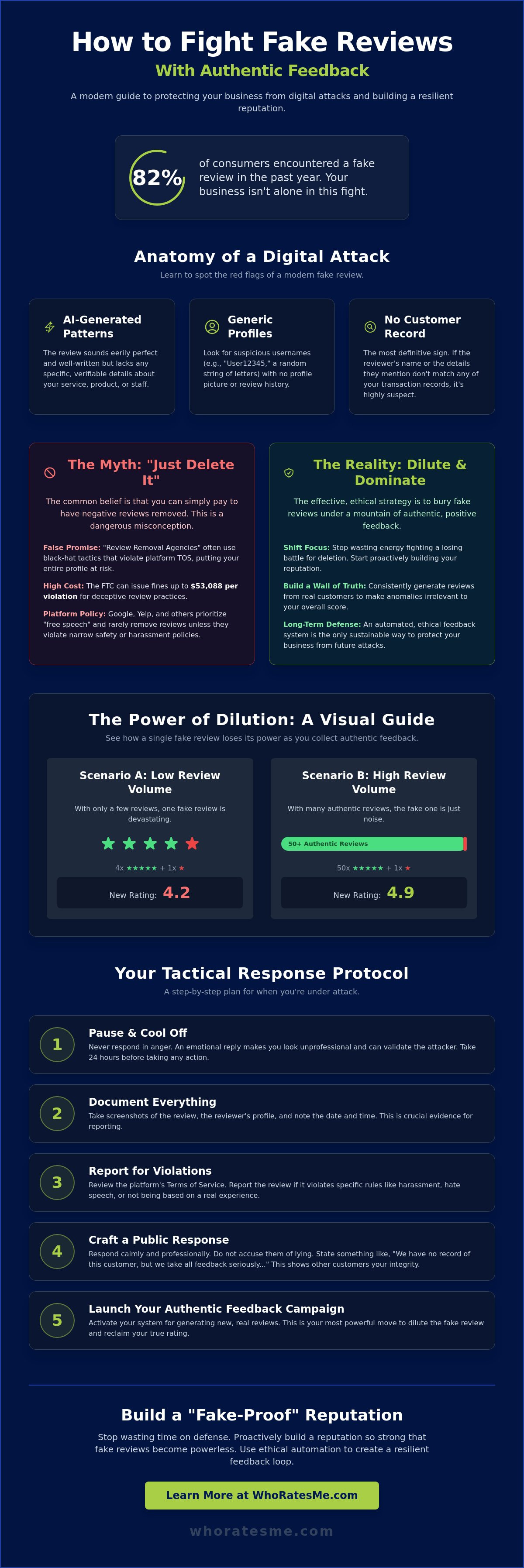
In 2026, the red flags have evolved. While old-school fake reviews were often easy to spot due to broken English, modern attacks use advanced AI linguistic structures. These reviews often sound eerily perfect yet lack any specific details about your service or staff. You might notice generic naming patterns, such as "User123" or names that don't match your customer records. Understanding these markers is the first step in learning how to fight fake reviews with authentic feedback. Mitigation isn't about a frantic search for a "delete" button that platforms rarely provide. It's about reducing the impact by proving who you really are.
Common Sources of Malicious Feedback
- Competitor-hired "hit squads": Unscrupulous rivals may use burner accounts to sabotage your local search rankings and steal your leads.
- AI-driven botnets: Automated systems can now target entire industries with generic 1-star ratings to extort business owners.
- Disgruntled former employees: Personal retaliation often takes the form of anonymous profiles claiming fictional workplace horrors.
The Immediate Response Protocol
When you're under fire, your first instinct is to fight back. Pause. Responding in anger always backfires because it makes the fake reviewer look like a victim. Instead, start by documenting everything. Take screenshots and note timestamps; this is your first line of defense for future reporting. Review the platform’s Terms of Service (TOS) to see if the content violates specific policies, like harassment or lack of a real experience. Most importantly, give yourself a "cooling off" period. A calm, professional presence is your greatest asset. By staying composed, you prepare the ground for the next phase: learning how to fight fake reviews with authentic feedback that restores your community's trust.
Myth vs. Reality: Why You Cannot Simply "Delete" Your Way to Success
It's tempting to look for a quick exit when a malicious review hits your profile. You might see ads for "Review Removal Agencies" promising a clean slate for a flat fee. The truth is harsher; most of these services are either outright scams or use "black hat" tactics that put your entire business at risk. Google and Yelp rarely remove content unless it clearly violates narrow safety guidelines. Suspicion alone isn't enough for them to act. Trying to manipulate the system creates a legal trap. The FTC's Rule on Fake Reviews has made it clear that deceptive practices can result in civil penalties of up to $53,088 per violation. At WhoRatesMe, we believe protecting your brand comes through integrity; not hiding behind deleted comments.
Learning how to fight fake reviews with authentic feedback requires a shift in perspective. You aren't just trying to hide a lie. You're trying to highlight the truth. When you focus on manual deletions, you're playing a game the platforms are designed to win. They prioritize the "freedom of speech" for the reviewer, even when that reviewer is a bot. Your energy is better spent building a wall of real experiences that make a single fake comment look like the outlier it is.
The Danger of Review Gating
Review gating is the practice of selectively asking only happy customers for feedback while filtering out those who might have complaints. By 2026, the FTC effectively banned this practice to protect consumer trust. There's also a significant "Trust Gap" to consider. Only 38% of shoppers in 2026 trust online reviews as much as personal recommendations. If your profile only shows perfect 5-star ratings with no variation, customers and platform algorithms become suspicious. Modern systems are trained to detect these patterns and may penalize your visibility for selective filtering.
The High Cost of "Quick Fixes"
Buying positive reviews to counter an attack is a death sentence for your digital presence. In 2025 alone, Google removed 292 million policy-violating reviews using advanced AI detection. These systems identify inorganic spikes in volume and can flag your entire profile for suspension. A 4.5-star rating built on authentic customer voices is far more valuable than a "perfect" score that looks manufactured. Building a foundation of truth is easier with a reliable review management strategy that focuses on real human connection. This long-term approach ensures your reputation remains stable even when the digital environment feels chaotic.
The Mathematical Solution: Review Dilution Through Volume
Dealing with a digital attack feels like a personal crisis. It's hard to stay calm when your average rating drops overnight due to a handful of malicious posts. However, the most effective way to protect your business isn't through a desperate search for a removal button; it's through dilution. Think of a fake review as a single drop of ink in a glass of water. If the glass is small, the water turns black. If you're pouring that same ink into an Olympic-sized pool, it disappears completely. This is how to fight fake reviews with authentic feedback at scale. By increasing the volume of real voices, you make malicious comments mathematically irrelevant to your overall reputation.
The math of the average is unforgiving. To neutralize one malicious 1-star review and maintain a 4.8 rating, you need approximately 19 five-star reviews to balance the scale. This reality highlights why having a "buffer zone" of existing positive feedback is vital for long-term stability. Research from Harvard Business School suggests that the economic incentives for review fraud often target businesses with lower review volumes. In these cases, a single negative post can cause significant damage to conversion rates. In 2026, search visibility relies heavily on recency. Algorithms prioritize fresh, consistent feedback over a stagnant profile. A review from three days ago carries more weight than a bot attack from three months ago, making a steady stream of new content your best shield.
Harnessing the Power of the Feedback Loop
Consistent, daily acquisition is your best defense. Most of your customers are happy, but they are often part of the "silent majority." They don't think to leave a review because their experience was seamless. Turning every successful service call into a moment for feedback creates a defensive wall of social proof. When your feedback loop is automated and steady, a sudden burst of fake activity looks like a temporary glitch to both customers and search engines. Your real customers provide the volume needed to push the noise off the first page.
Authenticity as a Competitive Differentiator
Perfection can actually be a red flag to modern shoppers. In 2026, consumers have grown weary of "too good to be true" profiles. They use minor imperfections as a signal that a business is real and trustworthy. A 4.7 rating with high volume often converts better than a perfect 5.0 with only a handful of entries. While bots rely on generic templates, real customer stories provide rich, service-specific context that AI cannot effectively mimic. This human element is what ultimately wins the trust of someone looking for a reliable local service.
A Tactical Response Framework for Suspicious Feedback
Seeing a suspicious review can feel like a punch to the gut. It's personal because your business is personal. However, the secret to a successful response is realizing you aren't actually talking to the reviewer. You're talking to the hundreds of silent observers who will read your words later. This "Crowd-Facing" mindset allows you to remain the "Trusted Ally" even when the situation feels chaotic. By using the WhoRatesMe mobile app, you can address these alerts instantly. Responding quickly ensures that a malicious comment doesn't sit unanswered for days, which is a critical part of how to fight fake reviews with authentic feedback.
Step 1: The Professional Verification Request
When you suspect a review is fake, your first goal is verification. Use neutral, professional language. A statement like, "We have no record of a client by this name in our system," is powerful because it's a fact, not an accusation. Ask for a specific invoice number or the date of service. This signals to future readers that the reviewer might not be legitimate. Keep this response brief. Anything over three sentences often looks defensive or overly emotional. You want to appear calm and organized, not frantic.
Step 2: Moving the Conversation Offline
Always provide a path to a manager. This shows you value real feedback and are ready to make things right. Provide a direct phone number or email address. Fake accounts and botnets almost never follow up. When a review remains "unsolved" despite your invitation to talk, its status as a fake becomes obvious to everyone else. A centralized dashboard makes it easy to track these interactions across every platform you manage, allowing you to maintain a steady, professional presence without feeling overwhelmed.
Step 3: The Internal Audit and Flagging
If the review clearly violates platform terms, it's time to flag it for moderation. This is a methodical process. Use your documentation from the internal audit to show why the review is non-transactional or malicious. Interestingly, sometimes a "fake" review can highlight a real service gap you didn't see. Use these moments to improve your internal operations while you monitor the status of your reports. This tactical approach clears the stage for real customer voices to shine, ensuring your reputation is built on truth rather than digital noise.
Building a "Fake-Proof" Reputation with ActivCycle Automation
Running a business is a labor of love. It shouldn't be a constant battle against anonymous trolls. You've already learned how to spot the red flags and respond with grace, but the true victory comes when you stop playing defense. The Elevate Google-compliant plan shifts your focus from damage control to natural growth. Through ActivCycle automation, you create a steady pulse of real customer experiences. This is how to fight fake reviews with authentic feedback without losing your sanity. It’s about building a reputation so solid that a single bot attack can’t even leave a scratch. You gain the "Autopilot" advantage. You focus on your craft while the system handles the noise.
Transitioning from reputation defense to reputation growth is a core business strategy for 2026. When you rely on manual efforts, you're always one step behind the bots. Automation changes the math. It ensures that every successful service call becomes a potential shield of social proof. This isn't about manipulation; it's about synchronization. By making feedback a natural part of your workflow, you ensure that the truth of your business is always the most recent thing a customer sees. It turns your "silent majority" into your most vocal advocates.
Staying Compliant While You Scale
Integrity is your most valuable asset. We understand the pressure to "fix" a bad rating, but we also know the high cost of shortcuts. WhoRatesMe rejects review gating and removal services because they create a false sense of security. These tactics violate the latest 2026 Google review policies and can lead to permanent profile suspension. Instead, we use a "Quiet Innovation" approach. This ensures you remain ahead of regulatory changes by focusing on transparency. You get peace of mind knowing your account is safe from the sudden penalties that hit businesses using risky, non-compliant methods.
Your Next Steps to Control
Transformation doesn't have to be complicated. You can set up your first ActivCycle loop in under 10 minutes. This simple step moves your feedback collection from a manual chore to a streamlined part of your daily operations. You'll use our multi-platform dashboard and mobile app to monitor everything in one place. It provides an unfiltered view of your brand's health. You'll see the real stories that define your hard work. It's time to move from being overwhelmed to being in total control. Protect your brand with the Elevate Google-compliant plan and let the truth of your service do the heavy lifting.
Secure Your Reputation for the Long Term
You've seen that the path to a stable reputation isn't paved with frantic deletions or risky removal services. It's built on the steady, honest voices of the people you serve every day. By understanding the math of review dilution and adopting a crowd-facing response strategy, you've already taken the first steps toward reclaiming your narrative. This is how to fight fake reviews with authentic feedback: you let the truth of your work speak louder than the noise of a bot.
Real transformation happens when you move these tasks to autopilot. Our Google-compliant ActivCycle automation ensures a consistent stream of real feedback without the legal risks of review gating. You can monitor every interaction from a centralized multi-platform dashboard; giving you the clarity you need to lead with confidence. Secure your business reputation with the Elevate Google-compliant plan.
Your hard work deserves to be seen clearly. We're here to help you protect it.
Frequently Asked Questions
Can I sue someone for leaving a fake review on my business profile?
You can pursue legal action under defamation laws, but it is often a complex and expensive path. Most business owners find that the legal fees and time required far outweigh the benefits of a single removal. It is usually more effective to focus on building a resilient reputation through transparent practices. This approach protects your peace of mind while you grow your business.
How long does it take for Google to investigate a flagged fake review?
Google typically processes most reports within three to five business days. However, more complex cases involving large botnets can take several weeks to resolve. It is frustrating to wait while a malicious comment stays visible. During this time, maintaining a steady flow of real customer voices is the best way to ensure your rating remains stable.
Will a single fake review significantly drop my search ranking?
A single negative post rarely causes a significant drop if you have a healthy volume of feedback. Search engines prioritize the overall "health" and recency of your profile rather than one specific comment. Learning how to fight fake reviews with authentic feedback ensures that one malicious actor doesn't define your brand. Consistency is what ultimately wins the favor of the algorithms.
Is it possible to "block" certain users from leaving reviews on my page?
No, review platforms do not allow businesses to block specific users or "pre-approve" comments. This policy exists to prevent censorship and ensure the platform remains a neutral space for consumers. While you cannot stop a troll from posting, you can control how you respond. A professional, fact-based reply signals your integrity to everyone else who visits your page.
What is the difference between a bad review and a fake review?
A bad review comes from a real customer who had a negative experience with your service. A fake review is a malicious, non-transactional post from someone who never actually used your business. It is vital to tell them apart. You should address real complaints with a solution, while fake attacks require a tactical response that highlights the lack of a transaction history.
Do I need to respond to every single fake review I receive?
Yes, you should respond to help the silent observers who are watching how you handle conflict. A calm and professional reply shows that you are an active, engaged business owner. You aren't trying to win an argument with a bot. You are demonstrating your commitment to transparency for the hundreds of potential customers who will see that interaction later.
Can software automatically detect if a review is written by AI?
Platform algorithms, including Google’s Gemini model, are increasingly effective at identifying AI-generated linguistic structures. These systems look for repetitive patterns and generic phrasing that real humans rarely use. While detection is an ongoing arms race, the best defense is a profile filled with specific, detailed stories from real people. Authentic human connection is still something a bot cannot mimic.
Why shouldn’t I use a review removal service that offers a money-back guarantee?
These services often use "black hat" tactics that violate platform terms and put your profile at risk of permanent suspension. The FTC also monitors these deceptive practices and can issue significant civil penalties for violations. It is much safer to invest in a compliant, automated loop. Building a foundation of truth is the only sustainable way to protect your hard work over the long term.
