How to Track Customer Feedback by Employee: The 2026 Training Guide
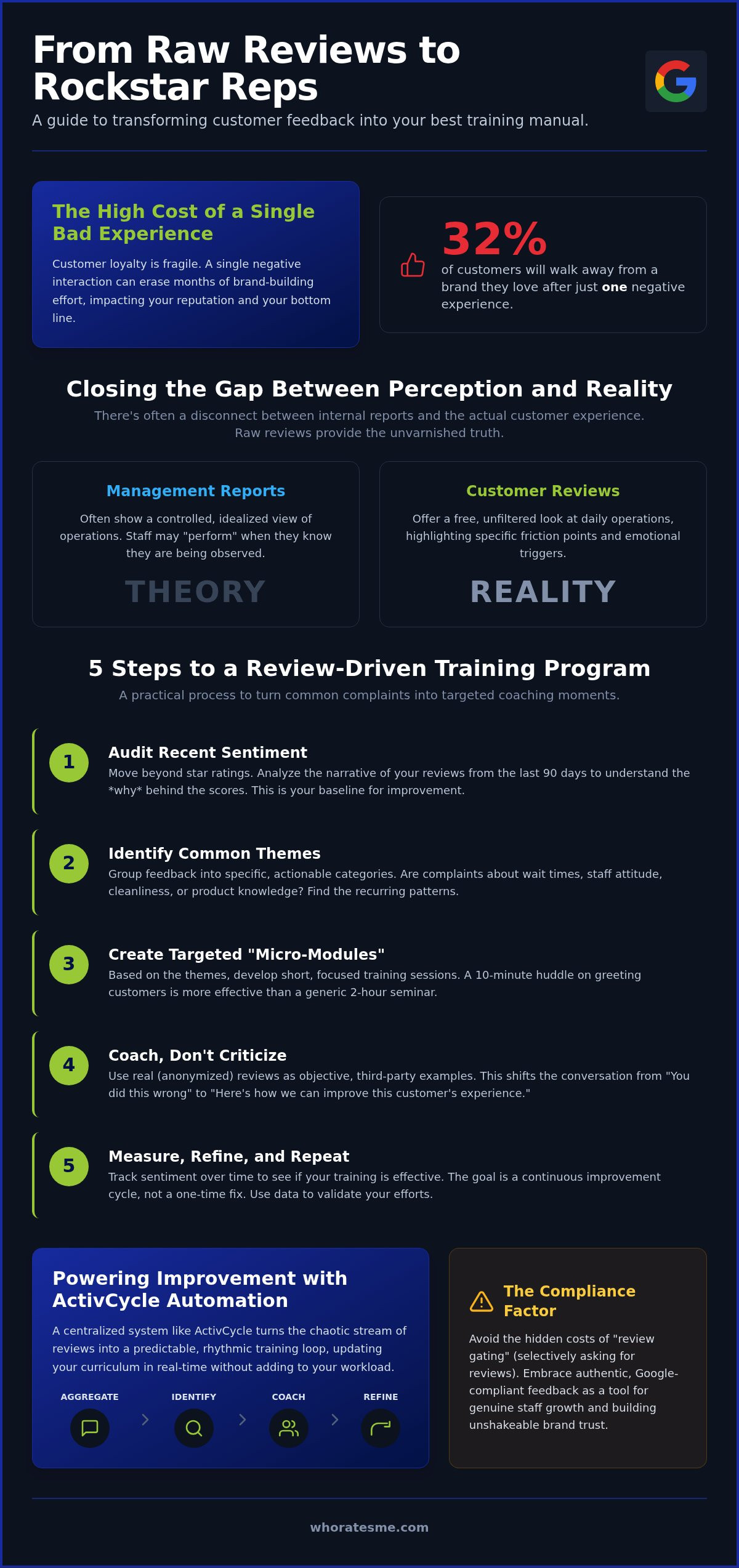
Did you know that 32% of customers will walk away from a brand they love after just one negative experience? It's a sobering reality for any business owner. You likely feel the weight of every 1-star review, especially when there's a disconnect between your management reports and what's actually happening on the front line. It's frustrating to see inconsistent service quality across different shifts without a clear way to fix it. You want to support your team, but you need a reliable way to understand how to track customer feedback by employee to turn those raw reviews into something constructive.
We understand the pressure of protecting your reputation while managing a busy team. This guide will show you how to transform customer comments into an automated training engine that builds unshakeable brand trust. We'll explore how tools like ActivCycle automation and the Elevate Google-compliant plan create a transparent feedback loop for your staff. You'll learn a repeatable system for development that replaces defensiveness with a culture of natural growth. From immediate coaching moments to long-term performance trends; we're providing a clear path to better service and higher Google ratings.
Key Takeaways
- Shift from counting stars to reading narratives to close the gap between your brand promise and the daily customer experience.
- Implement a centralized system for how to track customer feedback by employee that brings together data from every major platform into one clear dashboard.
- Avoid the hidden costs of review gating by embracing authentic, Google-compliant feedback as a tool for genuine staff growth.
- Follow a practical five-step process to audit your recent sentiment and turn common complaints into targeted coaching moments.
- Use ActivCycle automation to create a rhythmic training loop that updates your curriculum in real-time without adding to your daily workload.
Why Raw Review Feedback is Your Best Training Manual
Most managers feel a slight tightening in their chest when a new review notification pings on their phone. It is a natural reaction. We often view reviews as a final verdict on our hard work; a public scorecard that feels permanent. But there is a more supportive way to look at this data. Instead of a judgment, think of every customer comment as a free, high-impact training manual written by the people who matter most. When you understand how to track customer feedback by employee, you stop guessing about performance and start coaching with clarity.
There is often a quiet disconnect between the brand promise hanging on your office wall and the reality experienced at the front counter. Internal audits are helpful, but they have limitations. Staff might "perform" when they know they are being watched, creating a skewed version of daily operations. Reviews offer an unvarnished look at the truth. This serves as a modern, real-world 360-degree feedback process where the customer becomes the most honest evaluator in your business. This objective validation helps your team move away from feeling defensive. When the feedback comes from a third party, it feels less like a personal attack from management and more like a shared opportunity for growth.
Moving Beyond Star Ratings to Sentiment Analysis
A 5-star review that simply says "Great job" is wonderful for your ego, but it is actually quite thin on instruction. Paradoxically, a 3-star review is often your most valuable training tool. These middle-ground reviews usually highlight the "almost perfect" friction points; the server who was friendly but forgot the water, or the technician who was skilled but left a mess. These narratives reveal specific emotional triggers. You can use these stories to teach empathy by showing staff exactly how a small oversight makes a customer feel. Review-Driven Training is a continuous improvement cycle that uses authentic customer experiences to refine staff behavior and operational standards.
The ROI of Feedback-Led Coaching
Employee turnover often stems from a lack of clear expectations. When staff feel they are being judged unfairly or inconsistently, they lose heart. Providing data-backed feedback through a centralized system creates a sense of fairness. Everyone knows the standard because the customers are defining it in real-time. This clarity reduces the stress of "not knowing" how they are doing. Beyond retention, this approach directly impacts your bottom line. By linking review trends to specific training modules, you ensure your team is correcting the exact behaviors that drive away business. Better service leads to higher customer lifetime value, proving that a culture of transparency is also a culture of profit.
How to Track Customer Feedback by Employee with a Continuous Loop
Managing reviews across different sites often feels like chasing shadows. You check Google in the morning, Yelp at lunch, and Facebook before you head home. It is exhausting. This fragmented approach makes it nearly impossible to see the bigger picture of individual performance. To truly understand how to track customer feedback by employee, you need a rhythmic system that brings everything into one view. We call this the ActivCycle approach. It turns the chaotic stream of reviews into a predictable, manageable part of your work week.
Phase 1: Aggregating Multi-Platform Insights
Information silos are the enemy of consistent service. If a staff member is praised on Google but criticized on Yelp, you might miss the nuance if you aren't looking at both. Using multi platform review management allows you to see the full narrative in real-time. This isn't just about saving time; it's about accuracy. You can quickly identify if a service dip is a brand-wide issue or isolated to a specific location or shift. By centralizing this data, you gain a clear, unfiltered view of your team's impact.
Speed matters in coaching. When a "Red Flag" alert hits your phone via a mobile app, it's a signal to act, not an alarm to panic. These alerts allow you to address issues while the memory of the interaction is still fresh for the employee. It's much more effective to coach a team member an hour after a shift than it is to bring up a vague complaint from three weeks ago. This immediate connection between action and feedback is what builds trust and competency.
Phase 2: Distilling Signal from Noise
Not every review requires a change in strategy. Some customers are simply having a bad day, and their feedback might be an unreasonable outlier. You need to filter through the noise to find actionable patterns. We recommend categorizing feedback into three buckets: Product, Process, and People. If you notice a recurring "People" trend, it's time for a coaching conversation. However, be cautious when linking pay to customer feedback; the goal should be growth and support rather than strictly punitive measures.
Finally, don't forget to celebrate the wins. A "Review of the Week" spotlight in your team meeting can transform the atmosphere. It shows that you aren't just looking for mistakes; you're looking for excellence. This positive reinforcement makes the entire process feel like a shared victory. If you're ready to put your feedback on autopilot, consider exploring how ActivCycle automation can simplify your daily management routine.
The Compliance Factor: Why Non-Gated Reviews Create Better Teams
It is tempting to hide the rough edges. Every business owner wants their brand to shine, and seeing a critical review can feel like a personal setback. However, cherry-picking your best reviews creates a dangerous false sense of security. When you filter out the "bad" stuff, you aren't just protecting your public image; you are blinding your team to the truth. High-integrity google compliant review management ensures that your training data remains honest. This transparency is your greatest competitive advantage. When customer feedback is harnessed correctly, it empowers every department to own their performance and grow together.
Compliance is more than just a legal checkbox. It is a commitment to the success of your staff. Mastering how to track customer feedback by employee allows you to turn every authentic review into a teaching moment. By embracing the full spectrum of customer experiences, you provide your team with a clear, unfiltered view of their impact. This builds a culture where truth is valued over perfection; a place where staff feel supported in their development rather than judged by a curated metric.
The Danger of Gated Training Data
Selective filtering leads to what we call the Feedback Vacuum. If your staff only hear positive reinforcement, they lose the ability to spot systemic failures before they become crises. You cannot learn how to track customer feedback by employee effectively with a distorted lens. By 2026, FTC guidelines on review transparency have become even more stringent, requiring businesses to be fully transparent about how they collect and display reviews. Staying on the right side of these rules isn't just about avoiding penalties. It is about protecting the integrity of your training program so your team can see where they truly stand.
Building Trust Through Authentic Feedback
Teams thrive when they know they can be real with one another. You don't need a perfect team; you need a resilient one. Using non-gated review platforms provides the unvarnished training material necessary for genuine growth. It teaches staff how to handle the good, the bad, and the ugly with equal grace. This authenticity builds a company culture rooted in honesty and mutual respect. When management and staff both look at the same raw data, the "us versus them" mentality disappears. You become allies in the pursuit of excellence, working toward a shared vision of service that customers truly feel.
5 Steps to Implementing a Review-Driven Training Program
Finding the time to develop a comprehensive training program often feels like a luxury you can't afford. You are busy managing inventory, scheduling shifts, and keeping customers happy. But your customers are already providing the curriculum you need. By following a structured path, you can turn these public comments into a private engine for growth. When learning how to track customer feedback by employee, the first step is looking back to move forward. This process isn't about finding fault; it's about finding the path to a more consistent service experience for everyone.
Step 1 & 2: Audit and Mapping
Start by conducting a Sentiment Audit of your last 90 days of reviews. This gives you a statistically significant sample size to identify real patterns rather than one-off complaints. Look for the top three pain points that reappear in customer comments. Once these are identified, create a skills-gap matrix to determine which team members need specific support. For example, you might map a review complaining about a forty-minute wait for a simple task to a specific process efficiency goal for your front-of-house staff. This transition from a vague complaint to a concrete training objective makes the improvement feel achievable for the employee.
Mapping feedback allows you to be a mentor rather than a critic. It provides an objective baseline for performance reviews. Instead of saying "you need to be faster," you can say "our customers have mentioned wait times four times this month, so let's work on this specific workflow." This data-backed approach removes the emotion and focuses on the solution.
Step 3 & 4: Roundtables and Role-Play
Host Review Roundtables where staff discuss real feedback in a safe space. Establish ground rules early: this is about the process, not the person. Feedback should feel like a tool, not a weapon. During these sessions, work together to draft professional responses that turn frustrated customers into advocates. This collaborative approach ensures that everyone understands the brand voice and feels empowered to solve problems. Practicing the Pivot is essential; this involves role-playing how to turn a critique about a mistake into a moment of service excellence. It's about training your team to stay calm and helpful even when a situation feels tense.
Finally, monitor future reviews for what we call the Correction Effect. This is the period where you validate your success by watching previous complaints disappear and transform into praise. When you see a specific staff member who used to struggle with communication suddenly being mentioned by name for their helpfulness, you have proof that your system works. If you are ready to simplify this process, you can automate your reputation management to identify these coaching moments the moment they happen.
Scaling Service Quality with ActivCycle Automation
Scaling a business often feels like a trade-off between growth and quality. As you add more locations or team members, the personal touch that built your reputation can start to slip. This is where customer feedback automation becomes your most reliable ally. It removes the manual burden of digging through reviews, allowing you to focus on the human side of your business. When you implement a system for how to track customer feedback by employee that runs on autopilot, you ensure that no coaching opportunity is ever lost in the shuffle. It keeps your training curriculum updated in real-time based on actual customer experiences rather than outdated manuals.
The "Set and Forget" training loop is the ultimate goal for a busy manager. Once the ActivCycle is established, the system identifies trends and alerts you to the specific areas where your team needs support. You no longer have to spend hours compiling spreadsheets to see who is performing well and who needs a helping hand. Automated reporting provides a clear, visual history of team improvement over time. This transition allows you to move away from reactive management. Instead of just fixing mistakes after they happen, you begin to use these insights for proactive service design, creating a workplace where excellence is the default setting.
The Power of Real-Time Insights
Manual training methods often lag weeks behind the actual customer experience. By the time you sit down for a performance review, the details of the interaction are fuzzy. Using the WhoRatesMe mobile app changes this dynamic by enabling immediate Micro-Coaching sessions. When a review comes in, the manager can address it right then and there. This reduces the time between a customer issue and a training correction, making the lesson far more impactful. Automation allows you to stop acting as a data entry clerk and start acting as a mentor who is fully present for their team. It gives you back the time to build real connections with your staff.
Long-Term Reputation Growth
Training isn't a one-time event; it's a compounding investment in your brand's future. A team that is consistently feedback-aware naturally begins to anticipate customer needs before they are even voiced. You'll start to see a shift in your business's atmosphere. You move from a state of being overwhelmed by 1-star reviews to being in total control of your brand's narrative. This steady improvement isn't just about better ratings. It's about a well-trained, confident team that feels valued and supported. Ready to transform your team? Explore the Elevate Plan for Ethical Growth and discover how a transparent, automated loop can build unshakeable trust with your customers and your staff.
Building a Culture of Authentic Growth
Running a business is a high-stakes journey; it's easy to feel defensive when a 1-star review appears. But these moments are actually your most valuable training assets. By mastering how to track customer feedback by employee, you move away from the stress of inconsistent service and toward a culture of quiet confidence. You stop guessing and start growing based on the real experiences of your customers. This transformation relies on honesty; choosing non-gated, authentic feedback over filtered praise builds a team that is resilient and trustworthy.
You don't have to manage this process alone. With a centralized multi-platform dashboard and Google-compliant ActivCycle automation, you can put your staff development on autopilot. This allows you to focus on being the mentor your team needs while the system handles the data. It's about being real, not perfect. When you prioritize transparency and ethical, non-gated feedback loops, you protect your reputation and your people simultaneously. Elevate your team performance with Google-compliant review management and start building a future where every customer interaction is a step toward excellence. You've got this.
Frequently Asked Questions
How do you use customer feedback to train customer service teams?
You use feedback by mapping specific customer narratives to core service competencies. Instead of using generic modules, you present your team with actual reviews to deconstruct what went well or where the friction occurred. This turns a public critique into a private coaching moment. It allows staff to see the direct emotional impact of their actions on a real person, which is far more effective than reading a textbook.
Is it ethical to use negative reviews to discipline employees?
It is ethical when used as a neutral starting point for a supportive coaching conversation rather than a punitive strike. You should focus on identifying patterns of behavior rather than reacting to a single outlier. By understanding how to track customer feedback by employee over time, you can distinguish between a one-off bad day and a genuine skills gap that needs your attention and mentorship.
How often should we update our training materials with new review data?
You should update your materials continuously to stay relevant to changing customer expectations. In 2026, the pace of service is faster than ever. Using automated tools like ActivCycle ensures your team receives insights while the memory is fresh. This rhythmic approach prevents your training from becoming stale. It keeps your staff aligned with the real-time reality of your business operations.
What are the most common service skills identified through online reviews?
Online reviews most frequently highlight active listening, speed of resolution, and genuine empathy. Customers often mention whether they felt heard or if the staff member seemed rushed. By analyzing these comments, you can identify if your team needs to work on their soft skills or if your internal processes are causing delays. These narratives provide a clear roadmap for targeted professional development.
How can we encourage staff to embrace review feedback instead of fearing it?
You encourage staff by creating a safe space where reviews are treated as a tool for growth. Start your meetings by celebrating the 5-star wins and highlighting specific staff members mentioned by name. When the team sees that you value truth over perfection, the fear of a 1-star review begins to fade. It becomes a shared challenge to solve rather than a personal failure to hide.
Can automated feedback loops replace traditional customer service training?
Automated loops are a powerful supplement but they cannot fully replace the human element of mentorship. Automation provides the data and the timing for the lesson, but you provide the context and the encouragement. While tools like the Elevate plan streamline how to track customer feedback by employee, the most significant breakthroughs happen during the one-on-one coaching moments that the data makes possible.
What is the difference between review gating and ethical feedback collection for training?
Review gating is the practice of cherry-picking positive reviews while suppressing negative ones, which violates FTC transparency rules. Ethical collection involves gathering all authentic feedback to create a complete picture. For training purposes, gating is self-defeating because it hides the very mistakes your team needs to learn from. Authentic, non-gated loops provide the honest data required for unshakeable brand trust and real staff improvement.
How do we handle fake or malicious reviews in a training context?
You handle malicious reviews by identifying them early and removing them from performance metrics. These outliers don't reflect your team's actual service quality and shouldn't be used for coaching. However, you can use them as role-play scenarios for maintaining professionalism under extreme pressure. This helps your staff build resilience and stay calm when faced with difficult, unreasonable situations in the future.
