
Identifying Business Improvements from Review Data: A Practical Guide
What if the most useful improvement for your business is already hiding in customer reviews? Feedback is often scattered across platforms, and one frustrating experience can be hard to distinguish from a recurring problem. Identifying business improvements from review data means looking beyond individual comments to find patterns your team can investigate and act on.
You don’t need to respond to every comment with a major change. You need a clear way to see what customers consistently value, where their experience falls short, and which issues deserve attention first.
This practical guide shows you how to organize review feedback, group recurring themes, and weigh potential improvements by frequency, customer impact, and effort. You’ll also learn how to turn those insights into specific changes to service, communication, and everyday operations, then track what happens. The goal is a steady, evidence-led process, not guesswork.
Key Takeaways
- Keep review details in context by recording when and where feedback was shared, what service it relates to, and which business process it describes.
- Group comments into recurring themes, then compare feedback across platforms before treating a pattern as a reliable signal.
- When identifying business improvements from review data, weigh each theme by how often it appears, its impact on customers, and the effort needed to address it.
- Turn priority themes into specific changes with a clear owner, a baseline measure, and a date to review progress.
- Use authentic feedback from all customers to monitor changing experiences and guide genuine service improvements.
What Review Data Can Reveal About Business Improvements
A customer review is more than a public opinion. It’s an account of an experience, what the customer expected, and the outcome they believe they received. Read across reviews, these accounts can point to friction in service delivery, communication, reliability, or expectations set before work begins. A review might praise the quality of a repair while noting that the arrival window was unclear. That points to a different improvement opportunity than criticism of the repair itself.
Reviews can also reveal what your business is doing well. Repeated appreciation for clear explanations or careful follow-up identifies a strength to protect while you refine other parts of the customer experience. The broader practice of Business Process Improvement offers a useful frame: use evidence to examine how work happens and where a process could better serve people.
Star ratings provide a quick signal, but not the explanation. A low score alone won’t tell you whether a customer was unhappy with booking, the service itself, a delay, or a mismatch between expectations and the outcome. The written comment and its context help distinguish between these possibilities. Likewise, a high rating can include a specific suggestion that highlights a small, fixable point of friction.
Review-data analysis is a structured way to identify recurring customer experience patterns and use them to ask better questions about how your business works. The aim isn’t to treat every comment as a verdict. It’s to identify useful signals and investigate them carefully.
Which parts of a review contain improvement signals?
Read each review as a set of related details, not just a score. Separate the rating from the written comment, note the service or situation being described, and consider any business response. Then identify the part of the customer journey mentioned: booking, arrival, delivery, communication during the work, or follow-up afterward.
Specific descriptions are easier to act on than broad praise or criticism. “The technician explained the options before starting” identifies a behavior worth maintaining. “Poor service” signals dissatisfaction but leaves the cause unclear. Keep the original wording and context so a short summary doesn’t erase what the customer actually experienced.
What reviews can and cannot tell you
Reviews can suggest where to investigate, but they can’t prove what caused a problem. Reviewers choose whether to share feedback, so the people who post may not represent every customer. A recurring comment about missed arrival windows, for instance, is a reason to examine scheduling, not proof that scheduling is the only issue.
Test a review-based question against operational records, such as appointment notes or delivery logs, and direct customer conversations. If these sources point in the same direction, you have stronger grounds to explore a process change. If they don’t, investigate further before drawing a conclusion. This balanced approach makes identifying business improvements from review data more reliable and fair to both customers and staff.
How to Organize Review Data into Reliable Themes
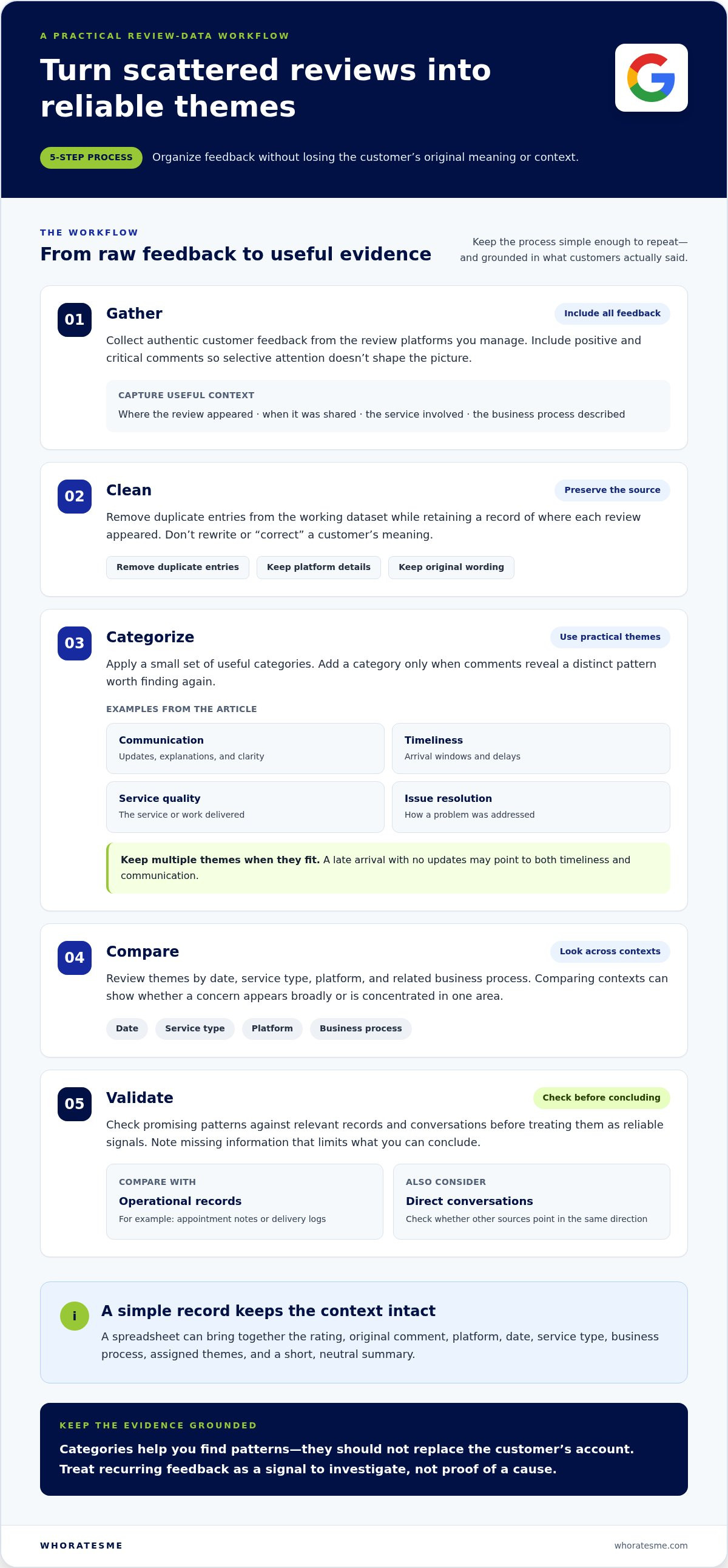
Scattered comments are difficult to compare, especially when customers describe the same experience in different words. A consistent workflow turns review text into organized evidence without stripping away the context that makes it useful. Keep the process simple enough to repeat, and preserve original comments so your summaries stay grounded in what customers said.
Work through these steps in order:
- Gather: Collect authentic customer feedback from the review platforms you manage. Include positive and critical comments so selective attention doesn’t shape the picture.
- Clean: Remove duplicate entries from your working dataset while retaining a record of where each review appeared. Don’t rewrite or “correct” a customer’s meaning.
- Categorize: Apply a small set of practical themes, such as communication, timeliness, service quality, and issue resolution. Add a category only when comments reveal a distinct, useful pattern.
- Compare: Review themes by date, service type, platform, and related business process. This can show whether a concern appears across contexts or is concentrated in one area.
- Validate: Check promising patterns against relevant records and conversations before treating them as reliable signals. Note any missing information that limits what you can conclude.
For each review, retain the platform, date, service type, and business process involved, such as booking or follow-up. A simple spreadsheet can hold those details alongside the rating, original comment, assigned themes, and a short, neutral summary. This structure makes identifying business improvements from review data easier to revisit and compare over time.
Build useful categories without flattening customer meaning
Let the customer journey shape your categories. A comment about a late arrival and a lack of updates may fit both timeliness and communication, because each detail points to a different part of the experience. Keep both themes when appropriate, and retain a representative phrase from the review. A category should help you find comments, not replace the customer’s account with a broad label.
Check whether a theme is genuinely recurring
Compare comments across time periods, services, and platforms where that information is available. Several reviews may describe the same disruption, so check dates and details before counting them as separate evidence of a recurring process issue. Record gaps as well: perhaps only one service type is represented, or a platform has few comments. Repeated, specific comments deserve more attention than isolated anecdotes because they offer a stronger lead to investigate.
A centralized view can make feedback across review platforms easier to scan and revisit. WhoRatesMe’s dashboard and mobile app support multi-platform review management, keeping customer input accessible as you continue your analysis.
How to Prioritize Business Improvements from Review Insights
A recurring complaint can matter without being the first change your team should make. Prioritization helps you choose a response that accounts for customer experience, operational realities, and the effort involved. For each theme, consider four factors: how often it appears, how much it affects customers, how much control your business has over the process, and what it would take to address it.
Review volume is useful context, not a complete measure of impact. Customers who post reviews may not represent all customers, and several comments may stem from one unusual event. A frequently mentioned issue also doesn’t automatically prove a financial impact. Use review evidence to decide what to investigate and improve, not to claim more than the data supports.
Which review themes should a business address first?
Give early attention to themes that repeatedly disrupt essential steps in the customer journey. Concerns involving safety, accuracy, access, or service reliability may call for faster escalation, even when they appear less often. Compare each concern with what the business can change. A confusing confirmation message may call for a straightforward process correction, while an issue requiring new systems or resources may need further validation and planning.
Keep a short record for every proposed priority: the theme, representative review details, where and when the comments appeared, and why the issue may be urgent. Note what’s known, what’s assumed, and what evidence is still missing. This makes decisions easier to explain and revisit, particularly when a small number of serious comments deserves attention despite a lower recurrence.
How to compare customer impact with effort
Place each theme on a simple two-axis matrix. Estimate customer impact and implementation effort qualitatively, using consistent descriptions rather than unsupported numerical scores. Then assign one of four next steps:
- Act now: High customer impact, manageable effort. Make a clear correction to an existing process and monitor it.
- Test next: Meaningful potential impact, with uncertainty about the best fix. Try a limited process change and learn from the result.
- Investigate further: Potentially high impact, but difficult or resource-intensive to address. Check operational records and gather more evidence before committing.
- Monitor: Lower apparent impact or limited evidence. Keep the theme visible and reassess if new feedback or operational information changes the picture.
Controllability adds an important check to this matrix. A high-impact issue may partly depend on factors outside the team’s direct control, while a lower-impact issue may be straightforward to fix. Record those constraints rather than letting effort alone determine importance.
This framework makes identifying business improvements from review data a transparent decision process, not a contest to fix whichever issue has the most comments. For example, repeated reports of inaccurate appointment information may justify reviewing confirmation steps. A proposed change requiring substantial operational investment may belong in “investigate further” until its cause and likely customer benefit are better understood. Revisit priorities as evidence develops, and update the reasons behind each decision.
How to Turn Review Patterns into Measurable Changes
A review theme becomes useful when it leads to a clear action your team can carry out and assess. For each priority, describe the customer problem, the process you’ll change, who owns that change, and when you’ll review the results. Keep the first adjustment focused. Changing several parts of the experience at once makes it harder to tell which change helped or what needs refining.
Start with a baseline before the new process begins. Choose an operational measure that relates directly to the issue, such as time taken to respond to customer questions, the frequency of rescheduled visits, or the number of repeat contacts about the same matter. Record how you measure it and the period it covers. This gives the team a fair point of comparison later.
Write an improvement action the team can own
Make the action specific enough that employees can apply it consistently. For example, if customers say they have to repeat information during handoffs, an initial change might be to add a short handoff summary to the existing process. Name the person responsible for putting the change in place, tell affected employees what to do differently, and state the intended customer experience: a smoother transition without having to explain the issue again.
A practical action record can include:
- Customer signal: The recurring experience described in feedback, summarized without overstating what reviews prove.
- Process change: The single adjustment the team will test first.
- Owner: The person accountable for communicating and carrying out the change.
- Baseline and measure: The current operational measure and how it will be tracked after the change.
- Review date: A realistic check-in after the updated process has been used enough to assess.
Share the updated steps with the employees whose work is affected. A process change that stays in a manager’s notes won’t create a consistent customer experience.
Measure progress without chasing perfect reviews
Review the chosen operational measure alongside new customer feedback. If the change aims to reduce repeat explanations, for instance, compare relevant repeat-contact records with comments that mention handoffs. Look for alignment, but don’t assume reviews alone prove the change caused a difference. Workload, service mix, and other process changes may also influence customers’ experiences.
Set a review rhythm that fits the business cycle and gives the updated process time to be used. If comments improve but the operational measure doesn’t, or the measure improves while feedback remains mixed, investigate the gap. The next step may be clearer staff guidance, a different adjustment, or more evidence. Don’t filter who can share feedback to make the results appear better. Authentic criticism is part of the signal.
A closed-loop improvement process turns customer signals into a focused change, assigns responsibility, then checks operational evidence and fresh feedback to decide what to do next. Identifying business improvements from review data is most useful when progress means a better customer experience, not simply a higher rating.
WhoRatesMe brings feedback from multiple review platforms into a centralized view, helping teams organize customer input as they assess changes. Explore centralized review management to support a more consistent review-to-improvement process.
How Ethical Review Management Supports Ongoing Improvement
Improvement depends on hearing what customers genuinely experienced, including criticism. If feedback is collected selectively, the comments your team analyzes may reflect who was invited to respond rather than the full range of customer experiences. That can hide recurring friction and lead to decisions based on an incomplete picture. Give customers a neutral opportunity to share honest feedback, without filtering requests according to whether their experience seemed positive.
Why ethical feedback collection matters to improvement
Think of review collection as part of listening, not a way to curate a preferred reputation. Use a consistent, neutral approach so customers can share positive, mixed, or critical experiences. Then treat all feedback as evidence to assess, not as a verdict that dictates a particular change. This keeps improvement grounded in real customer experiences. For more context on open feedback practices, explore this guide to non-gated review platforms.
Consistency matters, too. If feedback is requested only in certain situations, or only from customers expected to respond favorably, the resulting themes may not reflect the everyday experience. Keep the invitation process even-handed, and let customers decide what they want to say. Ethical collection doesn’t mean treating every comment as equally conclusive. It means preserving the integrity of the input you use to identify patterns and decide what to investigate.
Keep feedback visible across platforms and teams
When reviews sit across separate platforms, teams can miss a concern that appears in several places or overlook a strength worth protecting. A centralized dashboard provides one view of feedback across multiple review platforms, making it easier to compare themes and keep relevant teams informed. A dedicated mobile app supports access to centralized review management, while ActivCycle automates feedback workflows. These tools help organize customer input; the business still needs to interpret comments carefully and choose appropriate operational changes.
WhoRatesMe offers the Elevate Google-compliant plan and ActivCycle automation, alongside centralized multi-platform review management. Organized, authentic feedback can support a continuous cycle: listen openly, look for patterns, make a considered improvement, and return to customer and operational evidence to see what needs attention next. For a broader view of coordinating feedback across platforms, read about multi-platform review management.
Identifying business improvements from review data works best when feedback remains authentic and visible over time. Explore WhoRatesMe to bring your review workflows into a more organized, ethical process.
Make Customer Listening Part of How Your Business Grows
Make customer listening part of how your team learns, not a project that ends once a process changes. Set aside time to ask what customers are experiencing now, what your team has learned, and what deserves a closer look. That steady habit keeps everyday decisions connected to the people your business serves.
Identifying business improvements from review data isn’t about getting every decision right the first time. It’s about staying curious, making thoughtful adjustments, and learning from feedback that challenges your assumptions. Keep the focus on genuine experiences and progress your team can observe.
Make ethical review management a more organized part of that work with WhoRatesMe’s ethical review management. Start by listening to customer feedback, then use what you learn to guide your next improvement.
Frequently Asked Questions
How many reviews do you need before identifying a business improvement?
There’s no fixed number. One detailed review can flag a concern worth checking, but it usually isn’t enough to establish a pattern. Treat early comments as prompts to investigate, especially if they describe a serious customer impact. Compare them with service records or ask customers about the relevant experience. A larger set of consistent, independent comments can strengthen the case for a change, but context matters more than reaching a particular count.
Can negative reviews help identify operational problems?
Yes. Critical reviews can point to practical problems, such as confusing instructions, missed handoffs, or a product or service not matching what the customer expected. Look for the event behind the frustration rather than reacting only to the tone or rating. A complaint about unclear next steps, for example, may prompt a review of the information customers receive after booking. Verify the suspected issue before deciding how to fix it.
How do you distinguish a one-off complaint from a recurring issue?
Check whether separate reviews describe the same underlying difficulty, not just use similar words. Compare dates, services, and circumstances. Several comments about one unusual disruption may point to one incident rather than a continuing issue. Then look for another source of evidence, such as staff notes or customer conversations. If the pattern remains unclear, keep it on a watch list and continue observing rather than labeling it a business-wide problem.
Should a business make changes based only on online reviews?
Usually, reviews are best treated as a starting point, not the sole basis for a major decision. A comment may leave out relevant circumstances or reflect an unusual interaction. Before changing a policy or investing in a new process, check records, discuss the issue with employees involved, and seek direct customer input where appropriate. For a small, reversible adjustment, a limited test may help you learn while keeping the decision proportionate.
What if customer reviews point to conflicting improvements?
Conflicting feedback may come from different services, customer needs, or stages of the experience. Separate comments by context before deciding that customers disagree about the same issue. For example, some customers may value detailed updates while others prefer fewer messages. Consider offering clear communication options or testing a change with a defined customer group. Avoid automatically choosing the loudest opinion. Look at the evidence and the needs each comment represents.
How can a small business analyze reviews without a dedicated analyst?
Use a simple spreadsheet and a regular review routine. Capture each comment’s date, platform, service type, and main concern, then group related entries using a short set of labels. A filter or search function can help reveal repeated topics without specialized software. Set aside time to review the entries with someone familiar with the work. Identifying business improvements from review data can begin with careful reading and consistent notes, not complex analysis.
How can you tell whether a change improved the customer experience?
Compare a measure related to the change before and after it was introduced, then check whether customer comments about the specific experience also shift. If you updated appointment reminders, for instance, review missed-appointment records alongside feedback about scheduling communication. Consider whether other changes happened at the same time, and avoid claiming the adjustment caused every difference. Mixed results can show that the change needs refinement or another part of the process needs attention.
Can review automation identify improvements without human judgment?
No. Automation can help keep feedback workflows organized, and analysis tools may help surface repeated words or topics, but people need to interpret what those patterns mean. Similar phrases can refer to different problems, while a subtle comment may describe an important customer concern. Use automated summaries as leads for closer review, not final decisions. Human judgment helps preserve context, check assumptions, and choose a response that fits the real service process.
