
KPIs for Online Reputation Management: 2026 Ethical Guide
A perfect five-star rating doesn't mean much if the people behind the screen don't actually trust you. It's a heavy burden to carry; especially when you're worried that one bad review could undo years of hard work or that a small compliance mistake might trigger an FTC audit. You deserve to feel confident in your digital presence. Most business owners feel the same pressure to keep up with changing rules while trying to understand which numbers actually impact their bottom line.
Focusing on the right signals creates a sense of order in the chaos. By prioritizing metrics like tracking review response time kpi, you can transform a reactive scramble into a steady, synchronized system. We're going to move past vanity metrics to focus on what truly drives sustainable revenue. This guide provides a clear, ethical framework to help you gather authentic feedback and build a reputation that stands on solid ground.
We'll explore how to measure success through transparency and natural growth. You'll learn how to set realistic targets for your team and use automation to keep your feedback loop healthy. It's time to take total control of your brand's future with a strategy that values truth over perfection.
Key Takeaways
- Move beyond the 5.0 star rating to focus on authenticity; modern consumers look for real experiences rather than artificial perfection.
- Strengthen brand loyalty by tracking review response time kpi, ensuring every customer feels heard and valued in a timely manner.
- Protect your business from shifting regulations by adopting a zero-gating policy that aligns with the latest FTC and Google standards.
- Simplify your workflow with ActivCycle automation to maintain a steady flow of feedback without the daily pressure of manual requests.
- Transform raw data into growth by connecting your reputation metrics directly to bottom-line results like increased conversion rates.
Beyond the Star Rating: Why Your ORM KPIs Need a 2026 Reset
Running a business is deeply personal. You invest your time, energy, and heart into every customer interaction. It's only natural to want that dedication reflected in your online presence. Online reputation management (ORM) KPIs are more than just numbers on a screen; they are the pulse of customer trust. They tell you if your community feels seen and if your brand’s sincerity is reaching the right people. These metrics should act as a calm, stabilizing force, providing order in what can sometimes feel like a chaotic digital environment.
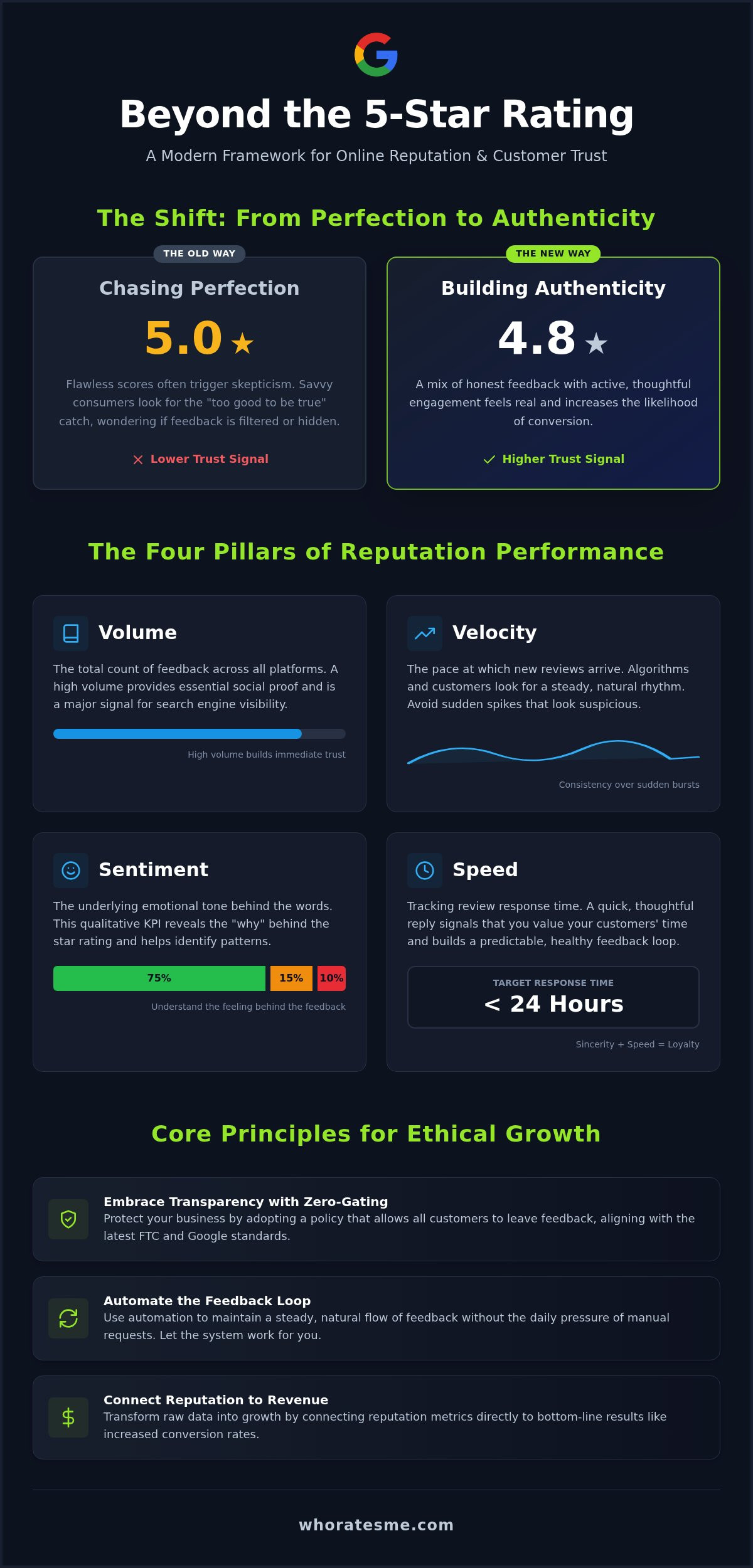
The goal used to be a perfect 5.0 star rating. In 2026, that has changed. Flawless scores now often trigger skepticism. Savvy consumers look for the "too good to be true" catch. They wonder if the feedback is filtered or if the business is hiding something. A 4.8 rating with active engagement often carries more weight than a silent 5.0 score. This shift moves us away from vanity metrics toward metrics that measure genuine human connection. Your KPIs should protect your business, not just promote it.
The Psychology of Trust in 2026
People connect with people, not corporate facades. Modern consumers actively search for authentic flaws. They want to see how you handle a mistake or a misunderstanding. This is known as bridging the Review Trust Gap. When potential clients see a mix of honest feedback, it increases the likelihood of conversion because the business feels real. This shift is a relief for business owners. You don't have to carry the heavy burden of perfection. Transparent KPIs help alleviate the emotional stress of ownership by showing that a single critique is just a moment for growth, not a permanent stain on your legacy.
Star Rating vs. Sentiment: What Matters More?
While the star count is a quick signal, it's the feeling behind the words that truly moves the needle. Sentiment analysis is a qualitative KPI that tracks the underlying mood of your feedback. Reputation Sentiment is the emotional tone behind customer words. Analyzing this allows you to see the "why" behind the stars. It's about protecting your business by identifying patterns before they become problems. Focusing on engagement means you are listening, not just broadcasting. It creates a synchronized relationship between you and your customers.
A vital part of this engagement is tracking review response time kpi. Speed matters, but sincerity matters more. When you respond quickly and thoughtfully, you signal that you value your customers' time. This builds a predictable system for gathering authentic feedback. It transforms your reputation from a source of anxiety into a reliable engine for sustainable growth. Ethical KPIs act as your safety net. They ensure your digital footprint remains clean and compliant for years to come.
The Four Pillars of Reputation Performance: Volume, Velocity, Sentiment, and Speed
Managing a business means juggling a million details at once. It's easy to feel lost in a sea of data points and metrics. By focusing on four core pillars, you can find the order and clarity you need. These pillars—Volume, Velocity, Sentiment, and Speed—act as the foundation for a healthy digital presence. They provide a clear view of how your brand lives in the minds of your customers.
Review Volume is your total count of feedback across all platforms. It serves as a major signal for search engine visibility and provides essential social proof. A high volume suggests you've helped many people over time, which builds immediate trust with new visitors. However, volume alone isn't enough. You also need to consider Review Velocity, which is the pace at which new reviews arrive. Algorithms look for a steady, natural rhythm. If you suddenly receive 50 reviews in a single day after months of silence, it looks suspicious to both customers and regulators. This type of artificial spike is often scrutinized under the FTC Rule on Consumer Reviews regarding deceptive practices.
Mastering Review Velocity Without Looking 'Spammy'
A natural flow of feedback depends heavily on your specific industry. A local cafe might expect daily reviews, while a specialized contractor might only see two or three a month. The goal is consistency. You want to avoid "review bombing," which can trigger platform filters and lead to suspensions. You can use customer feedback automation to ensure requests are sent out steadily after every service. This prevents the "feast or famine" cycle and keeps your growth looking organic and sincere.
Response SLAs: The KPI of Accountability
Setting a Service Level Agreement (SLA) for your team brings a sense of calm to your daily operations. We recommend a 24 to 48-hour response window for all feedback. This isn't about achieving perfection; it's about showing up for your community. Tracking review response time kpi allows you to see how effectively your team is maintaining these human connections. When you prioritize tracking review response time kpi, you ensure that no customer feels ignored or forgotten.
Speed correlates directly to customer retention and loyalty. When people see you care enough to reply quickly, they feel valued and respected. It's also helpful to track the resolution rate for negative feedback to measure your operational success. Turning a frustrated customer into a happy one is a powerful way to demonstrate your brand's integrity. If you're feeling the pressure of monitoring these metrics manually, our Elevate Google-compliant plan can help you stay synchronized without the emotional burden.
Compliance as a Metric: Balancing Growth with Ethical Standards
Compliance shouldn't feel like a legal chore. It's the safety net that ensures your hard work doesn't disappear overnight. In 2026, the most important metric for your peace of mind is "Zero Gating." This means you invite every customer to share their experience, not just the ones you think are happy. It sounds intimidating at first. However, when you open the door to all voices, you build unshakeable trust. It shows you have nothing to hide. This transparency acts as a stabilizing force for your brand's long-term digital footprint.
The cost of cutting corners is simply too high. Non-compliance leads to heavy FTC penalties and the sudden loss of a Google Business Profile. These isn't just a financial setback. It's a blow to your brand's integrity that's hard to recover from. To effectively manage your brand's online reputation, you must treat ethical standards as a core KPI. It's about moving from a fear-based management style to a solution-oriented growth mindset. You're protecting your legacy while you grow.
The Risks of Performance-Based Review Incentives
It's tempting to offer your team a bonus for every 5-star review they bring in. Don't fall into this trap. Paying for specific ratings is a dangerous practice that violates platform terms and consumer protection laws. Instead, focus on metrics that reward genuine effort and human connection. You can reward employees for their "Mention Rate" or their consistency in tracking review response time kpi. This shifts the focus toward providing excellent service rather than chasing a number. It helps you maintain a google compliant review management strategy that builds real community trust.
Audit Trails: The KPI You Hope You Never Need
Transparency is your best defense in a chaotic digital environment. You should measure the inclusivity of your feedback requests by keeping a clear log of every invitation sent. This audit trail is a vital KPI. It proves your review volume is organic and that you aren't selective about who gets to speak. If a platform ever audits your account, you'll have a predictable system to show your work. Keeping these records ensures that your data is unfiltered and honest. It allows you to stay in total control of your narrative, even when the rules change.
By tracking review response time kpi and maintaining these audit trails, you create a synchronized system of accountability. You aren't just reacting to reviews anymore. You're building a brand that stands for something real. This methodical approach to compliance turns a potential stressor into a quiet source of confidence for you and your team.
Building Your Reputation Dashboard: From Data Points to Actionable Insights
Checking Google, then Yelp, then industry sites feels like a never-ending chore. It's exhausting to keep up with every notification. By consolidating these platforms into a single source of truth, you reclaim your time and your sanity. A unified dashboard provides a clear, unfiltered view of your brand's health. It moves you from a place of confusion to a state of total control, allowing you to breathe easier knowing nothing is slipping through the cracks.
These data points are more than just numbers. They connect directly to your bottom line. High sentiment and consistent volume drive your click-through rates (CTR) and overall conversions. When potential customers see an active, honest community, they feel safer choosing you. This is where tracking review response time kpi becomes vital. It shows that your business is alive and listening. This human connection is what transforms a casual browser into a loyal client.
The dashboard also helps you use a rhythmic problem-and-relief structure in your management. You might notice a slight dip in sentiment regarding a specific service. Instead of panicking, you now have the data to identify the trend and apply a fix. Once the change is made, you can watch the metrics stabilize. It's a methodical way to ensure your business remains synchronized with customer needs. Accessing this data through a mobile app ensures these insights are always at your fingertips, keeping you grounded and prepared.
Platform-Specific Benchmarking
Not all platforms are created equal. You need to set specific targets for Google, Yelp, and industry-specific sites based on where your customers hang out most. Calculating your "Market Share of Voice" helps you understand how you stack up against competitors in your local area. It's about finding your place in the community and protecting your reputation there. To get started with a synchronized setup, you can follow our multi platform review management guide for dashboard setup.
Visualizing the Customer Journey
Seeing the path from a review to a lead is incredibly rewarding. It proves that your efforts to build trust are actually working. You can use these feedback trends to inform operational changes or product improvements that matter to your clients. You should use a 30-day rolling average to smooth out data noise and see the true direction of your brand's growth. This long-term view prevents you from overreacting to daily fluctuations. By tracking review response time kpi alongside these trends, you build a predictable system for success. If you're ready to simplify your workflow and see the big picture, our multi-review platform management with a mobile app provides the clarity you've been looking for.
Automating the Feedback Loop: Powering Your KPIs with ActivCycle
The manual hustle of requesting reviews often leads to missed opportunities and inconsistent data. It is a heavy emotional lift to ask every customer for a favor, especially when you are already managing the daily pressures of your business. This inconsistency creates gaps in your performance metrics. ActivCycle automation removes this burden by creating a predictable, synchronized loop. It ensures that every customer receives a sincere invitation to share their experience at exactly the right moment: after the service is complete and the experience is fresh.
This steady flow is essential for maintaining natural Review Velocity. As we explored in earlier sections, search algorithms value a consistent rhythm over sudden, suspicious spikes in activity. When your feedback loop runs on autopilot, you can focus on your craft while your reputation grows quietly and honestly in the background. It transforms your strategy from reactive "reputation defense" to proactive, natural brand growth. You are no longer just protecting your name; you are building a legacy.
Tracking review response time kpi becomes much easier when you aren't overwhelmed by the administrative side of gathering feedback. You finally have the mental space to engage deeply with the words your customers share. Using the Elevate Google-compliant plan acts as your long-term safety net. It ensures that your growth is always aligned with ethical standards, protecting your digital footprint from the risks of non-compliant tactics. It is a solution that offers both order and clarity.
The ActivCycle Advantage
Automated loops ensure that every customer has a voice without requiring constant manual effort from your team. This inclusivity is the cornerstone of modern brand trust. By using real-time mobile notifications, you can significantly reduce the Response Gap. You'll know the moment a new review lands, regardless of the platform. This allows you to prioritize tracking review response time kpi, turning your feedback process into a quiet innovator that strengthens customer loyalty every single day. It's about being present for your community without being tied to your desk.
Next Steps for Your Reputation Strategy
Transitioning to an ethical KPI framework starts with a simple baseline audit. Look at your current metrics honestly and identify where the gaps exist. Once you have a clear, unfiltered view of your starting point, set your first 90-day targets. We recommend focusing on a steady increase in Review Volume and a meaningful improvement in your Response Speed. These small, methodical steps lead to total control over your online presence. You deserve a system that works as hard as you do.
Experience the Elevate Google-compliant plan today and start building a reputation that reflects the true heart of your business.
Your Path to Unshakeable Brand Trust
You've worked hard to build a business that people value. It's time your online presence reflected that same level of care and sincerity. By moving beyond simple star ratings and focusing on pillars like review velocity and sentiment, you create a more honest connection with your community. This shift from chasing perfection to embracing authenticity is a relief. It allows you to focus on what really matters: the people you serve.
Consistency is key in this journey. Prioritizing tracking review response time kpi ensures that your customers always feel heard and respected. When you combine these ethical metrics with a centralized dashboard for multi-platform monitoring, you gain a clear, unfiltered view of your success. It's about having total control without the emotional burnout of manual management. You're no longer just defending your name; you're building a legacy of trust.
You don't have to navigate these changing regulations alone. We've designed a way to help you grow with quiet confidence. You can scale your reputation ethically with our Elevate Google-compliant plan. With ActivCycle automation for effortless feedback loops and 100% Google-compliant growth strategies, your brand's future is in safe hands. You have the tools to turn your reputation into your greatest ally. Let's build something real together.
Frequently Asked Questions
What is the most important KPI for a small business just starting with ORM?
Review Volume is the best place to start because it establishes immediate social proof for your brand. It shows potential customers that you are an active and trusted member of your community. Once you have a solid foundation of feedback, you can shift your focus toward consistency. This methodical approach helps you build trust without feeling overwhelmed by complex data points in the beginning.
How do I measure Review Velocity without triggering spam filters?
You measure Review Velocity by tracking the number of new reviews you receive over a specific period, such as a week or a month. The key is to maintain a steady, natural rhythm that matches your actual customer traffic. Using ActivCycle automation ensures that requests are sent out consistently after every service. This prevents the artificial spikes that often alert platform filters and lead to account suspensions.
Is it ethical to set a KPI for 'Percentage of 5-Star Reviews'?
No, focusing strictly on a percentage of 5-star reviews can lead to unethical practices like selective filtering or review gating. Instead, you should aim for a high level of Sentiment Analysis and authentic engagement across all ratings. Prioritizing a zero-gating policy ensures that your feedback is honest and transparent. This approach naturally leads to better ratings over time without risking your reputation on non-compliant tactics.
How can I track if my online reputation is actually increasing my sales?
You can track this by monitoring your "Review-to-Lead" conversion rate and your click-through rates (CTR) on your Google Business Profile. When potential clients see a healthy, active feedback loop, they feel much safer choosing your services. Connecting these reputation metrics to your bottom-line results provides a clear, unfiltered view of how digital trust translates into predictable, sustainable revenue growth for your business.
What is the difference between sentiment analysis and a star rating KPI?
A star rating is a quantitative metric that provides a quick visual signal, while sentiment analysis is a qualitative measure of the emotional tone behind the words. Star ratings tell you "what" happened, but sentiment analysis explains the "why." Understanding the underlying mood of your feedback allows you to make operational changes that truly resonate with your community, moving beyond surface-level numbers to genuine human connection.
How often should I review my reputation management dashboard?
You should check your dashboard daily for urgent notifications, but perform a deeper analysis of your KPIs on a monthly basis. Reviewing a 30-day rolling average helps you smooth out daily noise and identify long-term trends in your brand's health. This grounded rhythm allows you to stay in total control of your narrative without becoming lost in the technical details of every individual data point.
Can I automate my KPI tracking with a mobile app?
Yes, you can use our multi-platform management mobile app to keep all your success metrics at your fingertips. This allows for real-time monitoring of your digital footprint, making it much easier for tracking review response time kpi while you are on the go. Having this information accessible at all times provides a sense of order and ensures you can respond to feedback the moment it arrives.
What happens if I fail to meet my response time KPI for a negative review?
Missing a target occasionally is a human reality, not a permanent failure for your brand. If you fall behind on tracking review response time kpi, simply acknowledge the delay with sincerity and focus on resolving the customer's concern. The goal is to return to a steady, synchronized rhythm as quickly as possible. Consistency over the long term is far more important for building trust than being flawless every single time.
