
KPIs for Online Reputation Management: 2026 Guide
What if a higher star rating isn’t the clearest sign that your reputation work is paying off? A steady stream of reviews can look encouraging, but numbers alone don’t show whether customers feel heard or whether their feedback is helping you improve. That’s why setting kpis for online reputation management starts with a better question: what customer experience or business outcome should each measure help you understand?
If you’re unsure which metrics matter, you’re not alone. Review volume, response times, sentiment, and ratings can all offer useful signals. But tracking everything without a baseline, an owner, or a regular reporting rhythm can create more noise than clarity. The goal isn’t to chase perfect scores. It’s to build a small, honest system that connects authentic feedback with thoughtful follow-through.
This guide will help you choose practical reputation KPIs, set realistic targets from a consistent baseline, and establish a reporting routine your team can maintain. You’ll also learn how to use review activity to spot customer experience patterns while keeping feedback practices transparent and compliant.
Key Takeaways
- Choose KPIs that connect reputation goals to customer experience, rather than relying on star ratings alone.
- For setting kpis for online reputation management, start with a baseline, then choose a realistic target, owner, and reporting cadence.
- Learn how review volume and recency, average rating, response rate, and response time can reveal different parts of your reputation picture.
- Build a monthly review routine that compares channels while preserving the differences between platforms.
- See how WhoRatesMe’s Elevate plan and ActivCycle automation can support organized, authentic feedback workflows.
What Should Online Reputation Management KPIs Actually Measure?
Review counts and star ratings are easy to spot, but they rarely explain what needs attention. A rating can stay steady while recent feedback points to a service issue. Review activity can also rise without showing whether customers feel heard. Useful measurement starts with the goal behind the number.
An online reputation management KPI is a measurable indicator tied to a specific reputation goal. A general metric tells you what happened; a KPI helps you judge progress toward an outcome that matters.
“A metric records an activity or result; a KPI shows whether it advances a defined reputation goal.”
This distinction gives teams a clearer way to organize their measures:
- Activity metrics: reviews received or responses published.
- Customer-perception metrics: ratings, sentiment, or recurring themes in feedback.
- Operational outcomes: concerns routed to the right team or service issues addressed.
- Compliance guardrails: checks that feedback requests and responses follow applicable platform policies and stay authentic.
These categories place online reputation management within the broader practice of monitoring and shaping how a business is perceived. For foundational context, see Online Reputation Management on Wikipedia. The practical task is to choose measures that inform decisions, not simply fill a report.
Which business goals can reputation KPIs support?
Start with a goal such as building customer trust, gathering useful feedback, improving a service experience, or strengthening visibility where people compare businesses. A home-service company might track whether comments repeatedly mention appointment communication; a repair business might monitor how often customers describe clear explanations. In either case, the measure should help the team notice a pattern and decide what to investigate or improve.
Reputation KPIs support decisions, but they don’t prove that a change in reviews caused a change in bookings or revenue. Other factors may contribute. Treat the data as a signal to examine alongside customer conversations and business results. That makes setting kpis for online reputation management more grounded: each measure has a purpose, and its limits are understood.
Why are star ratings not enough on their own?
An average rating can hide whether reviews are recent, how many contribute to the score, and what themes appear repeatedly. One overall number also won’t show whether responses are helpful or whether a customer concern remains unresolved. A thoughtful reply and a recurring service issue may both matter, even if the rating barely changes.
Use ratings as one signal, not the definition of success. Pair them with review recency, feedback themes, and meaningful follow-through. The aim is authentic feedback that helps improve the customer experience, not a perfect score at any cost.
How to Set Online Reputation Management KPIs in Five Steps
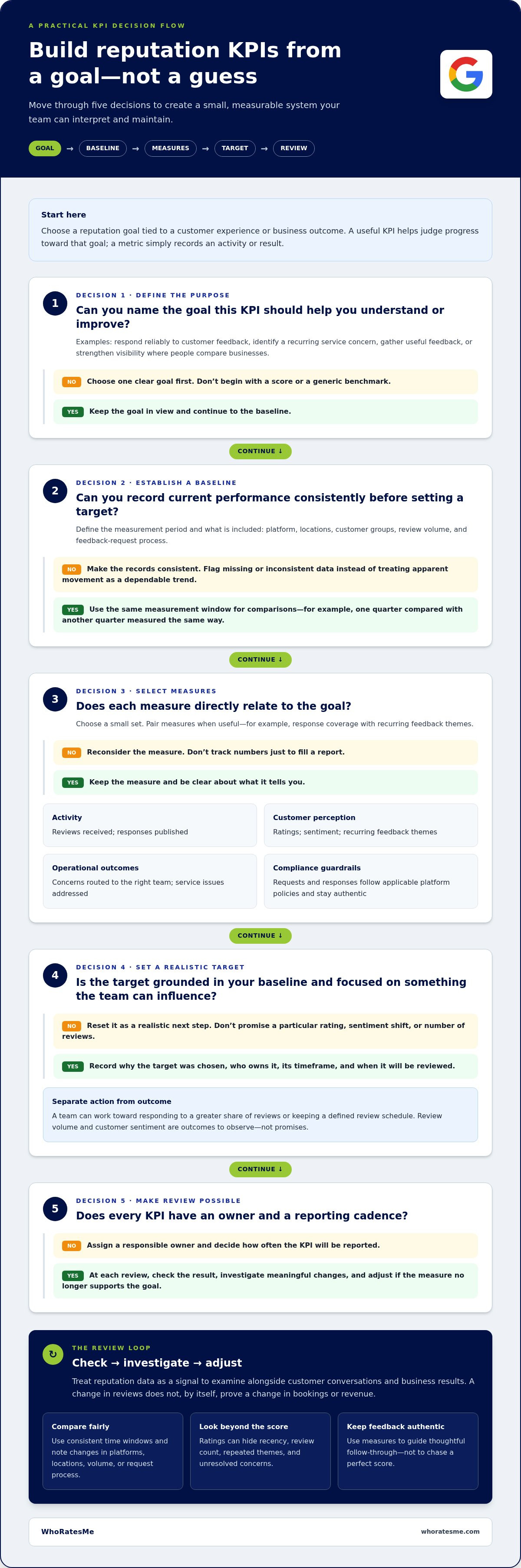
A useful KPI system doesn’t start with a target pulled from a generic benchmark. It starts with your business goal and the information you can measure consistently. Use this five-step process to turn setting kpis for online reputation management into a practical routine:
- Choose a goal. Decide what you want to understand or improve, such as how reliably the team responds to customer feedback or whether the same service concern keeps appearing.
- Establish a baseline. Record current performance before setting an improvement target. Define the measurement period and the channels, locations, or customer groups included.
- Select measures. Choose a small set of indicators that directly relate to the goal. Pair measures where helpful, such as response coverage with recurring feedback themes.
- Set targets. Use the baseline to define a realistic next step. Focus targets on actions your team can influence, and treat review volume or customer sentiment as outcomes to observe rather than promise.
- Review and adjust. Assign an owner and reporting cadence to every KPI. At each review, check the result, investigate meaningful changes, and update the approach if the measure no longer supports the goal.
How do you establish a useful baseline?
Capture the same measures across a clearly defined period before deciding what improvement looks like. Keep comparisons like-for-like: note the platform, number of business locations, review volume, and feedback request process. A change in any of these can affect the numbers. If records are missing or collected inconsistently, flag that limitation instead of treating the apparent movement as a dependable trend.
Use one measurement window throughout the comparison. For example, if you review a quarter, compare it with another quarter measured in the same way, rather than mixing timeframes or platform totals.
How can you make reputation targets realistic?
Set targets around steps the team can control, such as responding to a greater share of reviews or keeping a defined review schedule. Don’t promise a particular rating, sentiment shift, or number of reviews; those depend on real customer experiences and choices. For every target, record the reason, responsible owner, timeframe, and date it will be reviewed. That context makes results easier to interpret and keeps targets grounded in your own baseline, not a universal benchmark.
A centralized view can help organize measurements across review platforms while keeping each platform’s results distinct. WhoRatesMe’s multi-platform review management supports organized tracking through a centralized dashboard and mobile app.
Which Reputation KPIs Matter Most, and What Can Each Tell You?
The right scorecard balances activity, responsiveness, customer feedback, and business context. For setting kpis for online reputation management, define each measure the same way every time, then read it alongside its caveat. A number is useful when it prompts a better question, not when it’s mistaken for the whole story.
| KPI | What it measures | How to calculate it | Caveat |
|---|---|---|---|
| Review volume and recency | New reviews and how recently customers have shared feedback on a specific platform. | Count reviews posted during a fixed reporting window; record the date of the most recent review. | Volume can shift with customer numbers and feedback-request practices. Compare like-for-like periods and platforms. |
| Average rating | The average star score among reviews included in the selected period or dataset. | Add the ratings and divide by the number of ratings included. | An average can conceal changes in review volume, recency, and recurring experiences. |
| Response rate | The share of eligible reviews that received a business response. | Eligible reviews answered ÷ eligible reviews × 100. | Define which reviews count as eligible and use the same rule across reporting periods. |
| Response time | How long the team takes to respond after a review is posted. | Calculate the time between each review and its response, then report the average or median. | Specify whether time means elapsed hours or business hours. The two measures aren’t interchangeable. |
| Feedback themes | Repeated strengths, concerns, or service topics in review comments. | Classify reviews using consistent theme labels, then count mentions by theme. | Theme coding involves judgment. Keep categories clear and review examples, not just totals. |
| CSAT or NPS | Customer satisfaction or willingness to recommend, when collected through a consistent process. | Use the chosen survey’s standard scoring method and compare equivalent groups and periods. | Survey respondents may not represent all customers. Don’t mix methods or audiences without noting it. |
| Conversion or retention trend | Changes in inquiries, bookings, or repeat business alongside reputation measures. | Compare the selected business outcome with the same timeframe and customer segment. | Seasonality, promotions, service changes, and other factors may influence results. Correlation doesn’t establish that reviews caused a change. |
Which review metrics show activity and responsiveness?
Review volume and recency show whether feedback is arriving and how current it is, but only within a defined platform and reporting window. Response rate reflects coverage, while response time shows how long customers wait for a reply. Choose elapsed time or business hours, document the choice, and apply it consistently.
How do sentiment and business outcomes fit into the scorecard?
Track recurring themes to identify service strengths and concerns that may deserve attention. Add CSAT or NPS only if the business collects the measures consistently and appropriately. Conversion and retention can provide useful context, but treat them as related trends to investigate, not proof that review activity produced the business result.
How to Turn Reputation KPI Tracking into a Reliable Monthly Routine
A KPI report only helps if someone uses it. Set a review rhythm your team can sustain: monthly reporting may suit a steady flow of feedback, while a higher-volume business may need more frequent check-ins. Match the cadence to review activity and team capacity, then keep the measurement window consistent so each report can be compared fairly.
What belongs in a reputation KPI dashboard?
Give each KPI a clear place in one reporting view. Include its goal, baseline, current result, target, trend, owner, and reporting period. Show platform-level figures alongside any combined totals. A combined number offers a quick overview, but it shouldn’t hide differences in review volume or response patterns between platforms.
Add a short note when a result changes meaningfully. Explain what may have contributed, what data is missing or inconsistent, and whether a platform or process changed during the period. These notes help prevent teams from treating incomplete data or an unusual month as a dependable trend.
How should teams act on KPI findings?
Use recurring feedback themes to identify a customer experience issue the team can address. If customers repeatedly mention unclear appointment updates, for example, assign someone to review the communication process. Record the action, its owner, and a follow-up date. At the next check-in, look for new feedback on the same theme and assess whether the action needs adjustment.
Keep the routine straightforward:
- Review: Check KPI results and note meaningful changes.
- Investigate: Read relevant feedback to understand the pattern behind a number.
- Act: Assign a practical service follow-up with an owner and review date.
- Learn: Record what changed and revisit the result in the next reporting period.
A centralized dashboard and mobile access can help teams keep track of feedback across platforms without losing sight of where each review appeared. Consistent workflows make it easier to monitor authentic customer comments and follow through on what they reveal. That’s the practical value behind setting kpis for online reputation management: turning measurements into careful, accountable action, not pressure to influence what customers say.
Explore WhoRatesMe’s multi-platform review management to organize feedback monitoring and follow-through in one place.
How WhoRatesMe Supports Ethical Reputation KPI Management
A clear KPI framework gives your team direction. The next challenge is carrying it out consistently without letting automation interfere with honest customer feedback. WhoRatesMe supports organized review management for local service businesses, with tools designed to help teams monitor feedback and follow through across platforms.
The Elevate plan supports Google-compliant review acquisition and a structured approach to requesting authentic customer feedback. ActivCycle automates feedback workflows, helping make the process more consistent. Automation can support measurement by making routine steps easier to track, but it shouldn’t be used to steer what customers say or determine who gets asked based on expected sentiment. Genuine customer experiences remain the foundation.
How can automation support consistent measurement?
A repeatable workflow can make review activity easier to monitor over time. When feedback requests and follow-up steps are handled consistently, teams have a clearer process to examine when reviewing activity and customer responses. ActivCycle supports that workflow; it doesn’t guarantee a particular review volume, rating, or sentiment. Those outcomes depend on customers and their experiences.
WhoRatesMe’s centralized dashboard and mobile app support multi-platform review management. A shared view can help teams notice new feedback and keep platform-level results organized, while the mobile app provides another way to monitor reviews. The value is operational clarity, not a promised KPI result.
What ethical guardrails should remain in place?
Keep feedback requests fair and transparent. Don’t filter customers based on predicted satisfaction, offer incentives in exchange for reviews, or ask for a particular rating or message. Avoid buying reviews or promising rating gains. The goal is to hear from real customers, not to engineer a score. Review responses and follow-up should focus on the customer’s actual experience.
Platform and consumer-protection guidance can change. Before making specific policy claims or setting review-request procedures, verify the current guidance from Google and the Federal Trade Commission (FTC), along with any relevant platform requirements. That check helps keep your process informed and your reporting grounded in authentic feedback.
For teams setting kpis for online reputation management, tools are most useful when they support the habits behind the numbers: consistent monitoring, clear ownership, and thoughtful action on customer feedback. WhoRatesMe brings together Elevate, ActivCycle, and multi-platform review management to support that organized approach.
Bring more consistency to your reputation management with WhoRatesMe’s review management tools.
Build a Reputation KPI Practice Your Team Can Sustain
Strong reputation KPIs do more than report ratings. They connect authentic customer feedback to clear goals, consistent measurement, and practical service improvements. Start with a baseline, choose a focused set of measures, and give each one an owner and a regular review rhythm. Then use what customers say to guide follow-up, not to chase a perfect score.
That’s the value of setting kpis for online reputation management with care: your team gets a clearer view of what’s working, where attention is needed, and what to do next. The right tools can help make that process more organized. WhoRatesMe’s Elevate plan supports Google-compliant review acquisition, ActivCycle automates feedback workflows, and centralized multi-platform management with a mobile app supports review monitoring.
Explore WhoRatesMe’s Elevate plan for Google-compliant review management and take a thoughtful next step toward more consistent feedback practices. Progress comes from listening, learning, and following through, one customer experience at a time.
Frequently Asked Questions
What are the most important KPIs for online reputation management?
The most useful KPIs depend on your goal, but a practical starting set includes review volume and recency, average rating, response rate, response time, and recurring feedback themes. These measures show activity, responsiveness, and customer experience signals from different angles. Choose only the indicators your team can track consistently, assign an owner to each, and compare results with a baseline rather than relying on a generic benchmark.
How do you set a KPI for online reviews?
Start with a specific reputation goal, then select a measure that shows progress toward it. For example, if your goal is more consistent review responses, record the current share of eligible reviews answered, define how you’ll calculate it, and set a realistic target based on that baseline. Choose a reporting period, name an owner, and set a review date. Treat review volume and customer sentiment as observed outcomes, not guaranteed results.
Can a business use star rating as its only reputation KPI?
No. An average star rating can hide whether reviews are recent, how many contribute to the score, and what customers repeatedly mention. It also doesn’t show whether the team responds thoughtfully or resolves concerns. Use rating as one indicator alongside measures such as review recency, response rate, response time, and feedback themes. This broader view helps teams focus on customer experience instead of pursuing a perfect score.
How often should you review reputation management KPIs?
Review KPIs on a consistent schedule that fits your review volume and team capacity. A monthly check-in can provide a useful rhythm for comparing trends and assigning follow-up, while a busier review flow may call for more frequent monitoring. Keep the measurement window consistent so comparisons remain meaningful. If an urgent customer concern appears, respond through your normal service process rather than waiting for the next KPI review.
What is the difference between a reputation metric and a KPI?
A metric records an activity or result, while a KPI measures progress toward a defined reputation goal. Review count is a metric; it becomes a KPI when you use it to assess a specific objective, such as monitoring the consistency of authentic customer feedback. A number alone doesn’t show what action to take. Define the goal, measurement method, owner, and reporting period so the KPI can inform a decision.
Can online reviews be linked directly to sales or customer retention?
Reviews can be compared with sales, inquiries, or retention trends, but the relationship doesn’t prove that reviews caused a change. Seasonality, promotions, pricing, service changes, and other factors may affect business outcomes too. Compare equivalent time periods and customer segments, then treat any connection as a signal to investigate. Combine the figures with customer feedback and other business information before drawing conclusions or changing your approach.
How can a business track reputation KPIs across multiple review platforms?
Use one dashboard or reporting view to organize results across platforms, but preserve platform-level figures. Record the measurement period, calculation method, and any data gaps so comparisons stay clear. WhoRatesMe’s multi-platform review management tools, including a centralized dashboard and mobile app, can help teams monitor feedback across channels. Combined totals can summarize activity, but they shouldn’t conceal meaningful differences between platforms.
How do you keep review KPIs ethical and compliant?
Build KPIs around authentic feedback and fair, consistent processes. Don’t filter review requests based on predicted satisfaction, buy reviews, promise rating gains, or pressure customers to leave particular comments. Measure whether workflows are followed, not whether customers give a desired score. Review current Google and FTC guidance, along with the requirements of each platform, before making policy claims or setting procedures. Compliance supports trust; it can’t guarantee review outcomes.
