
Professional Response to Bad Review: The 2026 Guide to Turning Friction into Trust
Did you know that 67% of customers who leave a negative review will actually return to your business if you resolve their issue quickly? It's a startling figure that flips the script on public criticism. We understand that sinking feeling in your stomach when a notification pops up and it's a one-star complaint. It feels personal because you've poured your heart into your work. You're likely worried about losing future customers or accidentally tripping over complex 2026 FTC rules that now carry penalties up to $53,088 per violation. It's a heavy burden to carry when you're just trying to serve your community.
Crafting a professional response to bad review isn't just about damage control; it's a public performance for every potential customer watching how you handle pressure. This guide will show you how to transform these moments of friction into powerful marketing assets that build deep trust. You'll gain a clear, reusable framework for empathetic responses, learn to stay compliant with HIPAA and Google standards, and discover how to automate your feedback loop so your reputation grows while you stay focused on what you do best.
Key Takeaways
- Discover why a one-star review is a golden opportunity to showcase your transparency and integrity to future customers.
- Master a five-step framework that moves from a sincere apology to a solution that restores public confidence in your brand.
- Navigate the 2026 regulatory landscape to ensure your feedback management stays fully compliant with the latest FTC and Google rules.
- Access proven templates for a professional response to bad review, allowing you to handle common friction points with quiet confidence.
- Learn how ActivCycle automation creates a steady rhythm of fresh feedback to naturally protect and scale your online reputation.
The Anatomy of a Professional Response to a Bad Review
Running a business requires a deep emotional investment. When a negative notification arrives, it's easy to feel the sting of public criticism. But a professional response to bad review is far more than a simple rebuttal. It's a strategic communication tool for your future prospects. You aren't just talking to one unhappy person; you're performing for every potential customer who is currently weighing your integrity against your competitors. Mastering the professional response to bad review allows you to protect your brand without feeling like you're under attack.
A one-star review is actually a golden opportunity to display radical transparency. In 2026, where 67% of consumers worry about the authenticity of what they read, a perfect five-star record can actually look suspicious. A negative comment gives you the chance to prove you're real. Embracing the mindset of a Quiet Innovator means staying calm while others are frantic. You don't need to be the loudest voice in the room to be the most effective. By offering a grounded, honest reply, you position yourself as a stabilizing force in a chaotic digital environment. You value truth over perfection, and your audience will notice that sincerity.
Your response time is a direct reflection of your operational health. Modern reputation management relies on showing that you are present and attentive. If you ignore a critique, you're essentially telling the public that your service ends the moment the transaction is complete. In a world of synchronization and movement, being stagnant is the biggest risk to your growth.
Why the First 24 Hours are Your "Golden Window"
A prompt reply signals active management and genuine care. It tells the world that you don't just collect checks; you uphold a standard. We suggest a brief "cool-down" period of about one hour to ensure your response is logical rather than emotional. However, don't let the sun set twice on an unanswered complaint. The Golden Window is the peak of customer attention. If you wait longer than 24 hours, the narrative has already been written by the critic without your input.
The Psychology of the Silent Audience
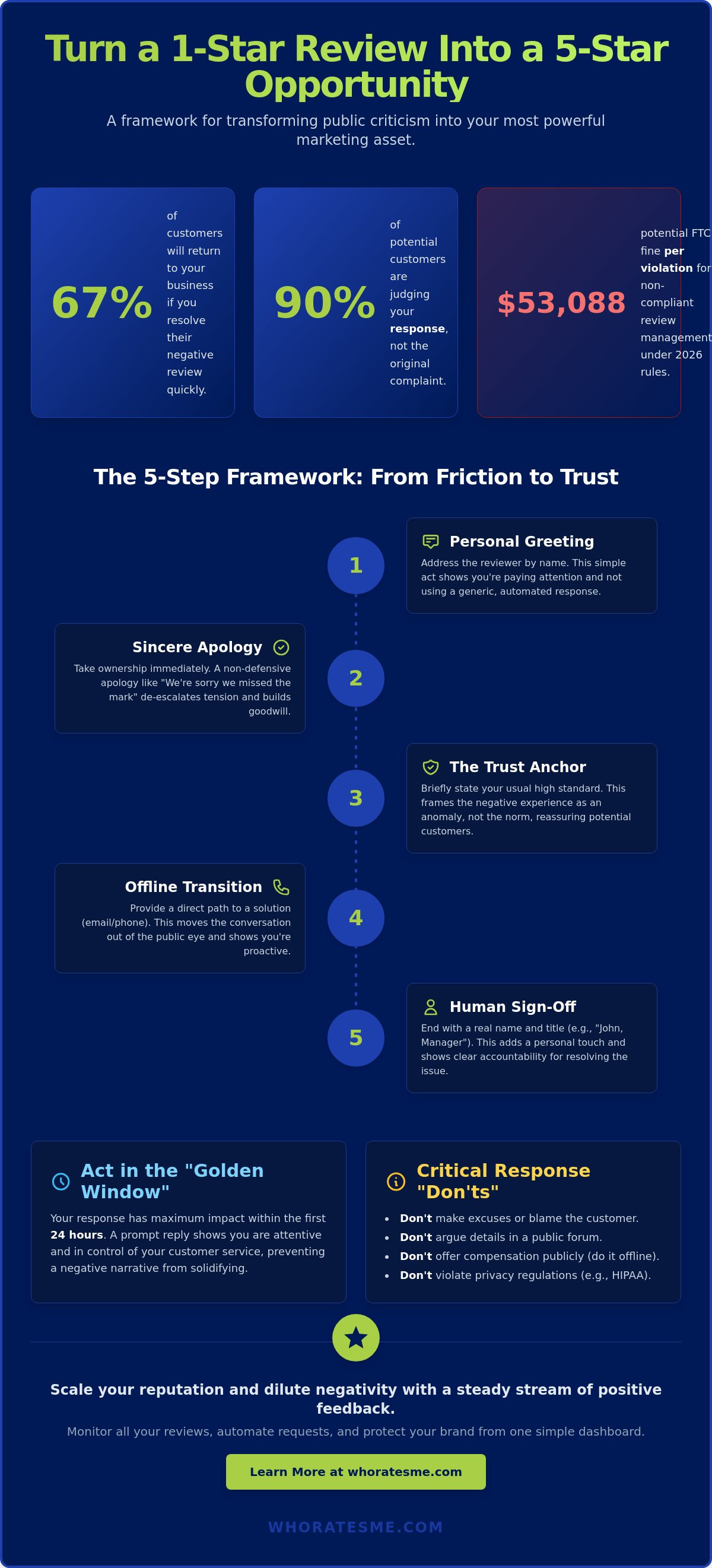
Most people scrolling through your feedback aren't looking for drama. In fact, 90% of readers are evaluating your reaction rather than the original complaint. They want to see if you are defensive or if you act as a solution-oriented mentor. By using relief-based language, you can reassure the browsing customer that their experience is safe in your hands. You shift the focus from the problem to the solution. This creates a sense of order and clarity that helps a nervous prospect feel in total control of their buying decision.
The 5-Step Framework: Turning Friction into Trust
Friction is a natural part of growth. It's how you handle that heat that determines if you build a bridge or a wall. To deliver a professional response to bad review, you need a repeatable system that removes the guesswork from high-stress moments. This five-step framework ensures every reply serves your reputation. It moves the reader from a place of frustration to a place of resolution.
Start with a personal greeting. Use the customer's name to show you've actually read their words. Follow this immediately with a non-defensive apology. A sincere "We missed the mark here" is far more powerful than a list of excuses. It aligns with the Essential Steps to Handle Negative Reviews recommended by experts to de-escalate tension. Next, insert your trust anchor. This is a brief mention of the standards you usually uphold. Provide a direct, offline path to a solution. Don't ask them to find your contact info. Give it to them. Finally, sign off with a human name. Accountability builds trust. Managing these interactions across multiple sites is easier when you can monitor your reviews from a single mobile app.
Crafting the "Trust Anchor" Without Sounding Arrogant
The trust anchor is your chance to remind the public of your commitment to excellence. It's a bridge between the mistake and your usual high standards. Phrases like "We're known for our punctuality, so it's disappointing to hear we fell short today" work well. This links a technical failure to your human commitment to the community. It suggests that the error was an anomaly, not a pattern. You're acknowledging the truth while protecting the natural growth of your brand's reputation. It's about being real, not flawless.
The Art of the "Offline Transition"
Never argue details in a public comment thread. It looks messy and defensive. Your goal is to make the customer feel heard before they are redirected. Use phrasing like "I'd like to listen to your experience more closely and make this right." This shows the silent audience that you are proactive. By moving the conversation to a phone call or email, you gain total control over the resolution process. It protects the privacy of the customer and the integrity of your business. This transition is the final step in delivering a professional response to bad review that actually wins back loyalty.
Why Ethical Responses Outperform Review Removal Traps
It's tempting to look for a quick fix when a harsh review lands on your profile. You might feel an urgent need to make the criticism disappear. This leads many businesses toward "removal services" that promise to scrub the internet clean. However, these shortcuts are often traps that can damage your long-term credibility. A professional response to bad review is a much safer investment in your brand's future. It builds a foundation of honesty that no removal service can replicate.
Choosing to manipulate your feedback is a high-risk gamble in 2026. The Federal Trade Commission is actively enforcing the Consumer Review Rule with civil penalties reaching up to $53,088 per violation. This isn't just about a slap on the wrist. It's a serious legal and financial threat. Platforms like Google have also sharpened their detection of "review gating," which is the practice of only asking happy customers for feedback. If you're caught filtering reviews, you risk losing your entire business profile. Following the SBA's guide to handling negative reviews is the only way to stay on the right side of these regulations.
Our Elevate Google-compliant plan is designed as the ethical alternative to these risky tactics. It focuses on movement and synchronization rather than suppression. Instead of trying to hide the truth, it helps you manage your reputation with integrity. You can face every comment with quiet confidence, knowing you're building a community of authentic voices.
Understanding the Consumer Review Fairness Act in 2026
Silence isn't a strategy. The Consumer Review Fairness Act makes it illegal to use contract terms that prevent consumers from posting honest reviews. For national brands, the risks of selective filtering are even higher. Trying to curate a perfect image often backfires when the public senses a lack of transparency. A resilient star rating is one that can withstand a few critiques because it's backed by hundreds of genuine, human interactions. Being real is more important than being flawless.
Building a "Bulletproof" Reputation Naturally
Perfection is often a red flag for modern shoppers. In fact, a 4.5-star rating with honest, professional responses is usually more trustworthy than a fake 5.0 record. Customers want to see how you handle mistakes. It gives them a clear, unfiltered view of your character. You can use the WhoRatesMe dashboard to monitor your compliance across all platforms simultaneously. This ensures your reputation grows naturally and stays fully protected against shifting platform rules. It’s about being a trusted ally to your customers, even when things go wrong.
Professional Response Templates for Common Scenarios
Having a library of starting points can save you from the paralysis of a blank screen. When you're in the heat of the moment, a pre-written structure provides the order and clarity you need to stay calm. A professional response to bad review should feel like a natural extension of your brand voice. It isn't a "canned" reply; it's a foundation for a real human connection. Here are four templates designed to address the most frequent points of friction.
- The Service Delay: "Hello [Name], thank you for your patience. We pride ourselves on efficiency, so hearing about this delay is disappointing. We respect your time and want to make this right. Please reach out to [Name] at [Phone/Email] so we can prioritize a solution for you."
- The Misunderstanding: "Hi [Name], thank you for the feedback. It seems there was a misunderstanding regarding our [Service/Policy]. Our goal is always clarity. I would appreciate the chance to explain our process further and hear your perspective. You can reach me directly at [Contact]."
- The Fake or Malicious Review: "Hello [Name], we take all feedback seriously, though we cannot find a record of a customer with your name or experience. We would like to learn more to ensure any legitimate concerns are addressed. Please contact us at [Contact] so we can investigate."
- The Pricing Objection: "Hi [Name], thank you for reaching out. We understand that cost is a significant factor. Our rates reflect our commitment to [Quality/Material/Safety]. We would love to discuss the specific value we provide and find a way to meet your needs. Please call us at [Contact]."
Managing these responses across different platforms can feel overwhelming. You can use our mobile app to manage multi-platform reviews from the palm of your hand, ensuring you never miss a chance to connect.
Handling the "Emotional" Reviewer
Sometimes a reviewer uses personal attacks or aggressive language. It's hard not to take it personally. Take a breath. It isn't about you. It's about their frustration. Use a rhythmic "problem-and-relief" structure to de-escalate the tension. Acknowledge the intensity of their feelings first. Then, offer the relief of a calm, professional path forward. Maintain a peer-to-peer register. You are two professionals working toward a resolution. This level-headedness protects the staff and keeps the conversation grounded in facts.
The "No-Text" 1-Star Review
A star without a story is difficult to fix. It leaves you guessing. Use this as an opportunity to ask for constructive insights. Your goal is to show the silent audience that you are proactive and curious. You can respond with: "Hi [Name], we see your rating and would love to understand the 'why' behind it. We are committed to constant improvement. Please reach out to us at [Contact] so we can listen to your experience and learn how to better serve you." This simple invitation often turns a silent critic into a helpful contributor.
Scaling Your Reputation: Diluting Negativity with ActivCycle
A single negative comment can feel like it's shouting over everything else. It's frustrating to see one person's bad day overshadow months of your hard work. While a professional response to bad review is your first line of defense, the ultimate victory lies in volume. The most effective way to protect your brand is to ensure that criticism is naturally diluted by a steady, rhythmic stream of positive experiences. This is where you transition from reputation defense to true reputation growth. You move from a place of anxiety to a place of quiet confidence.
We believe your focus should remain on your customers, not on refreshing your browser in fear. ActivCycle automation acts as a quiet, reliable autopilot for your feedback loop. It creates a consistent rhythm of review requests that mirror the natural movement of your business. Instead of a frantic scramble to "fix" your rating, you build a resilient foundation of trust. By using the WhoRatesMe mobile app, you can monitor these interactions across multiple platforms simultaneously. You stay in the loop without being tethered to your desk; you're always in command of your public narrative.
Moving from Overwhelmed to Autopilot
Running a business involves constant pressure. Automation provides the order and clarity needed to alleviate that stress. Having a Trusted Ally manage the collection process means you don't have to feel awkward asking for feedback. In 2026, the synchronization of reviews across different platforms is critical for your search engine visibility. Search engines reward businesses that show active, ongoing engagement. When your feedback loop is automated, your reputation grows even while you sleep. It’s about creating a synchronized system where every positive interaction is captured and shared. This prevents your profile from looking stagnant or neglected.
Visualizing a Simplified Future
Imagine a state of total control. In this future, a lone one-star review no longer causes panic or a sleepless night. You know that it will soon be surrounded by dozens of fresh, honest testimonials from your community of advocates. This consistency builds an unfiltered view of your excellence that potential customers can trust. You aren't hiding your flaws; you're highlighting your overall character. It’s a shift from being a reactive business owner to being a confident leader who values truth and natural growth. You can finally step back and watch your business thrive, knowing your reputation is handled with integrity and care.
Ready to automate your reputation? Explore the Elevate Plan
Step Into Total Reputation Control
The sting of a negative review is real, but it doesn't have to define your brand's future. By mastering the professional response to bad review, you've transformed a moment of friction into a public display of your integrity. You've moved from reacting in fear to leading with quiet confidence. You now have the tools to build a resilient reputation that values truth over perfection. This shift allows you to view every piece of feedback as a stepping stone toward natural growth.
Sustaining this growth requires a steady, reliable rhythm. Our ActivCycle automation serves as your autopilot, ensuring a consistent flow of fresh feedback that naturally dilutes occasional criticism. You can manage every platform from our centralized dashboard or mobile app, keeping you in total control while you focus on your daily operations. This system is strictly Google and FTC compliant, protecting you from the high-risk traps of review gating or removal services. It's time to replace the stress of public criticism with the clarity of a managed reputation.
Stop worrying about bad reviews and start growing with the Elevate Google-Compliant Plan. You've worked hard to build your business. We're here to help you protect it.
Frequently Asked Questions
Should I respond to every single bad review my business receives?
Yes, you should aim to respond to every piece of negative feedback. Data from early 2026 shows that 80% of consumers are more likely to choose a business that replies to all of its reviews. By answering everyone, you show the silent audience that you are an attentive, reliable mentor who cares about every customer's experience. It's about being present and showing your community that you value their voice.
How long should I wait before posting a response to a negative review?
You should ideally post your response within the first 24 hours. This is your "Golden Window" for impact. While it's helpful to wait an hour to cool down and gather your thoughts, delaying more than a day can make your business look inactive or indifferent. Speed is essential because 89% of consumers now expect businesses to respond to their online reviews. A prompt reply signals order and clarity.
Can I legally ask a customer to change their bad review after I fix the issue?
You can legally ask a customer to update their review, but you must never offer incentives to do so. The 2026 FTC Consumer Review Rule is very strict about this. Offering discounts, cash, or freebies in exchange for a better rating is considered a violation. These actions can result in civil penalties of up to $53,088 per instance. Focus on the resolution itself and let the customer decide to change their rating naturally.
What is the best way to handle a review that is clearly fake or from a competitor?
The best way to handle a suspicious review is to flag it for the platform and post a neutral, professional response to bad review. State clearly that you have no record of the transaction or the individual in your system. This signals to the 67% of consumers who are concerned about fake reviews that you are vigilant. It protects your integrity without starting a public fight that could damage your reputation.
Does responding to reviews help my business rank higher on Google in 2026?
Yes, responding to reviews significantly impacts your local search visibility. Google rewards active engagement and recent feedback. Since 74% of consumers only pay attention to reviews written within the last three months, your steady rhythm of responses keeps your profile fresh. It signals that your business is synchronized with current customer needs. Using our Elevate Google-compliant plan helps ensure this activity stays within platform guidelines for maximum growth.
Is it better to apologize even if the customer is technically wrong?
It is almost always better to apologize for the customer's experience even if the facts are in dispute. You aren't necessarily admitting a mistake; you are acknowledging their frustration. This empathetic approach de-escalates tension immediately. It helps you maintain a peer-to-peer connection while showing the public that you are the most reasonable voice in the room. You value the relationship over being right.
What are the risks of using automated AI responses for negative reviews?
The primary risk of AI responses is a loss of authenticity. While 82% of consumers read AI-generated summaries, they still value a genuine human connection in a professional response to bad review. If your replies feel robotic or repetitive, you risk looking insincere. Using a tool like ActivCycle ensures your feedback loop stays natural and human while benefiting from modern efficiency. It’s about finding the balance between automation and sincerity.
How do I move a public argument with a reviewer to a private channel?
You move the argument by offering a direct, offline path in your very first reply. Don't ask them to find your number; provide a specific name and contact method immediately. This shows you are a solution-oriented ally who takes accountability. It stops the public thread from becoming a spectacle and gives you total control over the final resolution. Moving the conversation demonstrates that you are a stabilizing force in a chaotic situation.
