Responding to Negative Reviews: 2026 Growth Guide
Did you know that only 20.5% of consumers trust a business with a perfect 5.0 rating? According to Forbes research from July 2026, customers are looking for authenticity over perfection. That single-star review isn't a permanent stain on your reputation; it's a public stage where you can prove your integrity by learning how to respond to negative reviews with poise.
We understand that a notification of a negative comment often feels like a punch to the gut. You’ve poured your heart into your business, and seeing public criticism is both stressful and exhausting. It’s natural to feel defensive or worried about losing the next lead. You want a solution that protects your hard work while keeping you in total control of the narrative.
This guide will help you master the art of responding with empathy while staying 100% compliant with the latest FTC and Google regulations. We'll walk through a clear strategy to defuse anger and show how ActivCycle automation can help you manage feedback on autopilot. By the end, you’ll have the clarity to turn every critique into a growth opportunity.
Key Takeaways
- Turn the emotional sting of criticism into a trust-building asset by understanding why modern consumers value authenticity over a perfect five-star rating.
- Follow a proven six-step de-escalation framework to learn exactly how to respond to negative reviews with professional precision and genuine empathy.
- Identify the best ways to handle specific challenges, ranging from legitimate service failures to vague neutral feedback and fraudulent reviews.
- Build a resilient reputation using ActivCycle automation to ethically dilute negative comments while maintaining 100% compliance with Google and FTC guidelines.
- Protect your business from scams and penalties by choosing transparent, human-centered management over risky shortcuts like review gating or removal services.
The Emotional and Business Reality of Negative Feedback
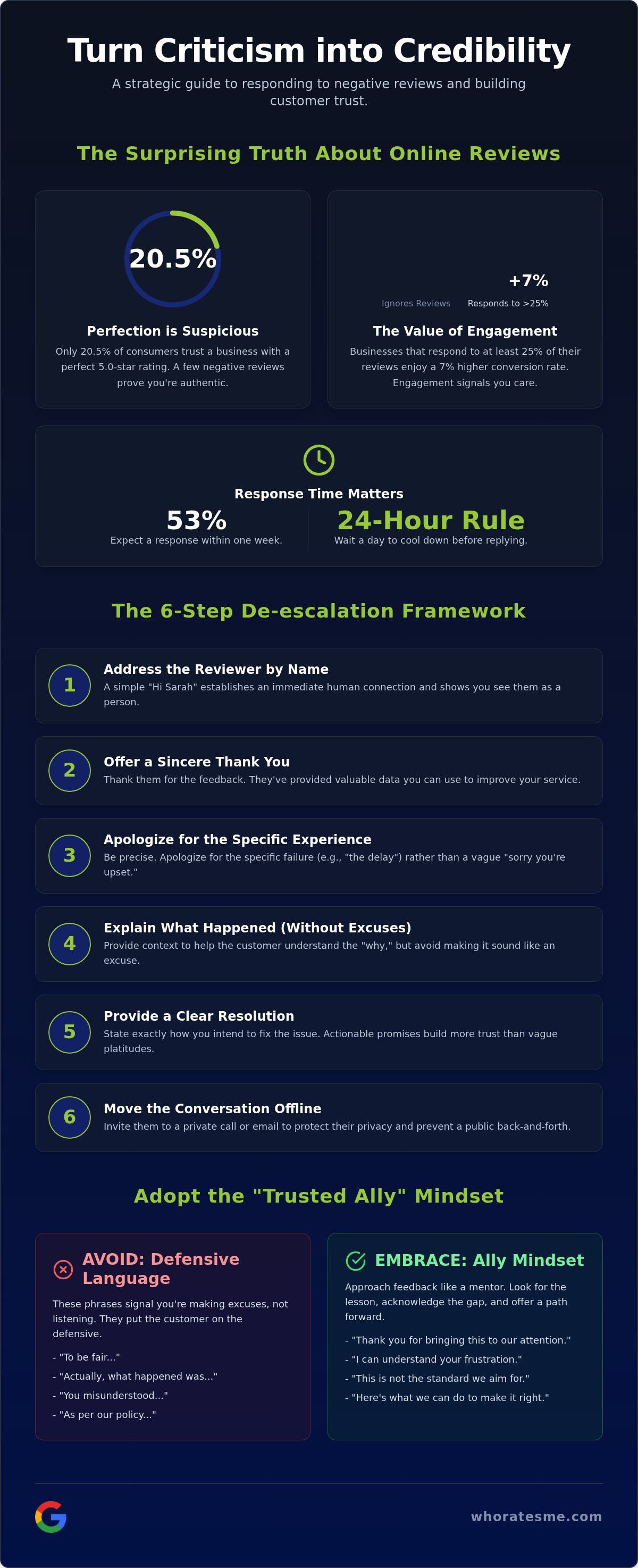
Receiving a one-star notification feels like a personal attack. You've spent years building your reputation, only to see it challenged by a single disgruntled comment. It stings. That reaction is human, but your next move defines your brand's future. Learning how to respond to negative reviews starts with accepting that a perfect record isn't actually the goal. In fact, Forbes research from July 2026 shows that only 20.5% of consumers trust a business with 100% positive reviews. A few blemishes prove you're real. They provide a baseline of honesty that customers appreciate.
When you reply, remember the "Audience of Thousands." You aren't just talking to the person who wrote the complaint. You are speaking to every potential lead who scrolls past that interaction. This is your chance to showcase operational excellence under pressure. However, speed can be a trap. While 53% of customers expect a response within a week according to SchedulingKit data, immediate replies often carry the heat of the moment. We recommend the 24-hour rule. Take a day to breathe. Let the initial frustration fade so your response reflects your values, not your temper.
The Psychology of the Defensive Response
Certain "trigger words" can instantly make a business owner sound combative. Phrases like "to be fair" or "actually" often signal to the reader that you're making excuses rather than listening. It's difficult to separate your personal worth from a service-related complaint. You are the heartbeat of your company. But a complaint about a late delivery or a cold meal isn't a verdict on your character. Adopt the "Trusted Ally" mindset. Approach the feedback like a seasoned mentor would. Look for the lesson, acknowledge the gap, and offer a path forward. This shifts the energy from conflict to resolution.
Why Ignoring Reviews is a Silent Revenue Killer
Silence is a statement. When a review goes unanswered, potential customers often interpret that void as a lack of care or a sign of poor management. This neglect has measurable consequences. Data from July 2026 indicates that businesses responding to at least 25% of their reviews enjoy a 7% higher conversion rate. Beyond the human connection, responsiveness impacts your visibility. Google prioritizes active businesses that engage with their community. By ignoring feedback, you aren't just losing one customer; you are potentially lowering your local search ranking and signaling to the market that your doors are closed to improvement. Authentic engagement is the simplest way to show you are a business that listens.
The Professional Response Framework: 6 Steps to De-escalation
Once you have waited the recommended 24 hours to cool down, it is time to act. A structured approach ensures you don't miss the human element while maintaining your professional standards. Mastering how to respond to negative reviews is less about winning an argument and more about demonstrating your brand's character. Follow these six steps to turn a tense moment into a display of leadership.
- Step 1: Address the reviewer by name. A simple "Hi Sarah" establishes a human connection immediately. It signals that you see them as a person, not just a notification on a screen.
- Step 2: Offer a sincere thank you. Thank them for the feedback. They have given you valuable data on where your service might be failing, which is information you can use to grow.
- Step 3: Apologize for the specific experience. Be precise. If they waited too long for a technician, apologize for the delay rather than just saying you are sorry they are upset.
- Step 4: Explain what happened. Provide context without making excuses. If a sudden equipment failure caused the issue, state it clearly. This helps the customer understand the "why" behind the "what."
- Step 5: Provide a clear resolution. Tell them exactly how you intend to fix it. Actionable promises build more trust than vague platitudes.
- Step 6: Move the conversation offline. Protect their privacy and your reputation by inviting them to a private call or email. This prevents a public back-and-forth that could escalate.
Managing these steps across several different platforms can feel like a full-time job. Using a centralized review management dashboard helps you track these interactions without feeling overwhelmed by the technical details.
The Art of the Sincere Apology
The difference between "I'm sorry you feel that way" and "I'm sorry we failed" is the difference between defensiveness and leadership. The first phrase is a non-apology; it shifts the burden of the emotion onto the customer. The second phrase takes full ownership of the service gap. By acknowledging a specific failure, you validate the customer's experience. This transparency creates a bridge of trust: it shows you are more interested in being honest than being perfect.
Taking the Issue Offline Professionally
Public resolution is for your future audience, but private resolution is for the actual customer. You want the public to see that you care, but the real work happens in a personal conversation. Provide a direct name and a phone number or email address. Transitioning from the dashboard to a personal chat removes the pressure of the public stage. It allows the customer to speak freely and gives you the space to offer a tailored solution that restores their faith in your business.
Handling Specific Scenarios: From Service Failures to Fake Reviews
Every piece of feedback carries a different weight. A customer who waited an hour for a scheduled appointment requires a different approach than a person who simply left a three-star rating with no text. Understanding how to respond to negative reviews means tailoring your voice to the specific context of the grievance. For legitimate service failures, honesty is your best asset. Own the mistake clearly. If your team missed a deadline or delivered a faulty product, acknowledge the error without layering on excuses. This transparency builds a bridge back to the customer's trust.
Neutral reviews can be just as confusing as angry ones. A three-star rating with no comment offers very little data for improvement. In these cases, be curious rather than defensive. Reach out and ask what could have transformed their experience into a five-star visit. If the complaint targets a specific employee, protect your culture. Never throw staff under the bus in a public forum. State that you take employee conduct seriously and will investigate the matter internally. This shows you are a responsible leader who values both your customers and your team.
Identifying and Flagging Fake Reviews
Malicious feedback is a reality of the digital marketplace. Red flags often include generic names, a sudden spike in one-star ratings, or vague complaints that don't mention a specific product or service. If you suspect a review is fraudulent, follow the Google-compliant process by using the Business Profile management tool to request an assessment. When you reply, do it for your future customers. A polite response stating that you have no record of their transaction alerts other readers that the review may be illegitimate. It demonstrates that you are attentive and protective of your brand's integrity.
Turning a Bad Experience into a Success Story
A negative review is not the end of the conversation; it is often the beginning of a better relationship. We have seen countless examples of customers who updated a one-star rating to a five-star review simply because the business owner reached out with a genuine solution. Don't be afraid to ask for a second chance. Phrases like "We would love the opportunity to make this right" show humility without sounding desperate. This proactive approach is a core pillar of a successful reputation management strategy. By showing you are willing to go the extra mile, you turn a public critic into a loyal advocate.
Beyond the Response: Building Resilience with ActivCycle Automation
While knowing how to respond to negative reviews is an essential skill, it's only one part of a larger reputation strategy. You also need a way to ensure that isolated incidents don't define your entire business story. This is where the "Dilution Strategy" comes into play. By consistently inviting feedback from every customer, you build a volume of positive sentiment that naturally pushes older, negative comments further down the page. It is a matter of resilience. A single low rating is much easier to weather when it is surrounded by a hundred authentic, recent stories of success.
Our ActivCycle automation streamlines this entire process. It creates a steady, reliable loop of feedback requests without the need for manual intervention or constant reminders to your staff. Most importantly, it operates without gating. We believe in transparency; every customer is given an equal voice. This approach keeps your business 100% compliant with Google’s strict anti-gating policies while ensuring your brand remains unshakeable. When your review profile is constantly refreshed with new, honest comments, potential customers see a business that is active, evolving, and deeply committed to its community.
The Power of Ethical Automation
Scaling your reputation requires moving away from reactive firefighting. You shouldn't have to wait for a crisis to start thinking about your online presence. Proactive customer feedback automation allows you to synchronize reviews across your entire service-based business. It replaces the stress of manual outreach with a methodical, grounded rhythm. Instead of struggling to keep up with every notification, you can focus on your daily operations while the system quietly builds your credibility in the background. It turns your customer service into a self-sustaining engine of growth.
Monitoring Reputation on the Go
Time is your greatest ally when it comes to de-escalating customer anger. The WhoRatesMe mobile app allows you to catch negative reviews the moment they land, regardless of where you are. You can manage Google, Yelp, and Facebook interactions from a single, centralized dashboard. This level of synchronization provides better business insights by showing you patterns in feedback across all platforms. Speed shows customers that you are present and attentive; it proves you care about their experience in real-time. For business owners ready to simplify their workflow and protect their hard-earned reputation, our Elevate Google-compliant plan provides the professional tools needed to stay in total control.
Maintaining Long-term Compliance and Trust in 2026
Building a reputation is a marathon, not a sprint. In the high-stakes environment of 2026, the temptation to take shortcuts can be strong. You might see offers for "guaranteed review removal" or software that promises to hide your worst feedback. Resist these. The Federal Trade Commission (FTC) has become increasingly active in enforcing the Rule on the Use of Consumer Reviews and Testimonials. Violations can result in civil penalties of up to $53,088 per occurrence. Beyond the legal risk, these tactics destroy the very thing you are trying to build: authentic trust with your community.
When you understand how to respond to negative reviews ethically, you don't need to fear the occasional critic. Modern consumers are savvy. They can spot a "scrubbed" profile from a mile away. Real growth comes from showing that your business is accountable and transparent. Our Elevate Google-compliant plan is designed for this exact philosophy. It focuses on gathering real feedback from real customers, ensuring your rating grows through merit rather than manipulation. This approach protects your brand from platform bans and keeps you on the right side of evolving consumer protection laws.
Why Gating is a High-Risk Strategy
Review gating is the practice of selectively filtering customers, only asking for public reviews from those who had a positive experience. While it might seem like an easy way to boost your score, it is a direct violation of Google’s terms of service. Selective filtering creates a distorted view of your business that eventually collapses under scrutiny. We advocate for a non-gated review platform philosophy. By giving every customer a voice, you prove that you have nothing to hide. Transparency wins in 2026 because it provides the "real story" that customers crave before they book a service or make a purchase.
Choosing a Google-Compliant Partner
Your reputation is too valuable to leave to chance or unverified tools. When evaluating customer feedback software, compliance must be your top priority. A partner should offer more than just automation; they should offer a shield for your brand’s integrity. WhoRatesMe is committed to long-term credibility, providing the tools you need to manage feedback without resorting to risky shortcuts. We help you stay organized, responsive, and fully aligned with the latest industry regulations. If you are ready to secure your business's future and build a rating that lasts, it is time to discover the Elevate Google-compliant plan and lead with confidence.
Turning Public Criticism into Private Growth
A single bad rating doesn't have to be a source of constant anxiety. By mastering how to respond to negative reviews with empathy and a clear framework, you transform a potential crisis into a demonstration of your business's character. You've seen that transparency and compliance are the only sustainable paths in 2026. Now, it's about moving from reactive firefighting to a steady, automated rhythm that protects your hard work while you focus on serving your customers.
You don't have to manage this journey alone. With ActivCycle automation providing 24/7 monitoring and a centralized multi-platform dashboard, you can maintain total control of your narrative without the manual stress. Our systems are built to be 100% compliant with Google and FTC guidelines, ensuring your growth is as ethical as it is effective. It's time to replace the sting of criticism with the confidence of a clear strategy.
Take control of your reputation with the Elevate Google-compliant plan and start building a brand that thrives on honesty. Your future customers are watching; let's show them why you're the right choice.
Frequently Asked Questions
Should I respond to every single negative review?
Yes, you should aim to respond to every negative review to demonstrate that your business is active and attentive. Research from February 2026 shows that 96% of consumers check online reviews before their first purchase. When you acknowledge every critic, you show those potential customers that you are a business that values feedback and takes responsibility for its service.
How long should I wait before responding to a bad review?
You should ideally respond within 24 to 48 hours of receiving the notification. This window is short enough to show you care, yet long enough to ensure you aren't replying while still feeling frustrated. Since 53% of customers expect a reply within a week, acting within two days positions you as a highly responsive and reliable leader.
Can I get a negative review removed if it's unfair?
You can only request removal if a review violates specific platform policies, such as containing hate speech or being a conflict of interest. Platforms like Google generally won't remove a review just because the customer’s perspective seems "unfair" or biased. It is usually more effective to write a calm, professional reply that provides your side of the story for future readers.
What should I do if a customer is being abusive in a review?
Flag the review immediately for a policy violation and avoid getting into a public shouting match. If you choose to reply, keep it brief and strictly professional. State that you take all feedback seriously but require a respectful environment to resolve issues. This approach protects your brand's dignity while signaling to others that you won't be bullied by unreasonable behavior.
How do I respond to a negative review without sounding defensive?
Focus on the service gap rather than the customer’s personality or tone. Use neutral language and avoid "trigger words" that shift blame back onto the reviewer. Learning how to respond to negative reviews with a focus on solutions rather than excuses is a vital skill. It shows you are more interested in improving your business than being right.
Is it okay to offer a refund in a public review response?
It is better to state that you want to "make things right" publicly and save the specific financial details for a private conversation. Publicly offering refunds can sometimes encourage others to leave bad reviews just to get a discount. Invite the customer to call or email you directly to discuss a resolution. This keeps your professional boundaries firm while showing you are generous.
How does responding to reviews help my SEO?
Active engagement signals to search engines that your business is trustworthy and relevant to the local community. High response rates are a key factor in maintaining the visibility needed to appear in the "Local Pack" on search results. Knowing how to respond to negative reviews helps you maintain the authentic rating that search algorithms prioritize when ranking service-based companies.
What is the best way to handle a negative review that has no text?
Treat a star-only review as an invitation to learn more about your customer's experience. Reply by thanking them for the rating and expressing your regret that they didn't have a five-star visit. Ask them to reach out to you privately so you can understand what happened. This simple act of curiosity shows you are a business that is always looking to grow.
