The Best Time of Day to Ask for a Review: A Data-Driven Strategy for 2026
31.27% of marketing emails are opened on Tuesdays, yet many business owners still find their feedback requests met with total silence. It's a common struggle. You've worked hard to provide a great service, but finding the best time of day to ask for a review feels like a guessing game. You don't want to annoy your customers during their morning rush or wake them up with a late night text. It's a delicate balance between staying top of mind and respecting their personal space.
We understand that managing these requests across different time zones adds a layer of stress you just don't need. You deserve a feedback loop that feels natural and earns the authentic comments your business relies on. In this guide, you'll discover the precise windows of opportunity to capture customer feedback and skyrocket your response rates. We'll walk through the latest 2026 data on the "Golden Window" of delight and show you how tools like ActivCycle automation can handle the heavy lifting. By the end, you'll have a clear strategy to turn quiet customers into your loudest advocates while remaining 100% Google-compliant.
Key Takeaways
- Capture the "Window of Peak Delight" by aligning your requests with the moments of highest customer satisfaction and dopamine.
- Identify the best time of day to ask for a review based on your specific industry, whether it's a mid-week B2B sweet spot or a Saturday morning B2C surge.
- Learn how to calculate the perfect "shipping buffer" for e-commerce or the "handshake moment" for service-based businesses to ensure feedback is authentic.
- Discover how to normalize feedback requests across multiple time zones so your message always arrives at a respectful, high-engagement hour.
- Transition from manual "blast" sending to automated, trigger-based feedback loops with ActivCycle to keep your review volume growing on autopilot.
The Science of Timing: Why "When" Matters as Much as "How"
Most business owners spend hours perfecting their email copy, but they hit "send" whenever they have a spare moment. This is a mistake. Timing acts as the bridge between a good experience and a public review. If you cross that bridge too early or too late, you lose the connection. Finding the best time of day to ask for a review isn't just about checking a box. It's about understanding the human on the other side of the screen. You want to catch them when they are emotionally available, not when they are drowning in daily tasks.
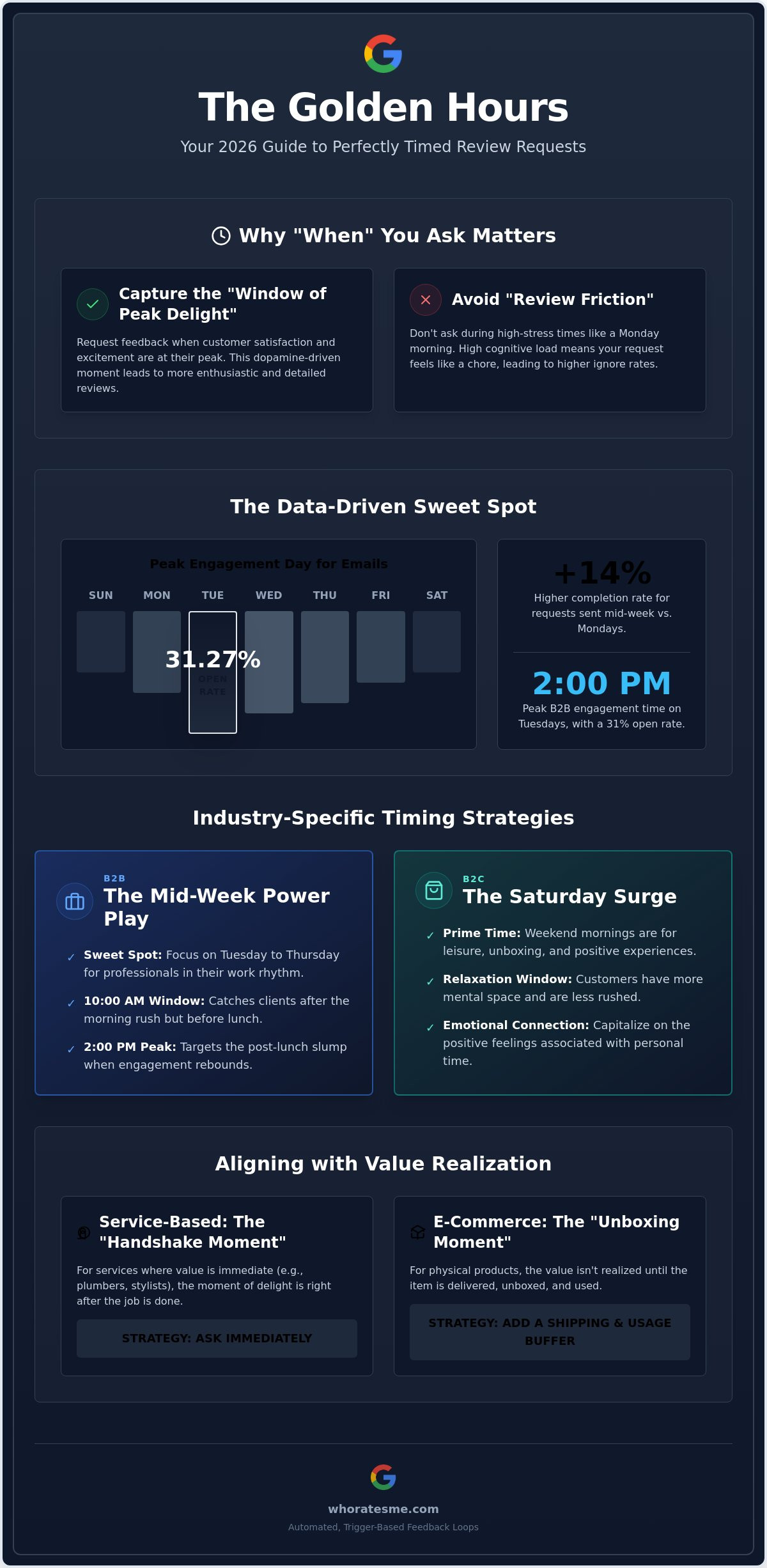
We live in a dopamine-driven economy. When a customer first experiences the value of your work, their excitement is at its peak. This is the "Window of Peak Delight." In 2026, digital behavior has shifted away from traditional office hours. People check their phones during commutes, late at night, or between meetings. If your request arrives during a high-stress moment, it creates "review friction." This leads to higher ignore rates because the effort to leave feedback feels disproportionate to their current mental state. Poor timing often results in:
- Increased cognitive load during peak work hours.
- The "out of sight, out of mind" effect if too much time passes.
- Frustration when requests interrupt personal or family time.
The Psychology of the Recipient: Cognitive Load
Think about your own 9:00 AM on a Monday. Your inbox is full. Your calendar is a sea of meetings. A review request at this hour feels like one more chore on an endless list. This is high cognitive load. We define "Cognitive Friction" as the mental effort required to leave a review. When friction is high, conversion is low. Conversely, the "Relaxation Window" during late afternoons or weekend mornings offers a moment of calm. This is often the best time of day to ask for a review because the recipient has the mental space to be thoughtful and sincere. They aren't rushing to the next task; they are reflecting on their day.
Peak Delight vs. Peak Utility
There is a subtle difference between the moment of purchase and the moment of value realization. For a plumber or a hairstylist, the value is immediate. You should ask for feedback the moment the job is done. For an e-commerce brand, the value isn't realized until the product is unboxed and used. Asking too soon feels pushy. Asking too late means the dopamine has faded. Understanding this nuance is a core part of customer feedback automation. By aligning your request with the specific moment of utility, you respect the customer's journey. The Science of Timing suggests that people value immediate rewards, and a sincere "thank you" coupled with a timely request feels like a shared win rather than a cold transaction.
Identifying the "Golden Hours" for Review Requests in 2026
Sending a request at the wrong hour is like trying to start a conversation with someone who is running for a bus. They might hear you, but they won't stop to answer. In 2026, the best time of day to ask for a review is no longer just about when people are at their desks. It's about when they have the emotional bandwidth to engage. Data shows that Tuesday remains the strongest day for email opens at 31.27%, while mid-week requests overall see a 14% higher completion rate than those sent during the frantic Monday morning rush. By avoiding the "black hole" of late Sunday nights, you ensure your message is a welcome interaction rather than a digital nuisance.
For B2B companies, the Tuesday to Thursday "Sweet Spot" is essential. Monday is for recovery; Friday is for checking out. Between these days, professionals are in a rhythm of execution and reflection. If you are a B2C brand, you might find more success with the "Saturday Surge." Weekend mornings are often a time of leisure and unboxing, where customers are more likely to share their positive experiences. Understanding consumer timework allows you to align your outreach with these natural ebbs and flows of human attention.
Morning, Noon, or Night? Breaking Down the Day
The 10:00 AM rule serves professional services well. It catches clients after they've cleared their initial morning fires but before the noon lunch rush begins. If you miss this window, consider the 2:00 PM slump. Research on 4.2 million marketing emails shows that B2B engagement peaks at 2:00 PM on Tuesdays with a 31% open rate. This confirms that the post-lunch period is a prime best time of day to ask for a review because people often pivot toward low-stakes tasks. For high-emotion consumer purchases, the 7:00 PM leisure window is highly effective. This is when "second-screen browsing" is at its peak, and customers are already in a mindset of digital interaction. If managing these windows manually feels overwhelming, you can automate your feedback loops to ensure you never miss a golden hour.
The Mid-Week Advantage
Wednesday acts as the anchor for high-engagement digital communication. By this point in the week, the chaos of Monday has subsided, and the weekend distractions haven't yet taken hold. There is a palpable transition from "work mode" to "reflection mode" that begins by Thursday afternoon. Customers are more likely to provide authentic, detailed comments when they feel their week is under control. By targeting these specific windows, you aren't just asking for a favor; you're inviting a conversation at a time when your customer is actually ready to have it.
Industry-Specific Timing: One Size Does Not Fit All
A local plumber and a national software company don't share the same calendar. While general data gives us a starting point, your specific industry rhythm dictates the best time of day to ask for a review. For service-based companies, the "Handshake Moment" is your greatest asset. When a technician finishes a job, the customer feels immediate relief. This is the moment to send your request. If you wait until the next Tuesday at 10:00 AM, that feeling of gratitude has already begun to fade. Authentic service comments are most likely when the interaction is still fresh in the customer's mind.
E-commerce brands face a different challenge. You have to account for the "shipping buffer." Sending an automated request the moment a label is printed is a fast way to annoy a customer. Instead, calculate your average delivery time and add a two-day window for the product to be used. This ensures your request arrives when the excitement of unboxing is at its peak. For SaaS and digital services, the best time of day to ask for a review is often right after a user achieves a "High-Value Action" within your platform. Don't just ask because it's Wednesday. Ask because they just exported their first successful report or hit a significant usage milestone.
High-Involvement vs. Low-Involvement Purchases
Luxury goods require a "honeymoon phase." A customer who just bought a premium watch or a high-end camera needs time to live with the product before they can write a meaningful review. Essential services, like emergency repairs, thrive on the immediate "relief" phase. Using a multi platform review management dashboard allows you to segment these customers. You can set different triggers for a high-ticket purchase versus a recurring subscription, ensuring each person receives a request at their personal peak of satisfaction.
The "Milestone" Request
Timing isn't always about the clock; sometimes it's about the calendar. For subscription models, asking after the first 30 days often yields better insights than the first 24 hours. However, one of the most powerful moments for any industry is the "Service Recovery Paradox." If a customer has a problem and your support team solves it quickly, their loyalty actually increases. Asking for a review immediately after a solved support ticket captures that surge of renewed trust. It's a strategic way to build a reputation based on reliability and care rather than just perfect transactions.
Building a Timing Strategy for National Brands
Running a national brand brings a unique set of challenges. When your team in New York hits "send" at 9:00 AM, your customers in Los Angeles are still asleep. A notification at 6:00 AM isn't a helpful reminder; it's an annoyance that can lead to an immediate "delete" or a revoked consent. To find the best time of day to ask for a review on a national scale, you must move beyond a single "blast" strategy. It requires a more deliberate, synchronized approach that respects the local rhythm of every customer, regardless of their zip code.
We recommend a five-step process to bring order to your national outreach:
- Step 1: Segment your list. Divide your customer database by geographic region or time zone.
- Step 2: Normalize the timing. A 10:00 AM send should mean 10:00 AM for the recipient, whether they are in Miami or Seattle.
- Step 3: Implement a "Smart Queue." This holds any trigger-based messages during late-night hours, ensuring they only arrive during high-engagement windows.
- Step 4: Monitor regional engagement. Look for local cultural variations. You might find that Midwest customers prefer weekend mornings while East Coast audiences engage more mid-week.
- Step 5: Use a mobile app. Real-time monitoring allows you to see incoming reviews across all regions, giving you a clear, unfiltered view of your brand’s health.
Managing the Coast-to-Coast Gap
The three-hour difference between the coasts is the most common pitfall for national outreach. As we noted, a 9:00 AM EST send is a 6:00 AM PST mistake. By synchronizing your requests to the recipient's local clock, you maintain a consistent "Golden Hour" across the country. This level of precision is a key part of google compliant review management. It ensures your brand standards remain high while respecting the diverse schedules of a national audience. It’s about being a silent, reliable presence in their day rather than a loud interruption.
The Follow-Up Cadence
Finding the best time of day to ask for a review also involves knowing when to ask again. We suggest the "Rule of Three." Your initial request should be followed by no more than two reminders. Wait at least 48 to 72 hours between the first and second message. This gives the customer enough time to use the product or reflect on the service without feeling pressured. Your final follow-up should be a "Final Call" approach. Be honest, empathetic, and low-pressure. Let them know this is the last time you'll ask. This transparency often earns a response because it shows you value their time as much as their feedback. If you're ready to simplify this process, you can explore our automated review management solutions to keep your national reputation growing steadily.
Automating the Perfect Moment with ActivCycle
Managing every single feedback request by hand is exhausting. You have a business to run, and hovering over a "send" button isn't the best use of your time. ActivCycle automation steps in to remove that burden. It ensures your requests go out at the best time of day to ask for a review without you ever having to check the clock. By moving away from generic "blast sending" toward precise, trigger-based feedback loops, you show your customers that you value their time as much as their opinion. It’s a transition from being a manual operator to being a strategic leader.
This automated approach does more than just save time; it builds a foundation of reliability. When your systems are synchronized, your reputation grows steadily and naturally. You can scale your volume while maintaining a non-gated review platform that earns the respect of both search engines and customers. The Elevate Google-compliant plan provides the peace of mind that comes with knowing your growth is ethical, transparent, and built to last.
Syncing Automation with the Customer Journey
Success lies in the triggers. You can set your automation to fire based on real-world milestones: a delivery confirmation, a project completion, or a successfully resolved support ticket. The WhoRatesMe dashboard centralizes this timing across Google, Yelp, and other critical platforms, so you never have to jump between apps to see your progress. However, "set and forget" automation only works when the initial logic is empathetic. You aren't just sending a link; you’re continuing a conversation. By aligning the best time of day to ask for a review with these specific journey points, your requests feel like a natural extension of your service rather than a cold after-thought.
The Ethical Edge: Compliance as a Growth Lever
When requests arrive at the wrong time, response rates inevitably drop. This frustration often leads businesses toward the temptation of review gating, but that’s a short-term fix that creates long-term risk. Ethical timing is a much stronger lever for growth. It helps you build a more resilient review management strategy that doesn't rely on shortcuts. By using ActivCycle to hit the "Golden Window" every time, you stay 100% compliant while maximizing your authentic feedback. Integrity in your timing is the fastest path to unshakeable trust. It proves to your audience that you are real, you are reliable, and you are ready to listen.
Turning Timing into Your Greatest Competitive Advantage
Finding the best time of day to ask for a review is more than just a logistical hurdle. It's a way to show your customers that you value their time and respect their daily lives. We've explored how the "Golden Window" of delight varies by industry; and why national brands must account for the local rhythms of their audience. By aligning your outreach with these moments of peak satisfaction, you transform a simple request into a meaningful interaction. It's about moving from a place of uncertainty to a position of total control.
You don't have to manage this complexity alone. Our ActivCycle technology handles the heavy lifting for you, ensuring every message arrives at the perfect moment. With a centralized dashboard and 100% Google-compliant automation, you can focus on running your business while your reputation grows on autopilot. It's time to replace the stress of manual follow-ups with a steady, predictable feedback loop. You've built a business worth talking about. Let's make sure your customers have the perfect moment to say so.
Start your journey toward ethical, automated reputation growth with the Elevate Plan.
Frequently Asked Questions
Is Tuesday really the best day to send a review request?
Yes, Tuesday remains the strongest day for digital engagement in 2026. Research shows that email open rates peak at 31.27% on Tuesdays, as professionals have cleared their Monday backlogs but haven't yet shifted into weekend mode. This mid-week anchor provides a reliable window for your message to be seen and acted upon by a focused audience.
Should I ask for a review immediately after a service is completed?
For service-based companies, asking immediately is the most effective way to capture the "Handshake Moment." When a technician finishes a job or a project is delivered, the customer’s sense of relief and satisfaction is at its peak. Capturing feedback in this moment leads to more authentic, detailed comments that reflect the true quality of your work.
How many times should I follow up on a review request?
We recommend following the "Rule of Three," which consists of one initial request and a maximum of two gentle reminders. This cadence provides enough opportunity for a busy customer to respond without feeling pressured. Sending more than three messages often leads to frustration and can result in customers revoking their consent for future communications.
Does the time of day affect the star rating of the review?
Timing primarily impacts your response volume, but it can indirectly influence the quality of the sentiment. A request sent during the best time of day to ask for a review finds the customer in a relaxed state of mind. If you interrupt a high-stress moment, the resulting friction may lead to a shorter or less enthusiastic comment than if you had waited for a calmer hour.
Is it better to send review requests via email or SMS?
The choice between email and SMS depends on your specific industry and audience habits. SMS often sees higher engagement during the late afternoon, specifically between 4:00 PM and 7:00 PM. Email is a powerful tool for B2B professional services, particularly when sent during the 9:00 AM to 11:00 AM window when people are actively managing their inboxes.
How do I manage review request timing for customers in different time zones?
You should always synchronize your outreach to the recipient's local time zone. A 10:00 AM request should arrive at 10:00 AM for the customer, regardless of where they are located. This prevents disruptive early morning or late-night notifications, ensuring your brand remains a respectful and stabilizing presence in their daily routine.
Can I automate the timing of my review requests while staying Google-compliant?
Yes, you can scale your feedback loops ethically by using the Elevate Google-compliant plan. This system utilizes ActivCycle technology to identify the best time of day to ask for a review based on specific customer milestones. It allows you to automate the process while ensuring you never engage in prohibited practices like review gating or selective filtering.
What is the "Window of Peak Delight" in reputation management?
The "Window of Peak Delight" is the period immediately following a positive interaction when a customer's satisfaction is highest. During this time, the value of your service is fresh in their mind, making them more likely to share their experience. Catching this window is essential for building a library of sincere, authentic reviews that resonate with future prospects.
