The Psychological Impact of Bad Reviews on Business Owners in 2026
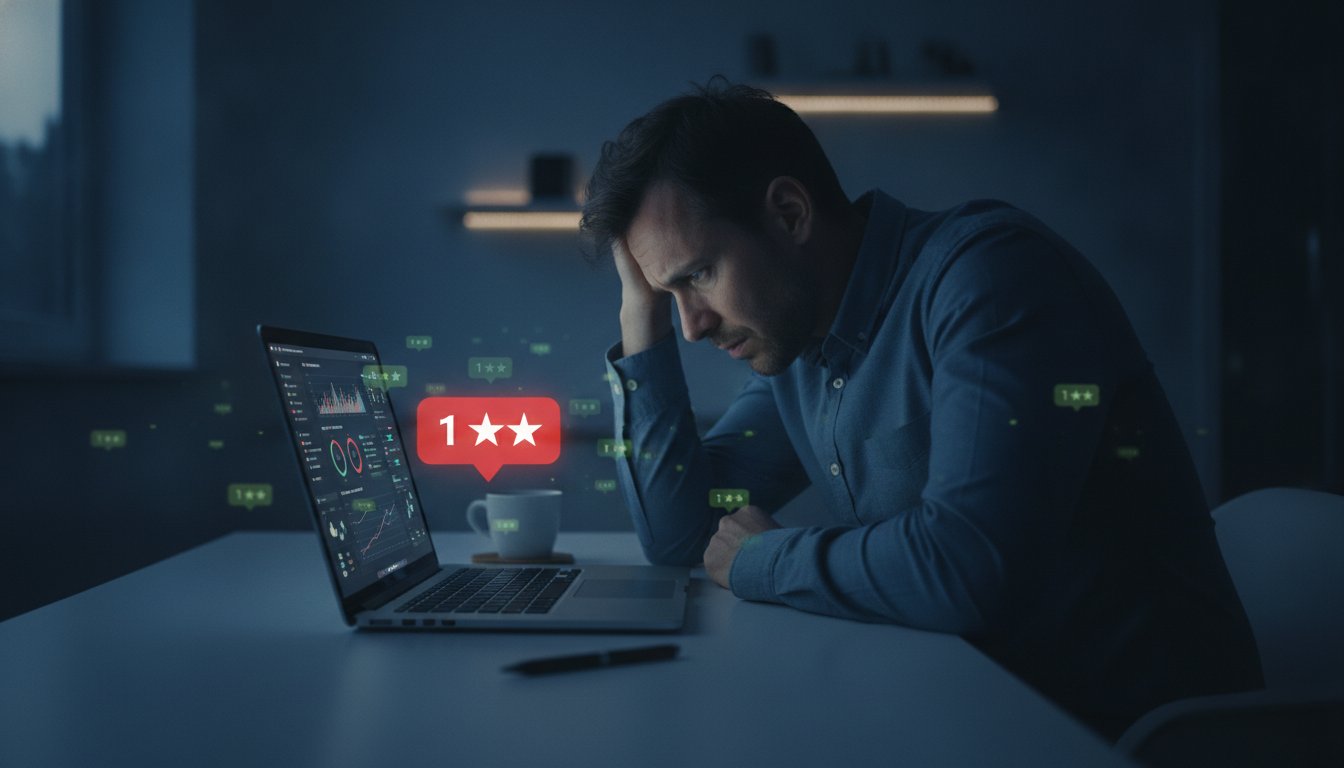
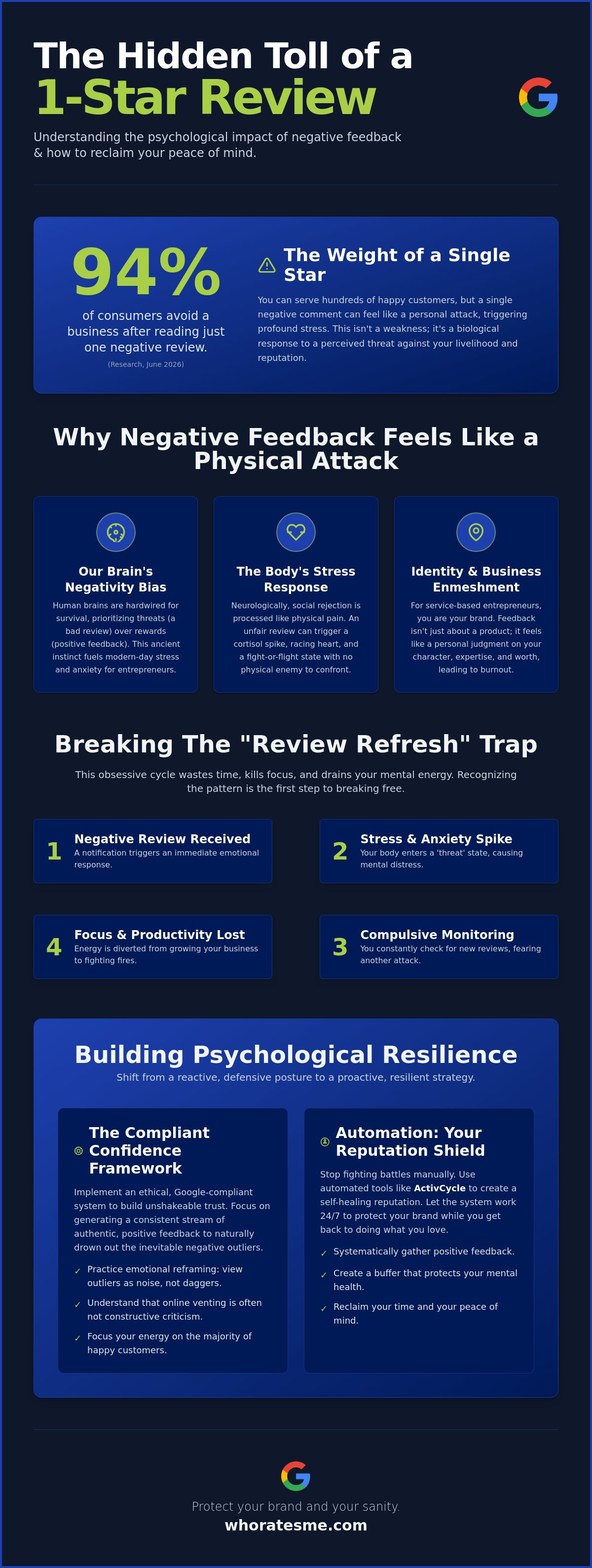
It is 2:00 AM, and you are staring at your phone's glowing screen, re-reading a single paragraph that feels like a personal attack. Even though you served hundreds of happy customers this week, that one-star rating is the only thing you can think about. This scenario highlights the profound psychological impact of bad reviews on business owners, where a digital comment can trigger physical stress and a sense of helplessness. Research from June 2026 shows that 94% of consumers report avoiding a business because of a negative review, making the stakes feel incredibly high for your livelihood.
You've poured your heart into your work. It's natural that unfair feedback feels like a punch to the gut. It's exhausting to feel like you're constantly on the defensive, fighting an impulsive desire to argue with strangers online. This guide will help you understand the mental toll of negative feedback and teach you how to build a resilient, automated system that protects both your brand and your sanity. We'll explore how to achieve emotional detachment and use the Elevate Google-compliant plan to reclaim your time while drowning out the noise with authentic, positive feedback.
Key Takeaways
- Understand why the human brain is hardwired to prioritize threats over praise and how this negativity bias fuels your daily stress.
- Explore the deep psychological impact of bad reviews on business owners and why service-based entrepreneurs often feel feedback as a personal betrayal.
- Identify the signs of the Review Refresh trap so you can stop the compulsive monitoring that doesn't just waste time but also kills your focus.
- Learn to implement the Compliant Confidence framework to build unshakeable trust using ethical, Google-compliant feedback systems.
- Discover how automated tools like ActivCycle create a self-healing reputation, letting you step back while the system quietly protects your brand.
The Weight of a Single Star: Why Negative Reviews Trigger Acute Stress
One notification can change your entire mood. You might have fifty glowing testimonials from the last month, but your brain fixates on the single person who wasn't satisfied. This isn't a lack of mental toughness; it is biology. Our ancestors survived by prioritizing threats over rewards. In 2026, a scathing comment is the modern equivalent of a predator in the grass. This hardwired response explains the significant psychological impact of bad reviews on business owners, as the brain treats a threat to your reputation as a threat to your survival.
When understanding user reviews, it's helpful to realize that digital platforms often provide a megaphone to the anonymous critic while you remain the visible owner. This creates a jarring power imbalance. You are a real person with a face, a family, and a history; they are often just a screen name. This vulnerability makes every word feel heavier than it would in a face-to-face conversation.
There's also the Endowment Effect at play. You value your business far more than any customer ever will because you built it from the ground up. To a reviewer, it might be a forty-dollar meal or a one-hour service. To you, it's your legacy. When they dismiss your work, they aren't just critiquing a product. They are devaluing your time, your effort, and your sacrifice. It's a fundamental mismatch in perceived value that leads to deep frustration.
The Biology of Reputation: Why It Feels Like a Physical Attack
Neurologically, social rejection is processed in the same regions of the brain as physical pain. When you read an unfair accusation, your body triggers a cortisol spike. Your heart races. Your palms sweat. You enter a fight or flight state, yet there is no physical enemy to confront. Business owners are uniquely susceptible to reputation anxiety because their financial security and social standing are inextricably linked to public perception.
The Mirror Effect: When Your Business Becomes Your Identity
Many entrepreneurs struggle with enmeshment, where their self-worth is tied directly to their latest rating. A bad review becomes a distorted mirror. It reflects a version of your company that isn't true, yet it's the only one you see in that moment. This creates a cycle of perfectionism that is impossible to maintain. In a 24/7 digital feedback loop, the pressure to be flawless becomes a heavy, invisible cost of doing business that can eventually lead to burnout.
Identity and the Entrepreneur: When Feedback Feels Like a Personal Betrayal
Service-based entrepreneurs face a unique challenge. You aren't just selling a mass-produced product; you are offering your expertise, your time, and your personal care. When a client leaves a stinging comment, it feels like a rejection of who you are. This deep connection is why the psychological impact of bad reviews on business owners is so much more intense in the service sector. It's the difference between a product being "broken" and a person being "unprofessional." One is a technicality. The other is a character judgment.
Most negative feedback isn't actually constructive criticism. It's often just digital venting. A customer might have had a flat tire, a fight with a spouse, or a long day at work before they ever walked through your door. When you understand the negativity bias in online reviews, you can see that people are statistically more likely to post when they are frustrated than when they are content. Their bad day shouldn't lead to your founder burnout. By practicing empathy for the customer's likely state of mind, you can create a buffer that protects your own mental health.
Navigating the "Unfairness" Factor
Fake reviews are particularly damaging. There is a profound sense of helplessness when a platform refuses to remove a demonstrably false claim. You know the truth, but the public only sees the rating. The psychological impact of bad reviews on business owners often stems from the feeling that the digital world is a courtroom where the jury is biased. To protect your peace, you must practice emotional reframing. View these outliers as noise in a larger data set. They are only daggers if you let them pierce your skin. By focusing on authentic service-related comments, you can maintain your integrity while the noise fades.
The Social Proof Paradox
Fear of public judgment often leads to a hyper-vigilant state. You might find yourself checking your phone every hour, bracing for a new attack. This isn't sustainable. Moving from reputation defense to reputation growth requires a comprehensive review management strategy that prioritizes automation over manual monitoring. When you have a system that naturally gathers positive voices, the occasional negative one loses its power. If you want to see how this looks in practice, exploring automated management options can be the first step toward reclaiming your time and your confidence.
- Detach your value: Your worth as a human isn't defined by a star rating.
- Analyze the source: Distinguish between a legitimate concern and someone simply having a bad day.
- Focus on the majority: Remember the hundreds of customers who left happy but didn't feel the need to post.
The Obsession Trap: Breaking the Cycle of Manual Review Monitoring
The notification pings. You feel a familiar knot in your stomach before you even look at the screen. This is the "Review Refresh" cycle: a compulsive habit where you check for new feedback multiple times a day. It feels like staying informed. In reality, it is a form of hyper-vigilance that slowly erodes your ability to focus on your actual work. This constant state of "waiting for the other shoe to drop" is a core part of the psychological impact of bad reviews on business owners, turning a useful tool into a source of chronic stress.
Manual monitoring is exhausting. It forces you to be the gatekeeper of your own reputation every minute of the day. When you outsource this watchfulness to a system, you give yourself permission to look away. Using customer feedback automation creates a necessary emotional buffer. It allows you to transition from a defensive posture to a productive one, knowing that your brand is being cared for even when you are offline. You regain the mental bandwidth needed to lead your team rather than just reacting to digital noise.
From Hyper-Vigilance to Autopilot
Mobile apps offer convenience, but they also bring the workplace into your living room. Seeing a negative comment in real-time can ruin your evening and distract you from your family. There is immense relief in moving toward an autopilot approach. ActivCycle automation ensures that review requests are sent consistently, preventing the "review droughts" that make a single bad rating feel like a catastrophe. When new, positive voices arrive daily, you no longer feel the need to obsessively guard the gate. This shift reduces the overall psychological impact of bad reviews on business owners by normalizing the feedback process.
The Power of the "Reputation Buffer"
Psychological peace often comes down to simple math. We call this "Volume as a Shield": when you have a steady stream of authentic, positive voices, the 1% of critics are naturally drowned out by the 99% of happy customers. This creates a reputation buffer that protects your mental health. You might be tempted to use "review gating" to filter out the bad, but this actually increases anxiety. The fear of platform penalties and the lack of transparency create a new kind of stress. True confidence comes from an ethical, open system that builds trust through volume and honesty.
Building Psychological Resilience Through Ethical Reputation Systems
Resilience isn't a personality trait you either have or don't. It is a structure you build. By adopting a "Compliant Confidence" framework, you align your business with Google’s latest guidelines, which immediately lowers your baseline stress. You no longer have to worry about the "what ifs" of platform penalties or the fear of being flagged for unethical practices. Using a non-gated review platform helps foster unshakeable trust. It shows the world that you have nothing to hide. This transparency is a powerful tool for softening the psychological impact of bad reviews on business owners, shifting your focus from hiding flaws to celebrating authentic, natural growth.
Moving from a reactive state to a proactive one requires a simple, four-step cycle. First, you must Collect feedback from every customer without exception. Second, you Centralize those voices into a single, clear view. Third, you Automate the request process so it happens while you focus on your craft. Finally, you Analyze the data to find systemic issues. This process creates a reputation buffer. It ensures that your online presence is a fair reflection of your hard work rather than a collection of random grievances. It turns the tide from defense to steady, quiet progress.
Transparency as a Mental Defense
Chasing a perfect 5.0 rating is a psychological trap that leads to constant anxiety. Authenticity is a much more sustainable goal. A mix of honest reviews, paired with your professional and calm responses, actually builds more credibility than a sanitized profile. There is a profound sense of relief in knowing your business is fully FTC and Google compliant. You can stand tall. You are playing by the rules; that integrity becomes your mental armor against the occasional outlier. When you stop fearing the "bad" review, it loses its power to disrupt your peace.
Turning Negative Feedback into Operational Fuel
It is time to reframe the "enemy." A negative review, when viewed through a calm lens, is often just a free consultant pointing out a blind spot in your operations. Instead of obsessing over a single incident, use a centralized dashboard to spot recurring patterns. This is where customer feedback software turns pain into process improvement. You stop taking the feedback personally and start taking it professionally. If you are ready to build this kind of resilience for your own brand, explore how an ethical system can protect your peace of mind and help you reclaim your time.
Reclaiming Your Peace of Mind with WhoRatesMe’s Elevate Plan
Running a business shouldn't feel like a constant battle against digital shadows. You've already explored how a single negative comment can trigger a physical stress response or lead to a cycle of hyper-vigilance. The Elevate Google-compliant plan is designed to be the antidote to that exhaustion. It removes the heavy lifting of manual review requests. This shift doesn't just improve your star rating. It fundamentally changes the psychological impact of bad reviews on business owners by replacing a reactive defense mode with a steady, automated flow of authentic praise.
Decision fatigue is a real threat to your productivity. Jumping between different apps to check feedback drains your mental energy. A centralized multi-platform dashboard brings everything into focus. It provides a clear, unfiltered view of your reputation without the chaos. This is how you achieve reputation serenity: by choosing ethical growth over frantic damage control. When the system handles the synchronization of your reviews, you can finally breathe again.
The Quiet Innovation of ActivCycle
Automation often sounds cold or robotic. ActivCycle is different. It is a quiet innovation that mirrors the calm, stabilizing force every owner needs. This hands-off approach to gathering real, authentic feedback allows you to step back. The system creates a self-healing reputation loop. If a negative voice appears, the consistent influx of positive reviews ensures that the outlier never defines your brand. We see ourselves as your Trusted Ally. We aren't here to be the loudest voice. We're here to be the most reliable one, protecting your hard work while you focus on your craft.
Your Future: From Overwhelmed to In Control
Imagine a morning where you check your phone and feel a sense of pride rather than a jolt of panic. This is the simplified future we offer. The WhoRatesMe mobile app is built for on-the-go monitoring, but it's designed to keep you from feeling on-the-edge. You can see the movement of your feedback in real-time without the anxiety of manual hunting. You are in total control of the narrative. It is time to move away from the obsession trap and toward a future where your reputation grows naturally and ethically. Start your journey toward ethical, stress-free growth with WhoRatesMe and reclaim the peace of mind you deserve.
Reclaiming Your Focus for a More Resilient Future
One bad review shouldn't ruin your week. It is a small piece of data, not a definition of your character. Throughout this guide, we've explored how the psychological impact of bad reviews on business owners can lead to chronic stress and a loss of focus. However, you don't have to carry that burden alone. By shifting from reactive defense to a proactive, automated system, you can reclaim your time and your sanity.
Our 100% Google-compliant strategy ensures your growth is both ethical and sustainable. With ActivCycle automation, you enjoy hands-free reputation building that works quietly in the background. A centralized dashboard stops the "refresh" obsession, giving you a clear view of your success without the anxiety of manual checking. It's time to step out of the courtroom and back into your role as a visionary leader.
Quiet the noise and grow your reputation ethically with WhoRatesMe. Your hard work deserves a fair reflection. You've built something remarkable; let's make sure the digital world sees it that way too.
Frequently Asked Questions
How do I stop taking bad reviews so personally?
Detaching your self-worth from your business rating is the first step toward clarity. It's helpful to view a review as a data point regarding a specific transaction rather than a judgment on your character. When you treat feedback as operational information, you can address the issue without the emotional weight. This perspective allows you to remain a calm professional while others are venting their frustrations online.
Is it normal to feel depressed or anxious after a 1-star review?
Yes, it's completely normal to experience a dip in mood or heightened anxiety. The human brain processes social rejection in the same centers as physical pain, so a public attack on your reputation feels like a personal injury. Acknowledging this biological reality can help you move past the initial shock. You aren't being overly sensitive; you are simply experiencing a natural human reaction to a perceived threat to your livelihood.
Can a negative review actually help my business psychologically?
Negative reviews can serve as an unexpected source of resilience for your team. They provide a stress test for your internal processes and offer a chance to show your professional integrity through a calm response. Psychologically, surviving a few bad reviews helps you realize that your business can endure criticism. This builds a sense of quiet confidence, as you learn that authenticity is more sustainable than a manufactured image that creates constant pressure.
How does automation reduce the stress of reputation management?
Automation removes the burden of being the constant gatekeeper of your reputation. By using tools like ActivCycle, you create a steady stream of positive feedback that naturally balances out the occasional critic. This reduces the psychological impact of bad reviews on business owners by ensuring that one voice never defines the whole brand. You can focus on your work, knowing the system is quietly gathering authentic voices in the background while you stay productive.
Why do I obsess over one bad review even when I have hundreds of good ones?
This obsession is rooted in negativity bias, where the brain prioritizes threats over rewards to ensure survival. Even with hundreds of happy customers, your mind fixates on the one person who wasn't satisfied because it perceives that person as a risk. It's an ancient survival mechanism that has become maladaptive in the digital age. Recognizing this bias helps you consciously shift your attention back to the silent majority of customers who value your work.
What is the most ethical way to respond to a negative review without getting defensive?
The most ethical approach is to acknowledge the customer's experience without validating false claims. Keep your response short, professional, and empathetic. Offer to take the conversation offline to resolve the issue privately. This strategy protects your brand’s integrity and shows potential customers that you are reasonable and solution-oriented. It also prevents a public argument, which only serves to increase your personal stress levels and damage your reputation further in the long run.
How can I protect my mental health while managing my online reputation?
Protecting your mental health requires clear boundaries between your personal life and your business notifications. Use a centralized dashboard to check reviews at scheduled times rather than reacting to every ping on your phone. This structured approach prevents hyper-vigilance and allows you to enjoy your off-hours without interruption. When you treat reputation management as a professional task rather than an emotional event, you maintain the mental clarity needed for long-term success and growth.
Does a "perfect" 5-star rating actually cause more stress for business owners?
Maintaining a perfect 5-star rating often creates immense pressure and reputation anxiety. The fear of losing that perfect score can make every customer interaction feel like a high-stakes gamble. Research suggests that consumers trust businesses with a 4.2 to 4.5 rating more than those with a perfect 5.0, as it feels more authentic. Embracing a few honest, less-than-perfect reviews can actually reduce the psychological impact of bad reviews on business owners by lowering unrealistic expectations.
