
Training Employees to Request Customer Reviews: A Practical Guide
What if the best review request feels less like a request? Training employees to request customer reviews can be challenging: staff may forget in the moment or worry that asking will sound scripted and put customers on the spot. A simple, respectful approach helps employees invite feedback naturally without pressuring anyone to respond positively.
It’s understandable to want consistency across your team while protecting the trust you’ve built with customers. The goal isn’t to chase praise or give employees a rigid pitch. It’s to help them offer every eligible customer a clear, neutral invitation to share honest feedback, while recognizing that review-platform rules differ.
This guide explains how to build that process: when to invite feedback, what employees can say in their own words, and how managers can reinforce ethical habits without relying on incentives or review quotas. You’ll find a practical training framework that supports authentic reviews and keeps customer choice at the center.
Key Takeaways
- Make the team standard about inviting honest feedback, not requesting a particular rating, sentiment, or wording.
- Training employees to request customer reviews works best when staff practise natural, adaptable language for different customer interactions.
- Give every eligible customer the same opportunity to share feedback, and respect their choice if they decline.
- Use role-play and ongoing coaching to prepare employees for routine invitations, declined requests, and customer concerns.
- WhoRatesMe’s Elevate Google-compliant plan, ActivCycle automation, and centralized multi-platform management can support a consistent process while keeping employee judgment central.
Why Training Employees to Request Customer Reviews Starts with Trust
Employees may hesitate to ask for reviews because they don’t want to interrupt a good interaction or make a customer feel obligated. The answer isn’t a more forceful pitch. Training employees to request customer reviews means coaching them to invite honest feedback, then leave the choice and content entirely to the customer.
A customer review is an account of someone’s experience with a business. As the overview of customer reviews explains, reviews can help others assess a product or service, but their value depends on being genuine. A request should open the door to feedback, not steer what comes through it.
A neutral review invitation gives customers the option to share their experience without telling them what to think, rate, or write. That distinction matters. Asking for praise, a particular star rating, or a phrase about an employee turns an invitation into an attempt to shape the review.
What should employees understand before asking for a review?
The customer decides whether to leave feedback and what to say. Employees can invite an honest account after service is complete, but they shouldn’t imply that a review is expected or owed. Honest criticism belongs in the picture too: a process that welcomes only positive opinions can undermine the authenticity the team is trying to protect.
Timing and platform rules matter. For example, Google review requests shouldn’t be made while customers are still on the business premises, and Yelp doesn’t allow businesses to directly ask for reviews. Train staff to follow the current rules for each platform and use appropriate, non-pressuring follow-up methods where requests are allowed.
Why do employees hesitate to invite customer reviews?
Common worries are practical: “Is this a good moment?”, “What if they say no?” or “Will I sound like I’m reading a script?” Clear expectations help answer those questions. Explain when an invitation is appropriate, which platform rules apply, and how to accept a decline graciously. Practising the idea in their own words helps staff sound comfortable rather than rehearsed.
Managers set the tone. If an employee forgets to invite feedback, treat it as a coaching opportunity: ask what made the moment difficult and practise a more natural approach together. Don’t turn missed requests into pressure or quotas. The aim is a consistent, respectful process, not a conversation where customers or staff feel pushed.
Teach Neutral Review Requests That Protect Customer Choice
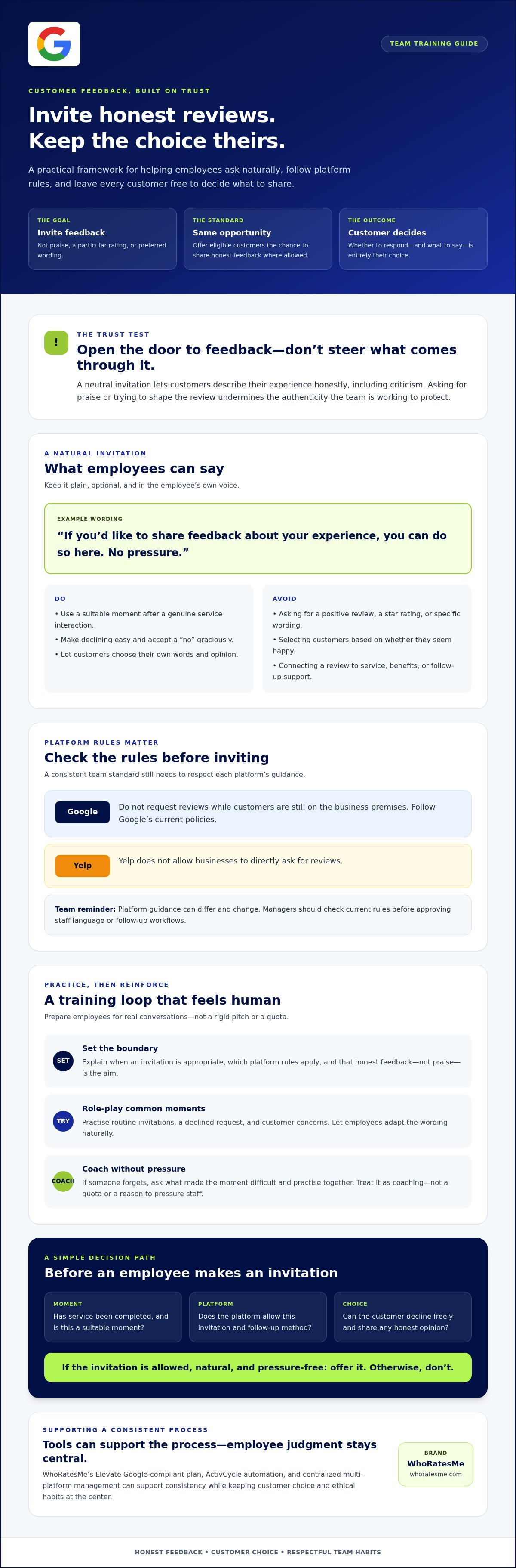
A team can be consistent without trying to control what customers say. Set one clear standard for platforms that permit direct invitations: employees may offer customers the same opportunity to share feedback, but must never suggest a star rating, positive sentiment, or preferred wording. The invitation should leave room for an honest account, including criticism.
Requesting an honest review means inviting a customer to describe their experience; soliciting a positive review means trying to influence what that experience sounds like. That distinction should guide staff conversations and every follow-up process. The FTC’s ethical guidelines for customer reviews offer a useful reference when reviewing how your business collects and presents feedback.
Which review-request practices should employee training rule out?
Make the boundaries explicit. Employees shouldn’t choose whom to invite based on who seems happy, withhold invitations from customers who raise concerns, or connect a review to service, benefits, or follow-up support. Don’t offer rewards for reviews or coach customers to mention a specific employee, service, or phrase. These practices can distort feedback and weaken trust.
Consistency doesn’t mean asking everyone on every platform in the same way. Rules vary: Yelp, for example, prohibits direct review requests, while Google has its own current policies. Managers should check each platform’s guidance before approving staff language or workflows, and update training when that guidance changes.
How can employees keep the invitation natural and optional?
Teach employees to look for a suitable moment after a genuine service interaction, rather than interrupting a customer or bringing it up while they’re still receiving service. Use plain language and make declining easy. For instance: “If you’d like to share feedback about your experience, you can do so here. No pressure.” Staff should adapt the wording naturally, without telling customers what to write.
Agree on an approved way to share the review destination, such as a business-approved follow-up message or link, where the platform permits a direct invitation. Don’t send customers to a public review page only after checking whether they seem satisfied. For platforms that prohibit asking, train staff to use only permitted passive ways to make the business’s presence known.
Clear boundaries can make employees more comfortable: they know what’s appropriate, and customers retain control. As you make training employees to request customer reviews part of a repeatable process, a review-management approach centered on authentic feedback can help keep practices aligned across platforms. Learn about WhoRatesMe’s review management approach.
Give Employees Review-Request Scripts They Can Make Their Own
Employees don’t need a word-for-word pitch. They need a few natural starting points and clear boundaries, so an invitation fits the interaction without turning into pressure. As part of training employees to request customer reviews, practise the purpose of the message, then let staff use their own voice while keeping the meaning neutral.
What can employees say at the end of a service interaction?
After completing service, an employee can thank the customer and, where the platform’s rules allow a direct request, offer a simple invitation. For example: “Thanks for choosing us. If you’d like to share feedback about your experience, you’re welcome to.” Don’t ask for a specific rating or promise a particular outcome. Also check platform rules: Google review requests shouldn’t be made while a customer is still on the business premises, and Yelp doesn’t allow direct review requests.
How should review invitations differ across channels?
A spoken invitation depends on the moment and the platform. A follow-up message gives the customer space to consider the invitation after the interaction. An approved digital prompt can make the destination easier to access, provided its use follows the platform’s rules. In every channel, the message should reflect the service actually received and leave the customer free to decide whether to respond.
Use a simple comparison during training. Managers can adapt examples like these to their approved channels and current platform policies:
- After service, in person where permitted: “If you’d like to share feedback about your experience, you’re welcome to.” Avoid asking on Google while the customer is on the premises, or directly soliciting a Yelp review.
- Follow-up message, where direct requests are allowed: “Thank you for choosing us. If you wish, you can share an honest account of your experience here.” Avoid “Please give us five stars” or language that assumes the customer was satisfied.
- Customer declines or raises a concern: “Of course, no problem,” or “Thanks for telling me. Let’s see how we can help.” Avoid repeating the request, defending the business, or making support conditional on a review.
Employees should know what to do next, too. A declined invitation calls for a gracious close, not another attempt. If a customer raises a concern, listen and follow the normal service-support process; don’t turn the conversation back toward a public review.
Keep the examples short, then invite staff to put them in their own words. Wording can vary by role and channel, but the principles should stay steady: be accurate, make the choice clear, and never coach the customer’s opinion.
Build a Review-Request Training Plan with Practice and Coaching
A written guideline helps, but employees also need a chance to try the approach and get supportive feedback. A repeatable plan makes training employees to request customer reviews part of everyday service standards, not a push to collect a certain number of reviews. Keep the focus on respectful invitations, approved channels, and customer comfort.
A practical training sequence sets boundaries, demonstrates neutral examples, practises real scenarios, observes the process, and refreshes the guidance as needed. Use these steps to put that sequence into action:
- Set boundaries. Explain which platforms allow direct invitations, when requests may be made, and what language or tactics are off-limits. Assign a manager to check platform guidance before approving or changing the workflow.
- Demonstrate examples. Show how an invitation can fit the employee’s role and service moment. Explain what makes it clear, optional, and free of suggestions about ratings or review content.
- Practise scenarios. Role-play a routine invitation, a customer who declines, and a conversation where a customer raises a concern. Give employees room to respond naturally rather than recite a script.
- Observe and coach. Watch the process in practice, using the same standards for timing, clarity, neutrality, and customer choice. Offer specific feedback privately and constructively.
- Refresh the guidance. Ask employees what feels awkward or unclear, then revisit examples and platform rules when the workflow or policies change.
How can managers run a useful review-request role-play?
Choose a familiar point in your service journey and assign one person as the employee and another as the customer. An observer can note whether the invitation fits the moment, uses plain language, and makes declining comfortable. Then replay the scenario with a different response: the customer might say no, ask why a review is useful, or mention a problem. This prepares staff to listen and adapt without turning the exchange into a pitch.
What should managers observe after training?
Check whether employees use approved channels and follow the intended process consistently. Ask staff which moments feel uncomfortable and whether customers have reacted in ways worth learning from. Review process indicators alongside customer complaints or feedback that suggests someone felt pressured. Avoid rating or review quotas; they can shift attention from respectful service to outcomes employees can’t control.
Measure the quality of the invitation, not whether a customer posts or what they say. That keeps coaching grounded in behavior employees can improve, while preserving honest customer choice. See how review management tools can support the process.
Make Ethical Review Requests Easier to Sustain with WhoRatesMe
Even a well-trained team can lose consistency when the next step depends on memory. Documenting who handles an invitation, which approved process to use, and when follow-up is appropriate gives employees a reliable guide without requiring them to sound scripted. Staff still judge the moment and speak naturally; the process simply helps prevent respectful follow-up from being forgotten.
That balance matters. Training employees to request customer reviews establishes the human principles, while a review-management process can help organize feedback collection across customer interactions and platforms. Automation may support consistency, but it can’t decide whether a conversation is appropriate or remove the customer’s choice to respond.
How can automation support a trained team?
WhoRatesMe’s ActivCycle automates feedback collection and management. Used as a process aid, automation can help teams maintain an organized approach to follow-up while employees remain responsible for customer-facing judgment. Before using any automated workflow, confirm its configuration and check the current requirements of each review platform. Automation shouldn’t be treated as a way to guarantee reviews, ratings, or business results.
WhoRatesMe also offers the Elevate Google-compliant plan. That description doesn’t mean Google endorses WhoRatesMe or guarantees an outcome. The useful standard is whether a tool supports a fair, transparent process that invites authentic feedback rather than attempting to influence it.
What should a business look for in review-management support?
Choose support that fits the values and training you’ve established. Consider whether it helps the team manage multiple review platforms from a centralized dashboard and mobile app, and whether its approach supports genuine feedback without review gating or paid review generation. Clear processes should make the next step easier to follow, not decide which customers deserve an invitation or shape what they write.
Review the workflow with employees as well as managers. For example, confirm how staff know when an invitation is appropriate, how a follow-up is handled, and where feedback from different platforms can be managed. Keep customer choice central, and revisit platform requirements as they change. The result should be a process that supports everyday service without replacing the personal care that makes the interaction feel genuine.
If you’re considering a tool to support that process, review WhoRatesMe’s Elevate plan as one option for managing reviews ethically.
Make Honest Feedback a Natural Part of Service
A reliable review process doesn’t depend on employees remembering a perfect line. Training employees to request customer reviews works best when the team knows the boundaries, practises natural invitations, and respects each customer’s choice. Consistent coaching can make the process feel comfortable without turning it into a quota or a scripted exchange.
Keep the focus on inviting honest feedback, not shaping ratings or comments. Document the steps, revisit platform requirements, and use automation to support follow-up while leaving judgment and customer choice with people.
WhoRatesMe offers the Elevate Google-compliant review-management plan, ActivCycle automation for feedback collection and management, and multi-platform management through a centralized dashboard and mobile app. These tools can support a more organized process, but authentic customer feedback remains the goal.
With clear guidance and a respectful routine, your team can make honest feedback easier to invite and easier to trust. Explore WhoRatesMe’s Elevate plan to see whether it fits your review-management approach.
Frequently Asked Questions
How do you train employees to ask customers for reviews?
Train employees to invite honest feedback without influencing what customers write. Explain platform-specific rules, show neutral examples, and practise common situations such as a routine invitation, a customer declining, or someone raising a concern. Then observe how the process works and coach employees on timing, clarity, and customer comfort. A repeatable process helps staff feel prepared without turning invitations into rigid scripts or review quotas.
What should employees say when asking a customer for a review?
Employees should use brief, natural language that makes the invitation optional. For example: “If you’d like to share feedback about your experience, you’re welcome to.” They shouldn’t suggest a rating, preferred sentiment, or specific wording, and they should accept a decline without asking again. Adapt the phrasing to the employee’s role and the service provided, and confirm that direct requests are allowed on the platform being used.
When is the best time for employees to request a customer review?
Choose a suitable point after the service interaction, when the invitation won’t interrupt the customer or feel like part of an obligation. Timing must also follow the review platform’s rules. For example, don’t request a Google review while the customer is still on the business premises, and don’t directly ask for a Yelp review. Where a direct follow-up is permitted, use an appropriate channel and give the customer room to decide.
Can employees offer an incentive for a customer review?
It’s safest to train employees not to offer rewards for reviews. Incentives can undermine trust, and Google prohibits incentives for reviews. Don’t offer a discount, gift, or benefit in exchange for leaving feedback, changing a review, or removing one. Keep service and follow-up support separate from whether a customer posts. Check current platform policies and applicable guidance before approving any review-related promotion.
Should employees ask every customer for a review?
For platforms that allow direct invitations, use a consistent approach so customers have the same opportunity regardless of whether staff expect positive or negative feedback. Don’t selectively invite only customers who seem satisfied. Platform rules still differ: Yelp prohibits direct review requests, so employees should follow its permitted passive-promotion practices instead. Make sure the team understands which process applies to each platform and customer interaction.
How can managers help employees feel comfortable requesting reviews?
Managers can reduce awkwardness by setting clear boundaries and letting employees practise with realistic role-play. Include a routine invitation, a customer who declines, and a conversation where someone shares a concern. Coach staff on listening, neutral language, and how to close the exchange respectfully. Treat missed invitations as a chance to clarify the process, not a reason to pressure employees or set review quotas.
Can review-request automation replace employee training?
No. Automation can help organize feedback collection and follow-up, but employees still need to understand when an invitation is appropriate, what platform rules apply, and how to respond to customers naturally. WhoRatesMe’s ActivCycle supports automated feedback collection and management across channels. Use automation as a process aid, not a substitute for employee judgment or customer choice, and review its workflows against current platform requirements.
