
Turning Customer Complaints into Business Opportunities: A 2026 Guide
A customer complaint is not automatically a verdict on your business. It can be a signal about where an experience fell short and what your team could improve. That doesn’t make difficult feedback easy to hear. Complaints can feel personal, arrive through several channels, and leave teams unsure what to address first. Turning customer complaints into business opportunities starts with listening carefully, not reacting defensively.
Not every complaint proves there’s a widespread problem. Instead, record what happened, look for recurring themes, and investigate possible causes before deciding what to change. A prompt reply matters, but lasting trust depends on following through with the customer and addressing any underlying issue your investigation identifies.
This guide lays out a repeatable process for capturing feedback, distinguishing actionable signals from isolated or unclear comments, and following up. You’ll learn how consistent records and organized feedback across review platforms can help your team spot patterns, while keeping human judgment at the center. The goal is practical improvement and a customer experience people can trust.
Key Takeaways
- Record each complaint consistently, including its channel and place in the customer journey, so you can compare useful details.
- Consider recurrence, customer impact, urgency, and your ability to act when deciding what to investigate first.
- Turning customer complaints into business opportunities means assigning ownership, testing a manageable improvement, and reviewing the results.
- Capture feedback consistently across review platforms to spot recurring concerns without assuming every comment points to a widespread issue.
- WhoRatesMe Elevate and ActivCycle support organized, authentic feedback management while leaving judgment and customer care to your team.
Turning Customer Complaints into Business Opportunities Starts with Listening
A complaint can sting, especially when your team has worked hard to serve someone well. Still, a customer’s frustration may point to something fixable: friction in a process, an unmet expectation, or a communication gap. Turning customer complaints into business opportunities begins by treating feedback as a reason to understand what happened, not as a personal verdict.
A customer complaint describes dissatisfaction with an experience, but the useful business signal often lies beneath the wording. Separate the customer’s immediate frustration from the event that prompted it. Consider what the customer expected, what your business communicated, and what actually happened. A single complaint can justify an investigation, but it doesn’t prove that other customers have the same experience.
What can a customer complaint reveal about the experience?
Look for a gap between what was promised and what was delivered. Did a customer expect an arrival window that wasn’t clearly explained? Was a service step completed without an update? The complaint could point to a process issue, an unclear expectation, or a misunderstanding. Treat each as a possibility to check, not a conclusion.
For example, a customer might report that a technician arrived later than expected. Review what was promised and how timing updates were shared. If similar concerns recur, examine scheduling and customer communications. If the report is isolated, focus on the details of that customer’s experience rather than assuming a broader problem.
Why a constructive response can create room for trust
Listening doesn’t mean agreeing with every claim or promising every requested remedy. Acknowledge the concern, ask focused questions if details are unclear, and explain what will happen next. For example: “I understand the delay disrupted your plans. I’ll review the appointment details and follow up with what I find.” This gives the customer a next step without making an unsupported promise.
Be specific and honest. If you’re still checking the facts, say so. Resolve the individual issue where possible, and consider a process adjustment if your investigation points to a wider concern. These are separate actions: one supports the customer in front of you, while the other may improve how the business works.
The aim isn’t simply to improve a public rating. It’s to make the experience clearer and more reliable. A sincere acknowledgment and a practical next step show that feedback is being taken seriously. Following through makes that response credible, whether the complaint leads to an individual resolution, a process review, or no wider change.
How to Find the Real Problem Behind Customer Complaints
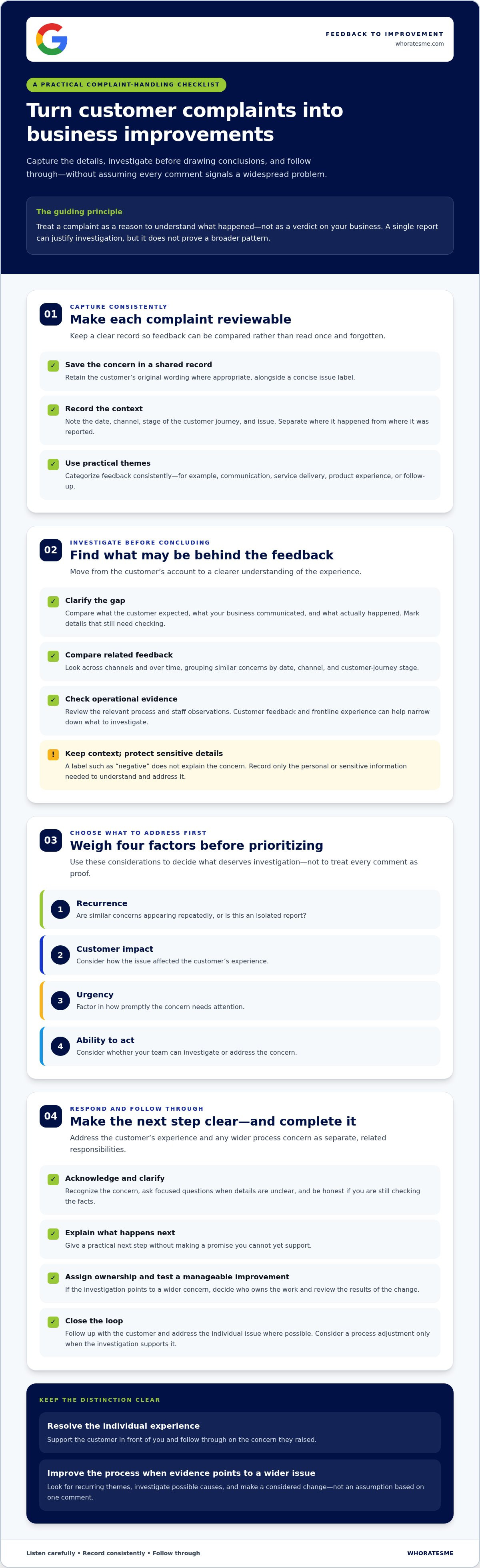
A complaint is more useful as a clear, reviewable record than as a message someone reads once and forgets. A consistent process helps your team move from the customer’s account of what went wrong to a better understanding of what may need attention:
- Capture the feedback: Save the concern in a shared record, retaining the customer’s original wording where appropriate.
- Clarify the issue: Note what happened, what the customer expected, and what details still need checking.
- Look for patterns: Compare related feedback across channels and over time.
- Investigate: Review the relevant process and staff observations before deciding what the feedback means.
For each entry, record the date, channel, stage of the customer journey, and issue using categories your team applies consistently. A concern raised after an appointment, for example, might relate to service delivery, communication, or follow-up. Separating where an issue happened from where it was reported makes comparisons more useful.
How should a business categorize complaints?
Use practical themes such as communication, service delivery, product experience, and follow-up. Keep the customer’s original wording alongside the category so a short label doesn’t erase important context. A sentiment label such as “negative” can help sort feedback, but it doesn’t explain the concern. A customer frustrated about a missed update needs a different investigation from one reporting incomplete work.
How can teams tell recurring patterns from isolated incidents?
Compare similar concerns by date, channel, and stage of the customer journey. Consider frequency alongside customer impact and operational evidence. A cluster of comments about unclear arrival times, for instance, is a reason to check staff notes and how appointment windows are communicated. One comment can still deserve attention, but it doesn’t establish that a problem is widespread.
Compare customer feedback with what frontline staff observe. Staff may notice that customers often ask the same question or that a handoff creates confusion. Neither source gives the whole picture on its own; together, they can help narrow down what to investigate. Handle personal or sensitive details carefully, and record only what’s needed to understand and address the concern.
Analysis matters when it leads to a considered response. Harvard Business Review’s discussion of closing the customer feedback loop supports connecting customer input with action. Organized feedback across review platforms can help teams notice themes. WhoRatesMe’s centralized multi-platform review management brings feedback into a dashboard and mobile app. Explore review management tools to support consistent listening, while leaving interpretation and decisions to your team.
Which Customer Complaints Should a Business Address First?
When several concerns arrive at once, the loudest or newest one isn’t necessarily the most important to investigate. Compare the factors below to decide where to focus, then check the details and context. Use them to guide investigation, not to treat a score as a verdict or assume a complaint proves fault.
| Factor | Questions to consider | Priority signal |
|---|---|---|
| Recurrence | Have similar concerns appeared more than once, across customers or channels? | Repeated reports may point to a process worth examining. |
| Customer impact | Does the issue disrupt an important task or leave the customer unable to proceed? | Greater disruption merits closer attention. |
| Urgency | Could delay make the customer’s situation worse or prevent a timely response? | Time-sensitive concerns may need prompt individual care. |
| Ability to address | Can the team resolve the individual issue or test a practical process change? | A realistic next step helps turn investigation into action. |
Consider the factors together. A one-off preference about a minor detail may call for a courteous response, not a broad operational change. Repeated confusion about a required booking step deserves closer review because it may prevent customers from completing an important task. Frequency matters, but it isn’t the only signal: a serious, time-sensitive concern may need prompt attention even if it’s the first report. Record why you prioritized an issue so decisions are consistent rather than arbitrary.
How do frequency and customer impact shape priority?
Give closer attention to recurring friction that affects an important part of the customer journey. Compare feedback with available operational evidence, and don’t claim a problem is widespread based on limited reports. The goal is to decide what merits investigation, not to make the evidence say more than it does. This measured approach keeps turning customer complaints into business opportunities grounded in what customers and operations actually show.
What if a complaint is unclear or cannot be resolved as requested?
Ask focused, respectful questions to fill in missing details. If the requested remedy isn’t feasible, explain why plainly and offer a realistic next step where possible. Address the customer’s immediate concern separately from any longer-term process review. You might resolve one customer’s issue while assigning an owner to investigate whether a broader change is warranted. Record the concern either way, so an unresolved request can inform pattern analysis without being treated as proof of a recurring fault.
A Practical Process for Turning Complaints into Business Improvements
Once you’ve identified an issue worth addressing, give it a clear path from feedback to action. Assign one person to coordinate the response. That owner doesn’t need to solve every part alone, but should know who handles the next step and when the team will review progress.
Then define a manageable change. If customers seem unsure about what happens after booking, for example, test a clearer confirmation message before redesigning the entire booking process. Tell affected staff what’s changing, why it’s being tested, and how to share what they observe. Explain relevant changes to customers plainly, without promising results the team can’t control.
A consistent workflow helps carry feedback forward instead of losing it between channels or handoffs. This customer feedback automation guide can help teams consider how automation supports regular feedback handling. Use automation to make a dependable process easier to manage, not to replace judgment or personal communication.
How can a team close the loop with a customer?
Acknowledge the concern, summarize the next step, and set expectations you can meet. For instance: “We’re reviewing how appointment updates are sent. I’ll share an update when we’ve checked the process.” Follow up when there’s meaningful information, even if the wider review is still underway. Keep private customer details out of public replies and internal examples unless they’re needed to understand the issue.
How should a business check whether an improvement worked?
Choose an indicator connected to the friction you’re trying to reduce. If customers struggled to understand a process, watch for fewer repeated questions about that step. After introducing a change, review new feedback and ask staff who handle that part of the experience what they’re seeing. Set a review point in advance so the test leads to a decision rather than drifting.
If the same confusion continues, adjust the change or investigate another possible cause. Take new issues seriously too. A small test doesn’t guarantee the first fix will work; it’s a practical way to learn before making a broader operational commitment. That steady cycle is what makes turning customer complaints into business opportunities useful in day-to-day operations.
For a more organized way to manage feedback across review platforms, explore WhoRatesMe review management. Keep feedback authentic and use it to decide what your team should improve.
Build a More Reliable Feedback Loop with Ethical Review Management
Feedback is easier to learn from when it’s captured consistently across the places customers share their experiences. A recurring concern may appear in a public review, a direct comment, or another feedback channel. Bringing those signals together helps your team notice themes and decide what merits closer attention. A pattern is a prompt to investigate, not automatic proof of fault.
WhoRatesMe’s Elevate plan provides Google-compliant review management, and ActivCycle automates feedback processes across channels. A centralized dashboard and dedicated mobile app support multi-platform review management and help teams keep feedback organized. Automation can support consistent listening and follow-up, but it can’t determine what a customer meant or which operational change is right. Staff should consider the details before acting.
How can feedback automation support a human response?
A centralized view makes it easier to monitor customer comments across multiple review platforms and notice concerns that might otherwise remain separated by channel. ActivCycle supports consistent feedback processes, while your team reads the context, distinguishes an individual experience from a possible pattern, and chooses an appropriate response. This balance keeps the process organized without making customer care feel impersonal.
What does ethical review management look like in practice?
Invite feedback through a consistent process, without choosing who receives a request based on whether they seem satisfied. Don’t offer payment or incentives in exchange for positive reviews, and don’t make review removal part of your response to criticism. Instead, welcome authentic feedback from real customers, respond constructively, and use recurring concerns to guide practical improvements. For more context, read these guides to Google-compliant review management and non-gated review platforms.
A consistent, authentic feedback process helps your team listen across channels, recognize recurring concerns, and respond with care. That’s the value of turning customer complaints into business opportunities: not simply collecting comments, but using them thoughtfully to strengthen the customer experience and long-term credibility.
WhoRatesMe’s Elevate plan supports Google-compliant review management, and ActivCycle helps automate feedback processes across channels. The approach avoids review gating, paid review generation, and review removal, keeping authentic customer feedback at the center.
Make Customer Feedback a Steady Source of Improvement
Complaints can be difficult to hear, but thoughtful listening can reveal friction, unclear expectations, or a process worth reviewing. Capture feedback consistently, look for patterns across channels, and investigate before deciding what needs to change. Then assign an owner, test a manageable improvement, and follow up with customers honestly.
That’s the practical value of turning customer complaints into business opportunities: don’t treat every comment as proof of a widespread issue; use credible feedback to make the customer experience clearer and more reliable. A consistent, ethical review process helps your team listen without filtering feedback according to whether a customer seems satisfied.
WhoRatesMe’s Elevate plan provides Google-compliant review management, while ActivCycle supports automated feedback processes across channels. WhoRatesMe avoids review gating, paid review generation, and review removal, keeping authentic customer feedback at the center.
Explore WhoRatesMe Elevate for ethical review management and build a more organized way to listen and respond. Each complaint is a chance to understand the experience better and take a considered next step.
Frequently Asked Questions
How can a business turn customer complaints into opportunities?
Listen carefully, check what happened, and use the feedback to guide a practical next step. Record the concern and its context, then look for similar reports and compare them with staff observations. If the evidence points to a process issue, assign someone to investigate or test a focused improvement. Follow up with the customer honestly. The goal is a better experience, not simply a more favorable public rating.
Should a business respond to every customer complaint?
A business should aim to acknowledge complaints and respond appropriately, especially when a customer is seeking help or clarification. A useful reply recognizes the concern, explains the next step, and avoids arguing or making promises the team can’t keep. For public feedback, protect private details and keep the response professional. The reply doesn’t need to settle every disagreement publicly; it should show that the business has considered the concern and is handling it responsibly.
What should a business do when the same complaint keeps happening?
Repeated complaints call for a closer look at the process, not just another individual reply. Group the reports by issue, channel, and customer journey stage, then compare them with staff observations and available operational records. Assign an owner to investigate the likely cause and propose a manageable change. After testing it, review new feedback to see whether the same friction continues. A recurring theme is a reason to investigate, not automatic proof that every case has the same cause.
How do you prioritize customer complaints?
Consider recurrence, customer impact, urgency, and whether your team can take a practical action. Repeated confusion that prevents customers from completing an important step may deserve more investigation than a one-off preference. Still, a serious time-sensitive concern may need prompt attention even if it’s the first report. Use these factors to guide decisions, not to decide fault automatically. Record why an issue was prioritized so the team can apply its judgment consistently.
Can customer complaints improve a business even when the customer is mistaken?
Yes. A customer may misunderstand a policy or have an inaccurate account, but the interaction can still reveal unclear instructions, confusing expectations, or a communication gap. Check the facts respectfully before deciding what happened. Explain the situation plainly, and consider whether the information could be easier to understand next time. The complaint doesn’t have to be fully accurate or lead to a process change to offer a useful opportunity to clarify the customer experience.
How can a business collect feedback without review gating?
Invite feedback through a consistent process that doesn’t select customers based on whether they seem satisfied. Avoid offering payment or incentives in exchange for positive reviews, and don’t filter out critical voices. WhoRatesMe’s Elevate plan supports Google-compliant review management, while ActivCycle automates feedback processes across channels. Your team can organize and review feedback with human judgment, using authentic comments to understand customer concerns rather than steering which opinions are shared.
