Using Customer Sentiment for Growth: 2026 Ethical Guide
What if the most valuable asset in your business isn't your product, but the quiet whispers of your customers scattered across the web? You probably feel the weight of the Experience Gap, that frustrating distance between the service you strive to provide and the feedback you see online. Learning how to use customer sentiment for business growth shouldn't feel like a high-stakes gamble with Google’s strict 2026 compliance rules. It’s exhausting to manually track comments across five different platforms while trying to keep up with twenty different state privacy laws. You want to listen, but you also need to protect your reputation without the constant anxiety of a policy violation.
We understand that your time is better spent serving people than decoding complex data. This guide promises to help you transform raw feedback into a strategic growth engine that runs on autopilot. You'll discover how to build a streamlined, ethical feedback loop that satisfies both your customers and the latest FTC standards. We will walk through the shift toward automated sentiment analysis, the importance of authentic service-related comments, and the exact steps to achieve sustainable growth built on transparency and trust.
Key Takeaways
- Learn how to use customer sentiment for business growth by treating every review as a predictive indicator of future revenue rather than just a record of the past.
- Discover why strict adherence to Google’s 2026 compliance standards builds a foundation of authentic trust that protects your brand from policy violations.
- Find out how centralizing feedback from multiple platforms into a single dashboard can eliminate the stress of manual tracking and provide a clear view of your reputation.
- Understand how to transform negative feedback into a roadmap for innovation while using positive sentiment as sincere social proof in your marketing.
- Explore how automated systems like the Elevate plan provide the stabilization you need to scale your business aggressively without compromising your integrity.
Understanding Customer Sentiment as a Growth Catalyst
A five-star rating feels good, but it rarely tells the whole story. It's a snapshot of a moment, a simplified version of a complex human experience. To truly understand Sentiment Analysis, you must look for the emotional subtext hidden within the actual words of a comment. This subtext is the real driver of long-term success. Learning how to use customer sentiment for business growth involves moving beyond the vanity metrics of a high average score and listening to the "why" behind the "what."
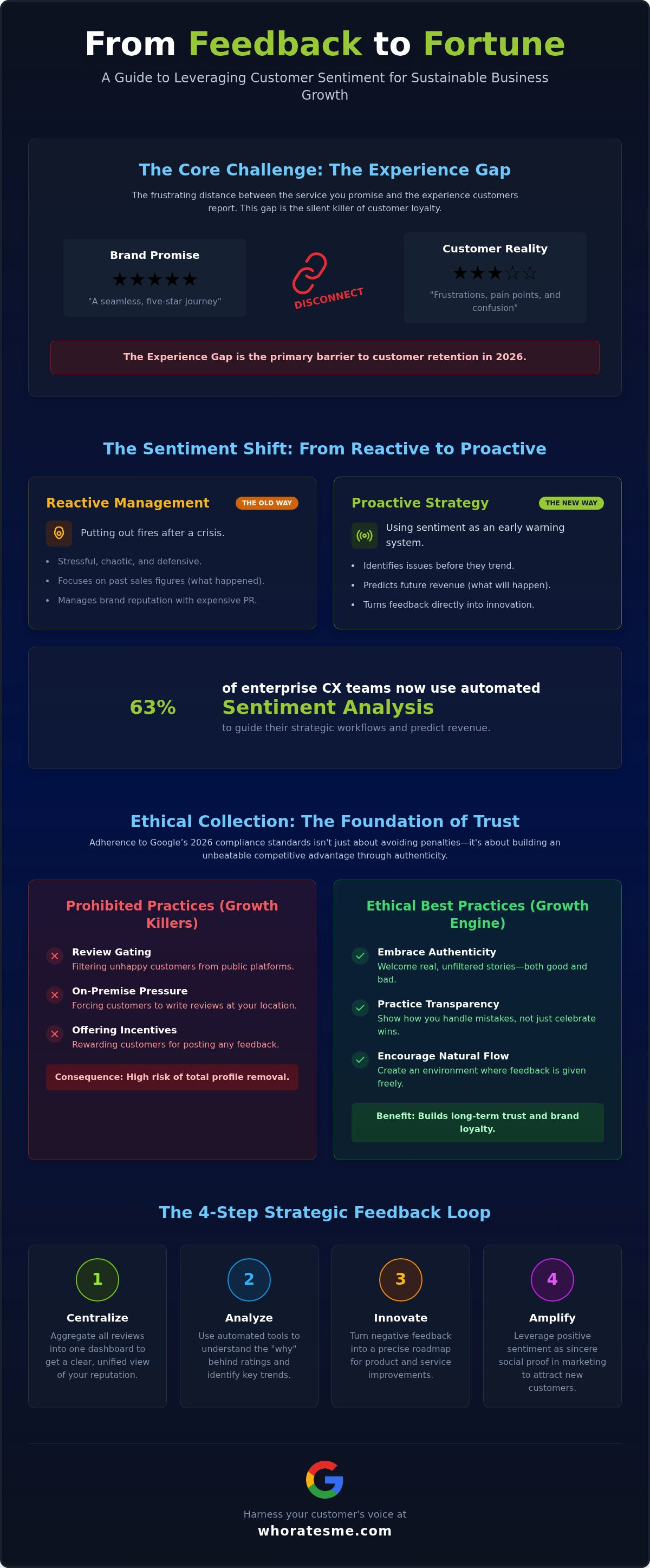
By 2026, sentiment data has become more predictive of future revenue than last month's sales figures. While sales tell you what happened, sentiment tells you what is likely to happen next. In fact, 63% of enterprise CX teams now use automated sentiment analysis to guide their workflows. A numeric score is a blunt instrument; it lacks the nuance of a sentence that describes a specific pain point or a moment of delight. When a customer takes the time to write, they are handing you a piece of their perspective. These words are the raw materials for your strategic growth engine, providing the clarity needed to make confident, human-centered decisions.
The Experience Gap: Where Growth Goes to Die
Your marketing might promise a seamless journey, but your reviews might tell a different story. This disconnect is where customers lose trust. When your brand promise doesn't match the reality of the interaction, you're facing a leak in your sales funnel. The Experience Gap is the primary barrier to customer retention in 2026. If you ignore these subtle signs of frustration, you're letting your growth potential slip through the cracks. It's a silent killer of loyalty that often goes unnoticed until your churn rate starts to climb. Identifying this gap requires an unfiltered view of feedback across every platform you use.
From Reactive to Proactive: The Sentiment Shift
Waiting for a public relations crisis to erupt is the most expensive way to manage your brand. It's stressful. It's chaotic. Instead, treat customer sentiment as an early warning system for shifts in the market. By listening with empathy, you can identify a minor frustration before it becomes a widespread trend. This proactive approach turns feedback into a tool for innovation: it's about synchronization. Using sentiment proactively allows you to stay ahead of the curve by:
- Identifying product or service flaws before they impact a larger audience.
- Pinpointing specific staff training opportunities based on real, authentic feedback.
- Recognizing emerging trends in customer preferences before your competitors do.
When you stop reacting and start listening, you regain control over your business's future. It's a shift from putting out fires to building a foundation of authentic trust. This transition creates a sense of order in a chaotic digital environment, allowing you to focus on the success of your users with quiet confidence.
Ethical Sentiment Collection: The Foundation of Trust
Many business owners feel a quiet pressure to hide any sign of a less than perfect experience. It's a natural instinct. You've invested your heart and soul into your company, and you want that to reflect online. However, in 2026, the pursuit of a flawless five star rating often backfires. When customers see a profile with zero negative feedback, they don't see excellence; they see a lack of transparency. Authentic trust is built on real, unfiltered stories. Understanding how to use customer sentiment for business growth starts with the courage to be honest. It's about creating a Quiet Innovator environment where feedback flows naturally without the need for high pressure tactics or prohibited incentives.
Google’s 2026 policies are very clear: pressuring customers to write reviews while on your premises or offering rewards for feedback is a violation that can lead to total profile removal. By following these rules, you aren't just avoiding a penalty. You're building a competitive advantage. Authenticity beats perfection every time in the eyes of the modern consumer. They want to know how you handle mistakes, not just how you celebrate wins. This transparency creates a sense of order and reliability that "perfect" brands simply cannot match.
Why Review Gating Kills Long-Term Growth
Review gating is the practice of selectively filtering out unhappy customers before they reach a public platform. It might seem like a shortcut to a better score, but it’s a growth killer. Beyond the legal risks from the FTC, there's the Trust Tax. Modern consumers are savvy; they can sniff out curated ratings quickly. To build a fortress of authentic feedback, you need to follow the definitive guide to non-gated review platforms. Embracing every comment, even the difficult ones, proves you have nothing to hide and values truth over a manufactured image.
ActivCycle: Automating the Ethical Feedback Loop
Asking for feedback can feel awkward. It often happens at the wrong time, or it feels like a burden on the customer. ActivCycle automation solves this by synchronizing requests with the peak moments of customer satisfaction. It removes the human error and the emotional weight of the ask. By creating a steady, predictable rhythm, you ensure every customer has a voice. This leads to a balanced sentiment profile that feels grounded and real. When your feedback loop is on autopilot, you can stop worrying about the mechanics of collection and start focusing on the insights. If you're looking for a way to simplify this process, you might explore how a centralized dashboard can bring order to your multi platform reputation.
Analyzing Sentiment Across Multiple Platforms
Managing your online reputation can feel like a full-time job you never applied for. One moment you're checking Google, the next you're jumping to Facebook, only to finish the hour on Yelp. It's a fragmented, exhausting cycle. This chaos of fragmentation doesn't just cause burnout; it obscures the very insights you need. When your data is scattered, it's nearly impossible to see the bigger picture. You might miss a recurring complaint about service speed on one platform because you're too busy responding to a compliment on another. To truly master how to use customer sentiment for business growth, you need a panoramic view rather than a collection of peepholes.
Centralizing your feedback into a single, unified review management dashboard brings a sense of order to the noise. It allows you to identify cross-platform trends that would otherwise remain hidden. If "slow checkout" appears in three different places, you aren't just looking at isolated incidents. You're looking at a systemic issue that requires your attention. By organizing this data, you reduce the daily pressure of monitoring, allowing you to move from a state of constant alert to one of quiet confidence. It's about synchronization: making sure your brand's reality matches your brand's promise across every digital touchpoint.
One Dashboard, Infinite Clarity
A centralized view is more than just a convenience. It's a strategic necessity. Utilizing multi platform review management helps you identify these systemic business issues before they impact your bottom line. Seeing your aggregate sentiment score in real-time provides a stabilizing force in a chaotic environment. Many business owners find that "consolidating every platform into a single view allows us to reclaim over 10 hours of administrative work each week, effectively turning frantic reputation monitoring into a streamlined, automated process." This reclaimed time is better spent on the human side of your business, where real growth happens.
Monitoring on the Move: The Mobile App Advantage
Your business doesn't stop when you leave your desk, and your reputation management shouldn't either. The mobile-first reality of 2026 means you need to be able to listen and respond from anywhere. A mobile app allows you to maintain control without being tethered to a computer. This is especially critical during the "Golden Hour"—that brief window of time where responding to critical sentiment can prevent a minor issue from going viral. By staying connected through a mobile app, you can protect your reputation while managing the daily operations of your company. It provides the freedom to grow your business on your own terms, knowing that your feedback loop is always within reach.
Strategic Implementation: Turning Feedback into Revenue
Data without action is just noise. To truly master how to use customer sentiment for business growth, you must bridge the gap between listening to your customers and changing your operations. This isn't about vanity metrics or generic "thank you" replies. It's about a methodical approach to revenue generation. When you treat every review as a piece of a larger puzzle, you begin to see patterns that your competitors miss. You can identify your Brand Champions, those vocal supporters who provide free word of mouth marketing, and focus your energy on keeping them satisfied. Closing the loop by showing customers that their feedback resulted in real change is the fastest way to build unshakeable loyalty.
Negative Feedback: Your Most Valuable Growth Asset
A critical review isn't a failure; it's a free consultation. Critics tell you exactly where the friction exists in your business. The secret is separating the "noise" of a one off bad day from the "signal" of a systemic issue. Using specialized customer feedback software allows you to categorize these complaints into actionable tasks. Instead of feeling overwhelmed by a negative comment, you can use the "Pivot" strategy. If multiple customers mention a specific service takes too long, don't just apologize. Use that sentiment to launch a new, streamlined service tier. This turns a recurring complaint into a fresh revenue stream while proving to your audience that you actually listen.
Social Proof: Turning Words into Wealth
Authenticity is the most powerful currency in 2026. While many businesses chase a perfect 5.0 rating, the psychology of the "Unfiltered Review" suggests that a 4.7 star average often sells better. Consumers are savvy. They trust a business that shows a human side more than one that appears suspiciously flawless. You can ethically repurpose this praise in your ad copy to lower your Customer Acquisition Cost (CAC). When a real customer describes their experience in their own words, it carries more weight than any marketing slogan you could write. It's a natural, honest way to build social proof that resonates with a skeptical audience. If you're ready to start turning your reviews into a strategic advantage, you can explore our automation tools to simplify the process.
By treating sentiment as a roadmap rather than a scoreboard, you create a business that evolves with its customers. This steady, organized growth feels less like a struggle and more like a natural progression toward total control. You stop guessing what people want and start building exactly what they are asking for.
Scaling Growth with the Elevate Google-Compliant Plan
Scaling a business often feels like trying to keep a fire burning while a storm is brewing. You want to grow, but you're worried about the stability of your foundation. In the 2026 digital environment, playing by the rules is your greatest competitive advantage. Google's algorithm has evolved to favor brands that show consistent, authentic human interaction over those using "hacks" or incentivized reviews. Understanding how to use customer sentiment for business growth means aligning your scaling strategy with these ethical standards. It provides the stabilization you need to grow aggressively without the fear of a sudden penalty wiping out your progress. When your growth is built on integrity, it becomes sustainable.
The Elevate plan is designed to be that stabilizing force. It doesn't just collect data; it synchronizes your reputation management with your business goals. By ensuring every step of your feedback process is 100% Google-compliant, you build a fortress of trust that protects your brand during periods of rapid expansion. This move from a reactive posture to a proactive, compliant strategy is what separates market leaders from those who are constantly struggling to keep their heads above water. You gain the peace of mind that comes from knowing your reputation is on autopilot, leaving you free to focus on the human side of your company.
The Quiet Innovator: Why Autopilot Beats Manual
Manual reputation management is a burden. It's a constant drain on your mental energy. You find yourself checking notifications at dinner or worrying about a single comment while trying to plan next year's budget. The psychological relief of knowing your feedback loop is always running is transformative. By implementing customer feedback automation, you reclaim your role as a leader. You move from "managing reputation" to "leading a sentiment-driven brand." This shift allows you to focus on high-level strategy while your feedback system operates quietly in the background. It creates a sense of order. It provides clarity. You finally have the unfiltered view of information needed to make bold moves with confidence.
Join the Ethical Growth Movement
The temptation to use shortcuts is always there. Some might suggest review removal services or selective filtering, but these are short-term gambles that lead to long-term failure. Integrity is the only sustainable path to growth in 2026. Choosing a Google-compliant strategy today protects your reputation for years to come. It's about being real, not perfect. When you prioritize sincerity, you build a community of loyal customers who act as your most effective marketing team. It’s time to move from being overwhelmed by feedback to being in total control of your narrative. Discover how the Elevate plan can transform your growth and help you build a business that thrives on authentic trust.
Building Your Sentiment-Driven Future
The journey from feeling overwhelmed to being in total control starts with a single shift in perspective. You've seen how treating feedback as a roadmap rather than a scoreboard can redefine your strategy. By mastering how to use customer sentiment for business growth, you don't just improve your ratings; you build a business that truly listens and evolves. Centralizing your feedback through a multi-platform dashboard and embracing ActivCycle automation allows you to reclaim your time while ensuring your reputation stays on autopilot.
Integrity is your greatest asset in 2026. Choosing to stay 100% Google-compliant isn't just about following rules; it's about building a foundation of authentic trust that your competitors can't match. You possess the tools to bridge the Experience Gap and turn every customer interaction into a catalyst for success. It's time to stop guessing and start leading with quiet confidence. Every comment is an opportunity to strengthen the bond with your community and secure your place in the market.
Scale your business ethically with our Elevate Google-compliant plan. Your reputation is in good hands.
Frequently Asked Questions
Is it possible to use customer sentiment for business growth without expensive AI tools?
Yes, it's absolutely possible to focus on the human side of your business without a massive enterprise budget. You can learn how to use customer sentiment for business growth by simply listening to the words your customers use. Tools like ActivCycle automation provide an accessible way to gather this data ethically. This approach prioritizes authentic connection over complex algorithms. It allows you to identify what people truly want without feeling overwhelmed by technical jargon or high costs.
How does Google's 2026 policy affect how I should collect customer feedback?
Google’s 2026 policies strictly prohibit businesses from pressuring customers to leave reviews while they're still on your premises. You also can't offer incentives like discounts or free gifts in exchange for feedback. These rules are designed to protect the authenticity of the platform. By following a Google-compliant plan, you ensure your reputation is built on a foundation of real trust. This protects your profile from being flagged or removed while building long-term credibility.
What is the difference between sentiment analysis and just reading my reviews?
Reading reviews gives you individual stories, but sentiment analysis identifies the emotional subtext and recurring patterns across hundreds of comments. It moves beyond the star rating to tell you how people feel about specific aspects of your service. While a single review is a snapshot, analysis provides a panoramic view of your brand's health. This deeper understanding helps you make strategic decisions based on collective emotions rather than isolated incidents, bringing clarity to your growth strategy.
Can I really grow my business by showing negative reviews?
Authentic transparency is often more persuasive than a manufactured "perfect" image. Modern consumers are savvy and often trust a 4.7 star rating more than a suspicious 5.0. Showing that you're real and that you handle mistakes with integrity builds unshakeable social proof. Negative feedback serves as a diagnostic tool for your operations. It highlights exactly where you can improve to better serve your community, turning potential friction into a clear path for future revenue.
How much time does automated customer feedback management actually save?
Automated systems can reclaim significant portions of your work week by centralizing feedback from multiple platforms into one view. Many business owners find that moving away from manual tracking saves them over 10 hours of administrative work every week. This reclaimed time allows you to focus on high level strategy and direct customer service. Instead of feeling tethered to your screen, you can let your feedback loop run on autopilot, ensuring you never miss a critical insight.
Is review gating still a common practice, and why is it risky now?
Review gating, or selectively filtering for only positive feedback, is a violation of both Google’s policies and FTC regulations in 2026. While it was once common, it now carries the heavy risk of legal penalties and total profile removal. Consumers also find "perfect" profiles less trustworthy. Embracing every piece of feedback proves you have nothing to hide. It builds a fortress of authentic trust that protects your brand from the "Trust Tax" and ensures sustainable, ethical growth.
How can a mobile app help me with customer sentiment management?
A mobile app turns reputation management into a flexible, on the go process rather than a desk bound chore. It allows you to respond to critical sentiment during the "Golden Hour," which is the brief window before a minor issue can escalate online. You can maintain total control of your narrative while managing your daily operations. This synchronization ensures that you're always connected to your customers’ needs, no matter where your work takes you throughout the day.
What happens if my sentiment score drops suddenly?
A sudden drop in your sentiment score is an early warning system rather than a reason for panic. It usually points to a specific, systemic change in your customer journey that needs attention. By using a centralized dashboard, you can quickly pinpoint whether the issue is related to staff, service speed, or a specific product feature. This proactive approach allows you to fix the leak in your sales funnel before it impacts your long term revenue or brand reputation.
