
Using Review Feedback to Train Customer Service Teams
What if a one-star review is a useful coaching signal, but not proof that an employee failed? Customer comments can reveal where service needs attention, yet a single account rarely tells the whole story. When feedback is scattered across review sites and channels, it’s even harder to spot recurring issues without overreacting.
It’s understandable to want clear answers from customer feedback. But coaching works best when it’s specific, fair, and focused on what the team can practice, not on blame. Using review feedback to train customer service teams means looking for patterns, checking the context, and turning real examples into supportive conversations.
This guide will show you how to organize reviews, distinguish repeated themes from one-off experiences, and translate useful comments into practical coaching and role-play. You’ll also learn how to close the loop by checking whether changes improve the customer experience while protecting customer and employee trust. With a consistent process, reviews become more than public ratings: they become a grounded way to learn and improve together.
Key Takeaways
- Use reviews as customer experience signals, not as stand-alone employee performance evaluations.
- Bring feedback from relevant channels into a repeatable process that preserves context while removing unnecessary personal details.
- Compare recurring, specific comments with isolated or unclear feedback before deciding whether coaching is needed.
- Turn validated themes into focused practice, such as role-play, response reviews, peer demonstrations, or job aids.
- Make using review feedback to train customer service teams a consistent learning loop, with software supporting organization and managers guiding interpretation.
What customer reviews can, and cannot, teach a service team
A customer review is a person’s description of an experience with a business. It may offer a useful view of how service felt from the customer’s side, but it isn’t a formal employee evaluation or a complete record of what happened. A comment about a missed update, for example, can point to a communication issue worth exploring. It can’t, by itself, establish why the update was missed or who was responsible.
That distinction matters when using review feedback to train customer service teams. Reviews can surface themes in communication, reliability, clarity, and handoffs between people or channels. The broader Customer service context includes interactions across different channels, so a customer’s account may reflect several steps in the experience rather than one employee’s actions. Treat the review as a prompt to understand the experience, not a verdict on an individual.
Review-informed coaching uses customer descriptions to identify skills worth reinforcing or practicing, while treating each review as partial evidence rather than a performance score. That definition sets a fair boundary: customer perspectives matter, and interpretation still needs care.
Which parts of a review are useful for coaching?
Focus on observable moments and the behaviors they may suggest. “I didn’t know when the technician would arrive” points to an expectation-setting opportunity; “the team kept me updated” identifies follow-through worth recognizing. Separate what the customer says happened from assumptions about intent. A delayed reply may feel dismissive to a customer, but the review alone can’t establish that an employee intended to ignore them.
Positive comments are useful, too. A specific mention of patient explanations or a helpful handoff can give managers a behavior to reinforce and teammates a concrete example to discuss. Look for actions, not just labels such as “great” or “rude.”
Why one review should not become a verdict
A review captures one person’s perspective, which can be shaped by the complexity of the service, what they knew at the time, or details they didn’t see. A customer may describe the final outcome without knowing that another team handled a delay. The account still deserves attention, but context can change what it teaches.
Don’t rank employees using isolated ratings or unverified public comments. Instead, use a review to begin a private conversation and check relevant service details before deciding on coaching. Ask what the employee remembers, whether the process or handoff contributed, and what could make the next interaction clearer. Reviews should prompt an evidence check, not automatic discipline.
This approach protects trust while keeping feedback useful. It allows a manager to take a customer’s experience seriously without treating one account as the whole story. The aim is a fair next step: reinforce a behavior, explore a possible process gap, or gather more context before drawing a conclusion.
How to turn customer reviews into a repeatable training loop
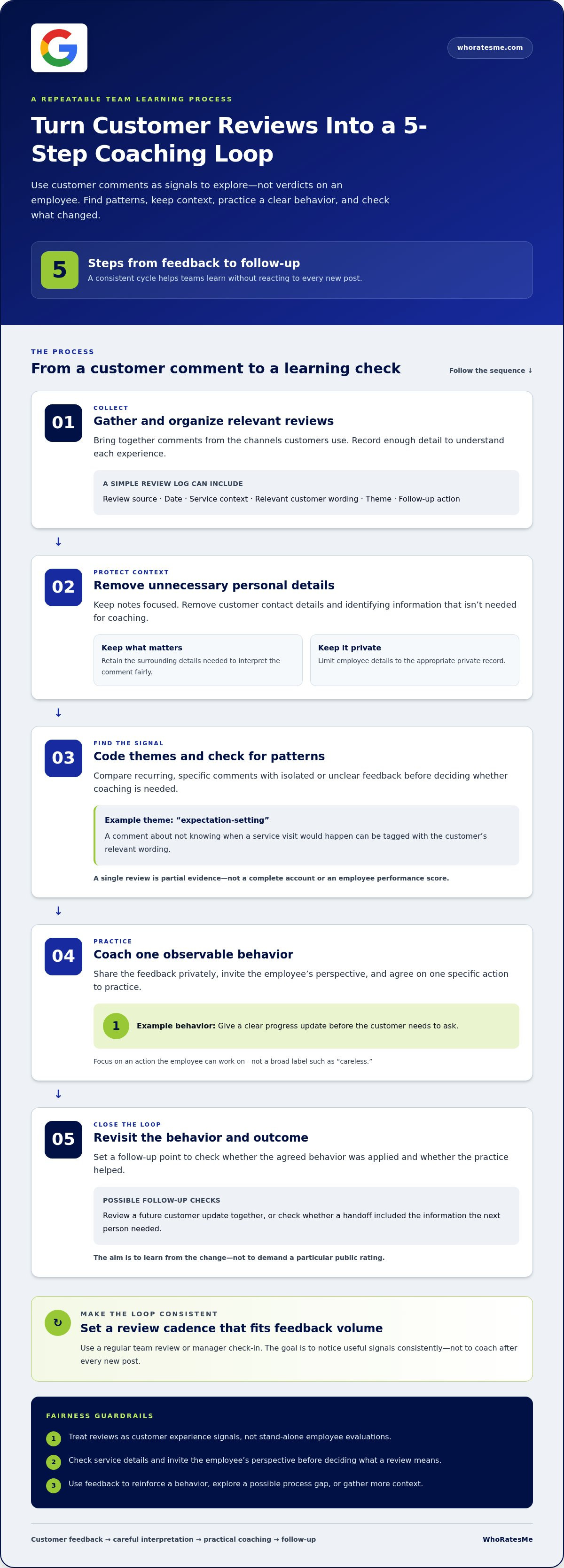
A reliable process keeps feedback from becoming a stream of urgent reactions. Instead of coaching after every new post, set a review cadence that fits the volume of feedback your team receives, such as a regular team review or manager check-in. The goal is to notice useful signals consistently, preserve enough context to interpret them, and connect any coaching to a clear next step.
Gather reviews, remove unnecessary personal details, code recurring themes, coach one observable behavior, and revisit the outcome. That five-step cycle makes using review feedback to train customer service teams more deliberate and easier to learn from. It also reflects the feedback-loop approach discussed in Salesforce’s Customer Service Best Practices.
Gather and organize feedback without losing context
Bring together relevant comments from the channels customers use, then record enough information to understand each one. A simple log can include the review source, date, service context, customer’s relevant wording, theme, and any follow-up action. For example, a comment about not knowing when a service visit would happen could be tagged as “expectation-setting,” while noting the wording that signals the concern.
Keep notes focused. Remove customer contact details and other identifying information that isn’t needed for coaching, and limit employee details to the appropriate private record. Don’t strip away context that changes the meaning of a comment. A short excerpt can be useful, but retain the surrounding details needed to interpret it fairly.
Move from a feedback theme to a coaching conversation
Once a comment points to a skill worth discussing, share it privately and invite the employee’s perspective. Ask what was happening in the interaction before deciding what the review means. Then agree on one behavior to practice, such as giving a clear progress update before a customer needs to ask. Avoid broad labels like “careless”; they don’t describe an action the employee can work on.
Close the conversation with a follow-up point. A manager might review a future customer update together or check whether a handoff included the information the next person needed. The purpose is to see whether the agreed behavior was applied and whether the practice helped, not to demand a particular public rating.
Organization can make this routine easier across multiple review channels. WhoRatesMe’s centralized dashboard and mobile app support multi-platform review management, while ActivCycle automation helps streamline customer feedback workflows. Those tools can help keep feedback in view; managers still decide what a comment means and whether it calls for coaching. If you’re looking to manage customer reviews across platforms, a consistent workflow can make the coaching loop easier to maintain.
At the next review, revisit the action: Was the behavior practiced? Did the team find the coaching useful? Is there enough new feedback to suggest a broader pattern, or is the original comment still an isolated account? That final check helps managers refine the training response rather than letting a single review define the lesson.
How to identify real training needs without overreading reviews
A collection of reviews can contain mixed signals: one customer praises a smooth handoff, another describes confusion, and a third leaves a low rating with no details. Don’t let the star score or strongest emotion decide what the team should learn. Group comments by service moment or observable behavior, then check whether similar experiences appear across customers and over time.
There’s no universal number of comments that proves a pattern. Consider how specific the feedback is, whether examples recur, and whether they relate to the same part of the service. Conflicting feedback is useful, too. It may point to different customer needs, inconsistent processes, or context that deserves a closer look.
Separate recurring patterns from one-off experiences
Compare review themes with relevant service records, employee input, and other customer feedback before deciding on training. For example, several detailed comments about unclear estimates may justify checking how pricing is explained. A single vague complaint may call for more context first. Keep opposing comments visible rather than forcing them into one conclusion.
Repeated, contextualized signals justify investigation, not automatic conclusions. This is a practical safeguard for using review feedback to train customer service teams: evidence can point to a question worth exploring without proving who or what caused the experience.
Choose a fair response to each feedback signal
Match the response to the strength and clarity of the signal. Repeated positive examples can become peer-learning material, shared without exposing customer or employee details. Unclear criticism calls for context gathering, not a training mandate. If comments point to a broken scheduling step or confusing policy, bring the issue to the people responsible for the process instead of placing the burden on one employee.
| Feedback signal | Supporting examples | Alternative explanations | Next step |
|---|---|---|---|
| Possible pattern: estimates seem unclear | Specific comments from different customers mention uncertainty about what work is included | Estimate wording, service complexity, or changing scope may contribute | Review estimate explanations and ask staff where customers commonly need clarification |
| Isolated, vague criticism | One comment says the visit was “disappointing” without describing why | Unstated expectations or an issue outside the interaction may be involved | Gather context before choosing a coaching response |
| Repeated positive behavior | Customers describe staff as patient when explaining next steps | Some interactions may be more complex than others | Share the behavior as a privacy-conscious peer example |
Use a simple evidence check before deciding: Does the comment describe a specific moment? Do other sources support the theme? Could the service process explain it? What response fits what’s known? That pause helps managers distinguish a skill-building opportunity from a process concern or an account that remains too incomplete to act on.
When comments conflict, don’t average them into a verdict. Check whether experiences differ by service type, handoff, or customer expectation. The aim is not to dismiss difficult feedback; it’s to make sure the next step is proportionate, grounded, and useful to the team.
Turn customer feedback themes into practical team training
A validated feedback theme becomes useful when it points to a skill an employee can practice. “Improve communication” is too broad to guide a training session. “Explain the next step and check that the customer understands” is observable, teachable, and easier to revisit. This is the practical heart of using review feedback to train customer service teams: move from a customer concern to a focused behavior, then give the team a safe way to practice it.
Match the exercise to the skill. Role-play can help with listening and difficult conversations; reviewing a written response can sharpen clarity and tone; a peer demonstration can show a helpful approach in action; and a short job aid can support a process employees need to follow consistently.
Build coaching exercises around real service moments
Create an anonymized scenario from a recurring theme, keeping the customer’s concern intact while removing details that could identify them. For example, if customers say they felt rushed while describing a problem, have one employee practice listening without interrupting, summarizing the concern, and confirming what help is needed. Ask the group to explain how each choice could make the interaction clearer for the customer.
Keep the practice specific and respectful. A manager might say, “You summarized the issue before offering a solution; that gave the customer a chance to correct a misunderstanding,” rather than “You’re naturally good with people.” Behavior-based feedback names what happened and why it helped. Use positive review examples to demonstrate useful actions, but share them without publicly singling out the employee or exposing the customer.
Choose the exercise that fits the learning need:
- Role-play: practice listening, de-escalation, or explaining a next step.
- Response review: compare wording for clarity, accuracy, and an appropriate tone.
- Peer demonstration: show a useful behavior, then discuss what made it effective.
- Job aid: provide a quick reminder for a repeated process or handoff.
Make follow-up part of the learning plan
End the coaching conversation with one practice goal and an agreed check-in point. For instance, an employee might aim to summarize a customer’s concern before proposing a solution, then reflect on how that felt in a later interaction. Keep the goal achievable and clear enough that both manager and employee can recognize it in practice.
At follow-up, review relevant interactions and new feedback alongside the employee’s perspective. Don’t use ratings alone as a measure of progress; consider whether the behavior was applied, what the employee learned, and whether customers’ descriptions offer useful context. If the same difficulty persists, ask whether tools, staffing, or a confusing process may be contributing. Training is not the answer to every service problem.
Authentic feedback from real customers can help surface coaching opportunities when it’s reviewed with care. Manage customer reviews across platforms to keep customer feedback easier to review as you build a thoughtful learning process.
Build an ethical review-to-training process that teams can sustain
A useful training loop depends on trust. Customers should be invited to share authentic feedback consistently, and managers should review it with the same care whether a comment is positive, negative, or mixed. Don’t surface only the reviews that support a preferred story. A balanced view helps teams learn from real customer experiences without turning public comments into a tool for blame.
Set simple safeguards before feedback enters coaching. Keep customer and employee details private, share only what’s needed for the learning conversation, and limit access to people with a clear role in the process. Most importantly, keep review feedback separate from performance consequences unless independent evidence supports a decision. A public comment can raise a concern; it shouldn’t stand alone as proof.
Set clear safeguards for using customer reviews in coaching
Write down how feedback is gathered, reviewed, and used. Apply the same approach across relevant channels, and don’t selectively request or share reviews based on their sentiment. In coaching, discuss the service behavior or process rather than judging an employee’s character. This clarity helps employees understand what reviews can inform and what requires a fuller evidence check.
Consistency also makes the process easier to sustain. Managers can set a regular review point, keep notes focused on the service theme, and record the coaching action without circulating unnecessary identifying details. If a comment suggests a broader issue, such as unclear customer updates across several interactions, review the process as well as individual practice.
Choose workflow support that fits the feedback process
When comments arrive on several platforms, centralized management can make it easier to see feedback together instead of monitoring each channel in isolation. WhoRatesMe supports multi-review platform management through a centralized dashboard and dedicated mobile app. ActivCycle automation can help streamline feedback workflows, but it doesn’t decide which comments signal a training need. Managers remain responsible for interpreting context, choosing coaching steps, and making employee performance decisions.
A thoughtful system should support, not replace, the human parts of the work: listening to an employee’s account, checking relevant context, and deciding whether practice or a process change would help. For a closer look at organizing an ethical feedback workflow, see the guide to customer feedback automation and this overview of ethical customer feedback software.
With clear safeguards and a consistent review routine, using review feedback to train customer service teams can become a fair learning practice rather than a reaction to isolated comments. If you want Google-compliant review management to support that process, explore WhoRatesMe’s Elevate plan.
Make the next coaching step small and consistent
Choose one service moment your team wants to improve and make it the starting point for a steady learning habit. Invite employees to help shape the practice: their perspective can reveal whether the challenge comes from an individual skill, a handoff, or a process that needs attention. That shared ownership helps keep using review feedback to train customer service teams constructive, not punitive.
As the routine takes hold, look for ways to make authentic feedback easier to gather and review across channels. WhoRatesMe’s ActivCycle automation supports customer feedback workflows, while a centralized dashboard and mobile app help manage multiple review platforms. The Elevate plan is positioned as Google-compliant review management.
Explore WhoRatesMe’s Elevate plan as you build a feedback process that supports thoughtful coaching. A small, fair next step can give your team room to learn and serve customers with greater confidence.
Frequently Asked Questions
How can customer reviews be used to train customer service teams?
Use customer reviews to identify service behaviors customers describe clearly, then build practice around those behaviors. For example, if customers mention uncertainty about what happens after booking, coach staff to confirm the next step before ending the call. Using review feedback to train customer service teams works best when managers connect customer wording to a skill the team can demonstrate, rather than asking employees to chase better ratings.
Can one negative review be used to coach an employee?
Yes, one negative review can open a coaching conversation, but it shouldn’t decide the outcome by itself. First, check the service record and ask the employee what they recall. A complaint about a missed callback, for instance, may reveal a personal follow-through issue or a scheduling system that failed to assign ownership. Use what you learn to decide whether individual practice or a process fix is appropriate.
What customer review feedback should managers prioritize for training?
Prioritize comments that describe a specific service moment, point to a behavior employees can influence, and connect to a customer need. A detailed account of confusing instructions is more useful for training than a rating with no explanation. Also look for themes that affect customers’ ability to make informed decisions or complete the next step. Keep positive feedback in view, since it can highlight practices worth sharing.
How do you turn customer feedback into a coaching plan?
Start with one skill the feedback suggests, then define what the employee should do differently in an observable way. For example, a plan might ask an employee to confirm the customer’s preferred contact method before closing a service request. Choose a practice activity, such as reviewing a sample interaction, and agree on how you’ll reflect on the skill afterward. Keep the goal narrow enough to use during real work.
Should managers use star ratings to measure customer service training?
No, star ratings shouldn’t be the sole measure of whether training worked. A rating may reflect factors beyond one employee’s interaction, and it rarely explains which behavior changed. Look at relevant interaction evidence, whether the practiced skill was used, and what customers say about the service experience. Treat ratings as one broad signal, not an employee score or a substitute for direct coaching follow-up.
How can businesses use customer reviews for training ethically?
Invite feedback consistently without steering customers toward positive comments, and preserve the customer’s meaning when sharing an example. Remove personal details that aren’t needed, keep coaching conversations private, and give employees a chance to add context. A review can inform learning, but avoid treating it as proof of misconduct or a performance decision without other supporting evidence. Clear boundaries help customers and staff trust the process.
How often should customer service teams review customer feedback?
Set a cadence that matches the amount of feedback and the time managers can devote to interpreting it. A team with frequent new reviews might scan them regularly for urgent service concerns, then hold a planned meeting to discuss broader themes. A lower-volume team may find a less frequent review useful. The key is consistency: avoid letting comments accumulate unnoticed or turning every new post into an immediate coaching event.
