What Is a Good Average Star Rating? The 2026 Benchmark for Business Trust
That "perfect" 5.0 star rating on your Google profile might actually be the thing driving your customers away. You've likely spent nights worrying that a single negative comment will ruin your business. It's a heavy burden to carry, especially when you see competitors with lower scores somehow winning the local search game. You want to know what is a good average star rating that actually builds trust without looking "too good to be true."
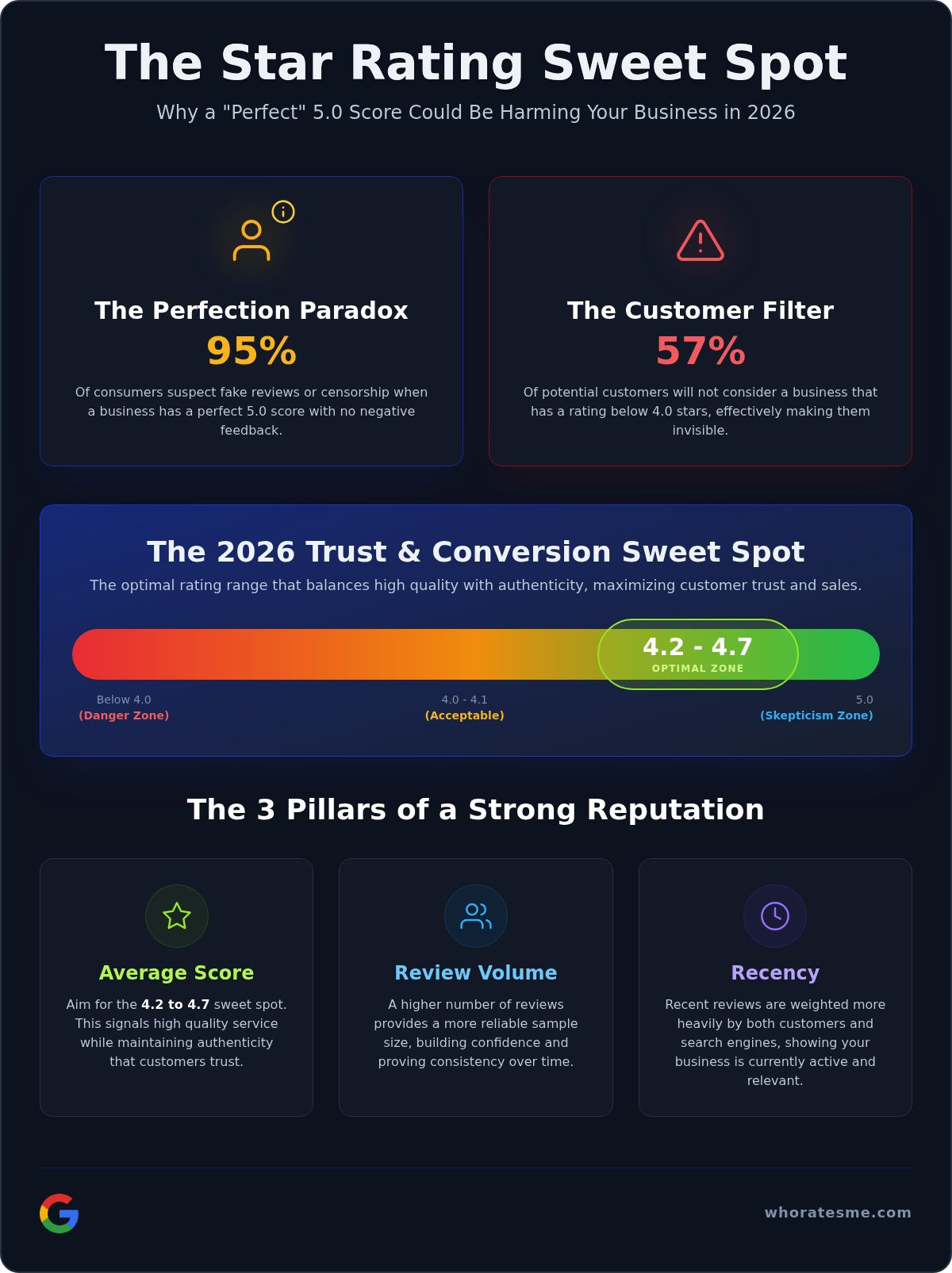
In 2026, consumers are smarter; they value authenticity over a flawless facade. Data shows that 57% of people won't even look at a business below 4.0 stars, yet a perfect score often triggers skepticism. This article will show you why the 4.2 to 4.7 range is your new target for maximum sales. You'll discover how to find your specific industry benchmark and learn a steady, ethical way to grow your reputation using tools like ActivCycle automation. It's time to trade your anxiety for a clear, manageable strategy that puts you back in control.
Key Takeaways
- Discover why the 4.2 to 4.7 range is the 2026 sweet spot for building genuine consumer trust and driving sales.
- Learn what is a good average star rating for your specific industry so you don't lose the 57% of customers who ignore businesses below a 4.0.
- Understand why a perfect 5.0 score often creates skepticism and how "imperfect" feedback makes your business appear more authentic.
- Master the three pillars of reputation: balancing your average score with review volume and recency to stay competitive in local search.
- Explore how to grow your reputation ethically using Google-compliant tools like the Elevate plan and ActivCycle automation.
Understanding the Psychology of Star Ratings in 2026
A star rating is a silent conversation between your business and a potential customer. In 2026, it serves as a vital social shortcut. People are busier than ever. They don't have time to read every single word of your website or compare dozens of service descriptions. Instead, they look for a visual cue of quality. While the history of star rating systems shows they were originally designed for simple classification, they've evolved into complex trust signals that dictate whether a person stays on your page or bounces to a competitor.
When you ask what is a good average star rating, you're really asking how much a stranger can trust you. A "good" rating today isn't just a high number. It's a balance between excellence and believable transparency. If you look too perfect, consumers start to wonder what you're hiding. They aren't looking for a business that never makes mistakes. They're looking for one that is reliable and honest. This is the core of social proof. High ratings don't just look nice; they directly improve your click-through rates by validating a user's decision to click on your link over a competitor's.
The 2026 Trust Benchmark
The "perfect" 5.0 has become a red flag. Savvy users often assume a flawless score is the result of family members posting reviews or, worse, paid manipulation. Research indicates that most consumers now feel most comfortable when a business sits between 4.2 and 4.7 stars. This range suggests a high level of service while acknowledging the reality of human error. This sweet spot also helps your visibility. Google's local search algorithm prioritizes businesses that show consistent, authentic engagement over those with stagnant, perfect scores. It's about being active, not just being perfect.
Emotional Investment vs. Business Reality
It's natural to feel a sense of dread when a notification pops up for a new review. For many business owners, a 1-star rating feels like a personal attack. You've poured your heart into your work. However, the modern market requires a shift from damage control to active reputation management. A single critical review can actually be a gift. It proves your other 5-star reviews are real. When a customer sees a 4.5 rating, they see a business that has faced challenges and survived them. It moves the focus from perfection to integrity. Embracing this shift helps you regain control. It reduces the daily pressure of maintaining an artificial image and lets you focus on what really matters: serving your community.
The Perfection Paradox: Why 5.0 Isn’t Always a Good Star Rating
It's easy to feel like you're failing if your rating isn't a perfect 5.0. You've worked hard to serve every customer with care. You've invested your time and energy into building a brand you're proud of. Naturally, you want that effort reflected in a flawless score. However, when businesses ask what is a good average star rating, they often assume the answer is perfection. In 2026, that assumption is actually a risk. A perfect score can create unrealistic expectations that are impossible to maintain, often leading to harsher feedback when the slightest thing goes wrong. It's time to breathe a sigh of relief: perfection isn't just unnecessary; it's often less effective than being real.
Consumer skepticism has reached an all-time high. In an era where AI-generated content and paid reviews are common, a 5.0 rating looks like a curated advertisement rather than a genuine reputation. People want to see the "human" side of your business. They want to know how you handle mistakes and whether you're honest about your service. The Consumer Review Fairness Act reinforces this by protecting a consumer's right to share honest, even negative, feedback. This legal framework reminds us that transparency isn't just a marketing choice; it's a standard for modern business integrity.
The Suspicion Factor
Data suggests that 95% of consumers suspect censorship or fake reviews when they see a profile with zero negative feedback. They feel like they're being sold a dream rather than a service. Review Skepticism is a protective consumer behavior in 2026 where buyers intentionally look for flaws to verify a business's honesty. Even Google's algorithms have evolved to recognize this. They are increasingly sensitive to "unnatural" growth patterns and perfect scores that don't match the typical customer experience. A 4.5 rating with a few honest critiques tells Google and your customers that your business is active, authentic, and trustworthy.
Converting Through Authenticity
Authenticity is a powerful sales tool. Interestingly, customers spend 5x more time on a site when they interact with negative reviews. They aren't looking for reasons to leave; they're looking for how you respond to criticism. The way you handle a 3-star review matters far more than the rating itself. A calm, solution-oriented response shows you are a "Quiet Innovator" who values truth over a vanity score. It proves you listen. Building this level of transparency is much simpler when you use an automated reputation strategy that focuses on capturing real, unfiltered customer voices. This approach moves you away from the stress of chasing perfection and toward the peace of mind that comes with a resilient, honest brand.
Beyond the Number: The Three Pillars of a High-Converting Rating
Many business owners fixate on the decimal point. It's a source of constant stress. You check your dashboard daily, hoping the number hasn't budged. But when you ask what is a good average star rating, the answer isn't found in the math alone. A high score is only half the story. To truly convert browsers into buyers in 2026, your rating must stand on three pillars: the average, the volume, and the recency. If one of these is missing, your credibility can feel unstable to a savvy consumer.
Think about your own shopping habits. Would you trust a 4.8-star plumber with only five reviews? Probably not. It feels like a small sample size, perhaps even a group of friends or family. Contrast that with a 4.2-star service with 500 reviews. That volume builds a wall of credibility. It proves consistency over years of service. Search engines are also looking deeper than the stars. They use sentiment analysis to scan the actual text of your reviews. They want to see specific words related to your service, which helps them decide how to rank you in local searches.
Reviews also have a "half-life." Feedback older than three months often loses a significant portion of its impact on consumer trust. Customers want to know how you are performing right now, not how you were a year ago. A steady pulse of feedback is always more persuasive than a stagnant, perfect score from the past.
Volume: The Strength in Numbers
Volume provides a safety net for your reputation. It creates a "critical mass" that makes your business look established and reliable. When you have hundreds of reviews, a single "cranky" customer who had a bad day won't tank your score. Their 1-star review gets diluted by the sea of positive experiences. Building this volume doesn't have to be a manual chore. Implementing customer feedback automation allows you to maintain a steady stream of new voices. This ensures your profile stays robust without adding another task to your busy schedule.
Recency: The "What Have You Done for Me Lately?" Factor
Data shows that 85% of consumers ignore reviews older than six months. If your last review was from last summer, potential clients might wonder if your quality has slipped or if you've closed your doors. Google sees this too. Fresh reviews signal that your business is active and relevant to current searchers. Instead of a one-time blast that looks suspicious, aim for a rhythmic feedback loop. This steady flow of information keeps your profile healthy and gives you the peace of mind that comes from being consistently visible.
Building a Resilient Rating Through Ethical Acquisition
It's tempting to want to filter out the negative voices. You've worked incredibly hard, and seeing a critical comment can feel like a personal setback. However, when you're figuring out what is a good average star rating, you have to look beyond the number and focus on how you got there. Integrity is the foundation of a rating that actually converts. If your score is built on cherry-picked feedback, it's a house of cards that could collapse under the weight of a single compliance audit. True resilience comes from a reputation that can handle a bit of honesty.
Modern consumers and regulators are aligned on one thing: transparency. The days of "gaming the system" are over. Today, a rating that feels manufactured is often ignored by the very people you're trying to reach. By focusing on ethical growth, you're not just protecting your score; you're protecting the long-term health of your business. You're building a brand that stands for something real, which is the most powerful marketing tool you have.
Compliance is Not Optional
Regulators like the FTC have made it clear that authenticity isn't a suggestion. Review Gating is the prohibited practice of pre-screening customers to ensure only positive feedback reaches public platforms. While it might seem like a quick fix to boost your score, it's a compliance nightmare that can lead to heavy fines. Understanding the Consumer Review Fairness Act means recognizing that every customer has a right to their voice, regardless of their experience. Avoid "Review Removal Services" at all costs. These are high-risk gambles that often violate terms of service and can get you permanently banned from Google.
The Right Way to Ask
Asking for feedback doesn't have to feel desperate or intrusive. It's about timing. The "Golden Hour" is that short window immediately after service delivery when the value you provided is fresh in the customer's mind. Reach out then. Use a mix of SMS, email, and QR codes to meet them where they are. This multi-channel approach makes it easy for them to share their experience without it feeling like a chore. It shows you value their time as much as their opinion.
Shift your mindset to a "peer-to-peer" approach. Make the customer feel like a partner in your growth rather than just a transaction. When you ask for an honest review, you're telling them that their opinion matters to the future of your community. Integrating a review management strategy that prioritizes the customer experience ensures you're growing ethically. You can start building this foundation today with WhoRatesMe's Google-compliant tools, which automate the process while keeping you firmly on the right side of the rules.
Elevating Your Reputation with Google-Compliant Automation
Managing your business is hard enough without the constant weight of reputation management hanging over you. You've spent this article learning about the 4.2 to 4.7 sweet spot and the importance of review volume. But knowing what is a good average star rating is only the first step. The real challenge is maintaining that score day after day while you're busy running your operations. This is where the WhoRatesMe Elevate plan becomes your trusted ally. It's designed to take the manual labor out of growth, replacing reputation stress with a sense of total control.
By using a centralized dashboard, you can manage multiple platforms like Google and Yelp from a single mobile app. You no longer need to log in to different accounts or worry about missing a customer's comment. This synchronization allows you to see an unfiltered view of your business's health in real time. It moves you away from a reactive mindset of damage control and into a proactive state of steady, natural growth. You aren't just chasing a number; you're building a community of authentic voices that speak for your brand.
ActivCycle: The Rhythmic Advantage
Success in 2026 is about consistency, not just occasional bursts of effort. ActivCycle automation creates a rhythmic feedback loop that ensures your reviews stay fresh and relevant. Many business owners find it awkward to ask for reviews manually. It can feel desperate or intrusive. Automation removes that human error and the social discomfort. It reaches out to your customers at the perfect moment, focusing on capturing authentic, service-related comments. This steady pulse of feedback signals to both customers and search engines that your business is active, reliable, and worthy of trust.
The Elevate Plan: Compliance as a Competitive Edge
Compliance isn't just about following rules; it's about future-proofing your business. Google's algorithms are constantly evolving to prioritize authenticity. The Elevate plan is built to be strictly Google-compliant, protecting you from the risk of being penalized for "unnatural" growth or deceptive practices. There is a deep peace of mind that comes from using a non-gated review platform. It tells the world that you aren't afraid of the truth. This transparency becomes your greatest competitive advantage, proving that your high-converting rating is earned, not manufactured.
You don't have to navigate the complexities of reputation management alone. It's time to trade the anxiety of a fluctuating score for a methodical, organized strategy that works on autopilot. Start growing your authentic reputation with the Elevate plan today and see how a clear, honest view of your business can transform your success.
Your Path to a Resilient Reputation
Building a strong online presence doesn't have to be a source of constant anxiety. You now understand that what is a good average star rating isn't a matter of reaching perfection; it's about building a believable, authentic story. By aiming for that 4.2 to 4.7 sweet spot and focusing on a steady volume of recent reviews, you create a brand that consumers actually trust. You've moved from a mindset of damage control to one of true reputation management.
We're here to support that journey. With ActivCycle automation, you can maintain a natural feedback loop without the manual effort. Our system is 100% compliant with Google and FTC guidelines, ensuring your growth is as safe as it is effective. You can monitor every new comment in real time through our dedicated mobile app. It's time to stop worrying about every single review and start focusing on the service you love. Elevate your reputation ethically with our Google-compliant plan today. You have the tools to succeed, and we're proud to be your ally in this next chapter of your business growth.
Frequently Asked Questions
Is a 4.0 star rating good for a small business?
Yes, it's the critical baseline for survival. Since 57% of consumers won't consider a business below 4.0, reaching this number is vital. While 4.11 is the national average, hitting 4.0 keeps you in the game. It provides a foundation to grow toward the 4.2 to 4.7 trust sweet spot. Focus on maintaining this level to ensure you aren't hidden from potential customers who are looking for reliable local services.
Can I remove a 1-star review if it is unfair?
Generally, you can't remove a review simply because it feels unfair. Google only removes content that violates specific policies, such as spam or harassment. Instead of fighting the platform, focus on a calm, public response. This shows other readers your side of the story with integrity. A professional, empathetic reply often carries more weight with future customers than the original complaint itself. It proves you're a business that listens.
How many reviews do I need to have a "good" average?
The number varies by industry, but you need enough to establish "critical mass." A 4.8 rating with only five reviews often triggers skepticism. Aim for a volume that matches or exceeds your local competitors. When asking what is a good average star rating, remember that high volume dilutes the impact of rare negative feedback. It creates a much more resilient and believable reputation for your brand in the eyes of savvy consumers.
Does Google penalize businesses with 5.0 ratings?
Google doesn't officially penalize a 5.0 rating, but its algorithms prioritize authenticity and engagement. A stagnant perfect score without new activity may rank lower than a 4.5 rating with consistent, fresh reviews. Consumers also tend to trust a 4.5 more than a 5.0, as perfection often looks manufactured. Real growth involves a mix of feedback that reflects the true, human nature of your daily business operations and service quality.
What is review gating and why is it illegal?
Review gating is the practice of pre-screening customers to only invite happy ones to leave public reviews. It's illegal under FTC guidelines and violates Google’s terms of service. It creates a deceptive view of your business. By avoiding this practice, you build a reputation based on true transparency. Ethical acquisition ensures your business remains compliant and protected from sudden algorithm updates or legal penalties that could damage your long-term success.
How often should I be getting new reviews to stay relevant?
You should aim for a rhythmic, steady flow of feedback rather than occasional bursts. Since 85% of consumers ignore reviews older than six months, recency is just as important as the score. A consistent stream of new voices tells Google your business is active and reliable. Automation can help maintain this pulse, ensuring your profile never looks abandoned or outdated to a busy searcher who needs your services right now.
What should I do if my average rating starts to drop?
Don't panic; instead, look for patterns in the feedback. If several customers mention the same issue, it's a chance to improve your service. Use a solution-oriented approach to address complaints publicly. To recover, focus on increasing your volume of authentic reviews through a compliant feedback loop. This natural growth will eventually lift your score back into the ideal range without the need for high-pressure tactics or stress.
Do customers actually read the text of reviews or just look at the stars?
Customers look at the stars first as a shortcut, but they read the text to verify trust. Most people specifically seek out negative reviews to see how a business handles conflict. This is why what is a good average star rating depends so much on the context of the comments. Authentic, service-related text helps search engines understand your business and helps customers feel a genuine human connection before they ever pick up the phone.
