
What to Do When a Competitor Gets More Reviews: A Strategic Growth Guide
What if the gap between your business and the top-rated competitor isn't about the quality of your work, but the efficiency of your system? It's exhausting to watch a rival climb the search results while you feel invisible. When you are wondering what to do when a competitor gets more reviews, the answer isn't to work harder or send manual emails late into the night. It's about finding a way to let your best work speak for itself: a quiet, reliable process that builds trust while you sleep.
You already know that your reputation is your most valuable asset, yet managing it often feels like a second full-time job. It's natural to feel uneasy about new FTC regulations or Google’s 2026 policy updates, which now carry penalties of up to $53,088 for non-compliance. This guide will show you how to build a compliant, automated feedback loop that outpaces your competition naturally. We will walk through a clear strategy to increase your review velocity and turn organic search traffic into loyal customers.
Key Takeaways
- Learn why "Review Velocity" is the engine behind your search visibility; it's the heartbeat of how customers find you in 2026.
- Discover how to audit a competitor’s feedback loop to identify missed opportunities and generic responses you can easily outperform.
- Understand what to do when a competitor gets more reviews by shifting from manual, exhausting requests to a steady, automated growth system like ActivCycle.
- Protect your business reputation by aligning with 2026 FTC and Google compliance standards that prioritize authentic customer voices over risky shortcuts.
- Build a clear roadmap to eliminate friction in your customer journey and scale your online presence with quiet confidence.
Understanding the Review Gap: Why Your Competitor is Pulling Ahead
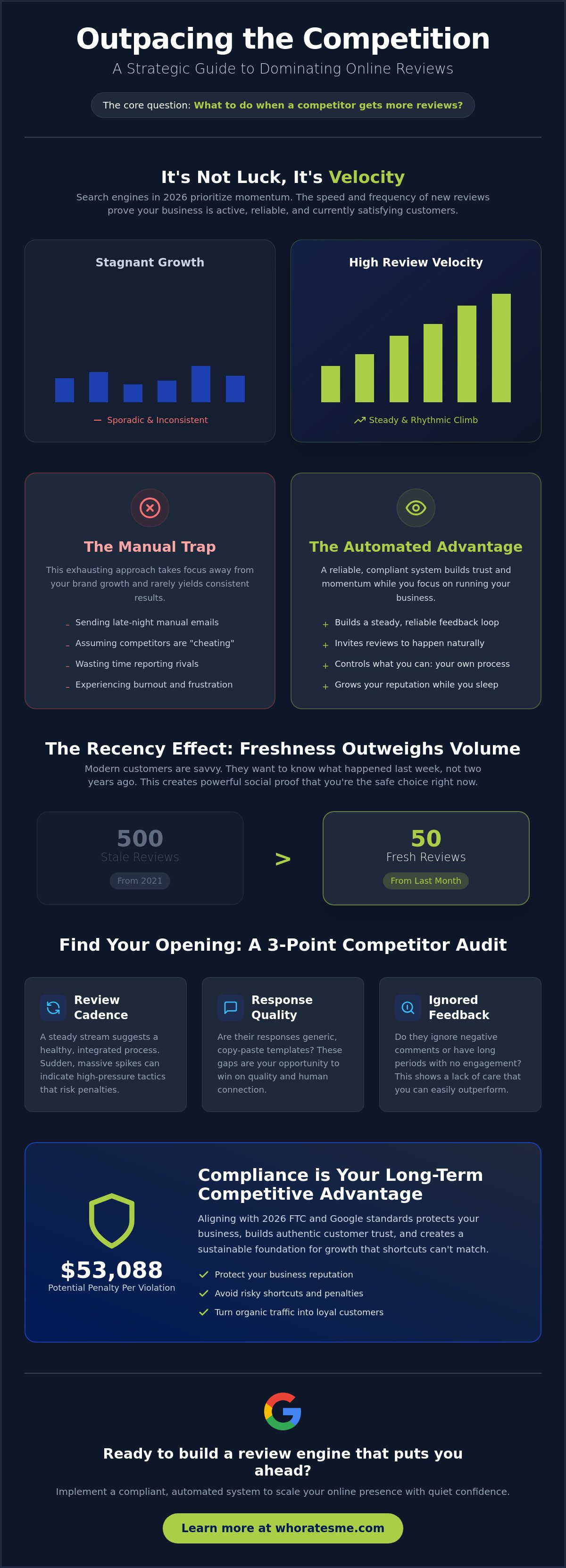
It starts with a quick search. You see a rival business with a higher count and a much fresher date on their latest feedback. It stings. This isn't just about vanity; it's about visibility. When you are wondering what to do when a competitor gets more reviews, it helps to realize that the gap is rarely about luck. It’s about a concept called Review Velocity. This is the speed and frequency at which a business earns new comments. In 2026, search engines prioritize this momentum because it proves a business is active, reliable, and currently satisfying its customers.
Seeing a competitor surpass your hard-earned rating can feel like a personal setback. You’ve invested years into your service. It feels unfair when a newer player seems to capture all the attention. Usually, this gap is built on three pillars: volume, consistency, and automation. While some businesses experience artificial spikes from risky shortcuts, most sustainable leaders have simply synchronized their request process. They don't wait for reviews to happen; they've built a system that invites them to happen.
There is a clear difference between natural growth and forced growth. Organic review patterns show a steady, rhythmic climb that mirrors actual sales. Artificial spikes look like sudden, isolated towers on a graph. Instead of worrying about the spikes, focus on the steady rhythm. A consistent stream of feedback is the most powerful signal you can send to both customers and search algorithms.
Quantity vs. Quality: What Searchers Actually See
Modern customers are savvy. They look past the big number at the top of a profile. They want to know what happened last week, not two years ago. This is known as the Recency Effect. A competitor with 50 reviews from the last month often carries more weight than a business with 500 reviews from 2021. This creates a powerful form of Social proof. It tells the searcher that your business is the safe choice right now. When you focus on what to do when a competitor gets more reviews, remember that fresh, relevant comments often outweigh a larger, stagnant total.
The Risk of the "Cheating" Assumption
It is tempting to assume a fast-growing competitor is using fake reviews or breaking the rules. You might spend hours scouring their profile for evidence. You might even try reporting them to platforms like Google. This is often a trap. Manual reporting is slow. It rarely results in immediate change. More importantly, it takes your focus away from your own brand growth. The most effective way to protect your reputation is to build a superior internal feedback architecture. Control what you can by refining your own process. A compliant, automated system is your best defense against a noisy competitor.
Analyzing Your Competitor’s Review Strategy (Without the Stress)
It's easy to feel a sense of unease when you see a rival's numbers climbing. Instead of letting that frustration simmer, try to view their profile as a blueprint. When you are figuring out what to do when a competitor gets more reviews, the most productive first step is an objective audit. You aren't looking for reasons to be angry. You are looking for the mechanics of their success.
Start by observing their "Review Cadence." Are they receiving a steady stream of feedback, or do they have sudden, massive spikes? A business getting 10 reviews every month suggests a healthy, integrated process. A business getting 50 in a single weekend might be using a high-pressure tactic that risks a penalty. Look for "Review Gaps" in their profile. Do they ignore negative comments? Are their responses generic, "copy-paste" templates? These gaps are your opportunity to win on quality and human connection. If their presence is synchronized across Google, Yelp, and Facebook, they are likely using multi platform review management to centralize their efforts. This allows them to respond quickly and keep their branding consistent without jumping between apps.
Identifying Their Review Acquisition Touchpoints
Look at the timing and tone of their reviews. This can reveal where they are asking for feedback. They might use a QR code at the point of sale, or perhaps they send an SMS via their mobile app. Pay attention to how they reply. Authentic, personalized responses suggest a brand that values its community. If their replies feel robotic, you can easily outshine them by being the more relatable, trusted ally in your market. You don't need to be the loudest voice; you just need to be the most sincere.
Spotting the Signs of a Fragile Reputation
A "perfect" 5.0 rating often triggers skepticism in 2026. If every review is short and generic, it may be a sign of review gating or selective filtering. These practices are now under heavy scrutiny. The FTC guidelines on consumer reviews are very clear about the illegality of suppressing negative feedback. With potential penalties of up to $53,088 per violation, a "perfect" score built on shaky ground is a liability, not an asset. Having a robust review management strategy means welcoming all honest feedback. It builds a resilient brand that customers actually trust. If you are ready to start building that trust today, you can see how our automated system works to simplify the process for you.
Implementing ActivCycle Automation: The Key to Scalable Growth
Manual review requests are a burden. You remember to ask one customer, but then you forget the next five because you're busy running your business. This inconsistency creates review request fatigue for you and your team. It also makes your growth look staggered and unnatural to search engines. ActivCycle automation is the stabilizing force that turns this chaos into order. It replaces the frantic, manual approach with a steady, methodical drip of feedback requests. It moves your business from a defensive posture to a proactive one.
When you're stuck wondering what to do when a competitor gets more reviews, the solution isn't to push your staff to work harder. It's to remove the human error and the awkwardness of the ask. Automation ensures that every customer receives an invitation to share their experience. This is the cornerstone of a compliant and healthy reputation. By making the process invisible and automatic, you ensure that your review count grows in direct proportion to your actual sales volume. It provides a clear, unfiltered view of your success without the stress of manual follow-ups.
How to Get Reviews on Autopilot Ethically
Timing is everything. If you ask for a review too early, the customer hasn't fully experienced your value. If you wait too long, the positive emotion has faded. Automation allows you to trigger a request exactly when the service value is at its peak. This creates a natural growth curve that reflects the true quality of your work. It also keeps your business safe from regulatory scrutiny. By inviting every customer to provide feedback, you align with the latest FTC guidance on online reviews. ActivCycle is a self-sustaining loop of customer feedback and brand visibility.
Centralizing Your Response Workflow
A successful growth strategy doesn't stop at the request. As your review volume increases, so does the need for a streamlined response process. If a competitor is pulling ahead, it might be because they are more responsive. You need a way to match that speed without sacrificing your personal life. A single dashboard for monitoring multiple platforms eliminates the need to jump between different websites. Using a mobile app ensures you can acknowledge feedback in real-time. This keeps your entire team synchronized on the customer feedback automation process. It ensures no customer feels ignored while giving you total control over your digital footprint.
Why Compliance is Your Long-Term Competitive Advantage
When you see a rival's review count skyrocket overnight, it's natural to feel a sense of urgency. You might even feel tempted by "quick fix" services that promise to catch you up. Don't fall for the hype. In 2026, the shortcuts that worked yesterday are the liabilities of today. When you are deciding what to do when a competitor gets more reviews, the most powerful move you can make is to choose integrity over speed. Compliance isn't just a legal hurdle. It is your strongest competitive advantage.
The Federal Trade Commission (FTC) has shifted from education to active enforcement. Following warning letters sent in late 2025, the agency is now strictly enforcing the Consumer Reviews and Testimonials Rule. Violations can result in civil penalties of up to $53,088 per violation. This includes practices like buying fake reviews or using undisclosed insider feedback. While your competitor might be winning the numbers game today, they could be one algorithm update away from a total platform ban. Our Elevate Google-compliant plan is designed to protect your business from these risks. It ensures your growth is natural, transparent, and built to last.
The Pitfalls of Review Removal and Gating
Some businesses try to "clean up" their image by paying for review removal services or using review gating to hide negative feedback. These are fragile strategies. Google’s 2026 guidelines are more explicit than ever. They now use advanced detection to spot "unnatural" patterns, such as a sudden lack of negative sentiment. Under the Consumer Review Fairness Act, suppressing honest feedback is not just a policy violation; it's a legal risk. A reputation built on filtered truth is a house of cards. Real growth requires a foundation that can withstand scrutiny.
Building Authenticity Through Transparency
Modern consumers value truth over perfection. They look for detailed, service-related comments that provide a clear view of what it's like to work with you. This is why non-gated review platforms are becoming the gold standard for building unshakeable trust. A 4.8-star rating with a few honest, well-handled critiques often converts better than a "perfect" 5.0 that feels scripted. Every negative comment is an opportunity. It is a public demonstration of your commitment to excellent customer service. By responding with empathy and order, you prove that you are a reliable leader in your field. If you want to build a reputation that search engines and customers both love, get started with our Elevate plan today.
Your Roadmap to Surpassing the Competition
Transformation doesn't happen by accident. It happens through a series of deliberate, organized steps. If you've been wondering what to do when a competitor gets more reviews, the path forward is now clear. You don't need to shout louder than they do. You just need to build a better engine. This roadmap is designed to move you from a place of anxiety to a state of total control over your digital reputation.
Step 1 begins with an honest audit of your current feedback loop. Look for friction points. Is the process of leaving a review too complicated for your customers? If there are too many clicks or a confusing interface, even your happiest clients will walk away. Identify where the silence is coming from so you can fill it with authentic voices. A simple, clear path for the customer leads to a more consistent result for you.
Step 2 is about scaling your efforts without adding to your daily workload. You can deploy google compliant review management software to automate the "ask." This ensures that every customer is invited to share their story, every time. It removes the human element of forgetfulness and replaces it with a steady, reliable rhythm of growth. Automation isn't about being robotic; it’s about being reliable.
Step 3 focuses on your team. Software is a powerful tool, but it works best when it amplifies "review-worthy" service. Train your staff to understand that every interaction is a chance to build a permanent asset for the company. When your team is synchronized and understands the value of a job well done, the feedback follows naturally. Your reputation is a team effort.
Step 4 is the commitment to responsiveness. Use a mobile app to monitor and respond to all feedback within 24 hours. Speed shows that you are listening. It turns a simple review into a conversation, signaling to both customers and search engines that your business is active and attentive. This level of care is what truly sets you apart from a competitor who might have more reviews but less heart.
Monitoring Progress and Adjusting Strategy
Success is a marathon. Track your review velocity relative to your top 3 competitors to see how the gap is closing. Analyze the sentiment of your reviews to find small ways to improve your core service. Don't forget to celebrate the small wins. Every authentic 5-star review is a permanent asset that works for you long after the job is finished. It’s about progress, not just perfection.
The Future of Your Reputation
Consistent, automated growth is the key to search dominance. By adopting a "set it and forget it" mindset with occasional human oversight, you win the long game. You can stop worrying about what to do when a competitor gets more reviews and start focusing on the success of your users. A simplified, successful future is within reach. Explore the Elevate Google-compliant plan today.
Building a Reputation That Lasts
Watching a competitor climb the search results can be a source of constant anxiety. It feels like they have discovered a secret that keeps you in the shadows. But you now have a clear, strategic roadmap. You've learned that the true answer for what to do when a competitor gets more reviews is to build a system that is more reliable, honest, and resilient than theirs. By choosing compliance over shortcuts, you protect your business from future algorithm updates while building unshakeable trust with your community.
Our ActivCycle automation handles the heavy lifting by creating a steady, natural rhythm of feedback. You can manage all platforms from our dedicated mobile app, ensuring you remain synchronized with your customers at every touchpoint. Most importantly, our strategies are 100% Google-compliant. Your growth will be permanent, not a temporary spike that risks a penalty.
Start growing your reputation ethically with the Elevate Plan. You have worked hard to build a business you are proud of. Now, let's make sure your online presence reflects that dedication with quiet, steady confidence.
Common Questions About Competitor Review Growth
Is it illegal for a competitor to have more reviews than me?
It is not illegal for a competitor to have a higher volume of reviews than your business. This is usually the result of a more efficient acquisition system or a higher volume of customer interactions. However, it becomes a legal issue if those reviews are proven to be fraudulent or incentivized under the FTC’s 2024 Consumer Reviews and Testimonials Rule. Focus on building your own honest system rather than worrying about their numbers.
How can I tell if a competitor is buying fake reviews?
You can identify potential fake reviews by looking for sudden spikes in volume that don't match the business's typical activity. Watch for generic, repetitive language or a high number of reviews from accounts with no previous history or photos. While it’s frustrating to see, focusing on your own growth is often more productive than trying to prove a rival is cheating. Platforms like Google are increasingly better at catching these patterns themselves.
Will Google penalize me if I start getting reviews too quickly?
Google does not penalize businesses for rapid growth if that growth is organic and reflects real customer experiences. Problems only arise when reviews appear in "bursts" that don't align with your actual sales data. When you are deciding what to do when a competitor gets more reviews, the key is to build a steady, rhythmic flow of feedback. This looks natural to search algorithms and builds long-term authority without triggering any red flags.
What is the best way to ask for a review without being pushy?
The most effective way to ask for feedback is to integrate the request into the natural end of the customer journey. Instead of a high-pressure in-person request, send a gentle, automated invitation shortly after the service is completed. This allows the customer to share their thoughts in their own time and on their own device. It feels like a genuine follow-up and a sign of care rather than a forced transaction.
Can I offer a discount or incentive for a Google review in 2026?
No, offering discounts, loyalty points, or free items in exchange for a review is strictly prohibited in 2026. Both Google’s updated guidelines and the FTC’s active enforcement rules carry heavy penalties for incentivized reviews. Authentic feedback must be given freely to remain compliant. Violating these rules can lead to the removal of your reviews or even civil penalties of up to $53,088 per violation.
What should I do if I suspect a competitor is review gating?
If you suspect a competitor is only sending review links to happy customers, the best response is to double down on your own transparency. Review gating is a violation of Google’s 2026 policies and can lead to the removal of their entire review profile. By welcoming all honest feedback, you build a more resilient and trusted brand. Search engines eventually favor businesses that show a real, unfiltered view of their customer service.
How does ActivCycle automation help with Google compliance?
ActivCycle automation ensures compliance by inviting every single customer to leave feedback, which prevents the illegal practice of selective filtering or gating. It creates a "hands-off" system that follows Google’s strict 2026 requirements for unbiased review collection. This methodical approach protects your reputation while ensuring your review velocity grows at a pace that reflects your actual service volume. It turns your daily hard work into a compliant, self-sustaining growth loop.
Is there a way to manage reviews for multiple platforms in one place?
Yes, you can manage feedback from Google, Facebook, and other major platforms through a single, centralized dashboard. This allows you to monitor your reputation and respond to customers in real-time using a dedicated mobile app. Having all your data in one place provides a clear, unfiltered view of your growth. It ensures that no customer comment goes unnoticed, allowing you to match or exceed the responsiveness of any competitor.
