Why Online Reviews are Important: The Digital Heartbeat of Your Business in 2026
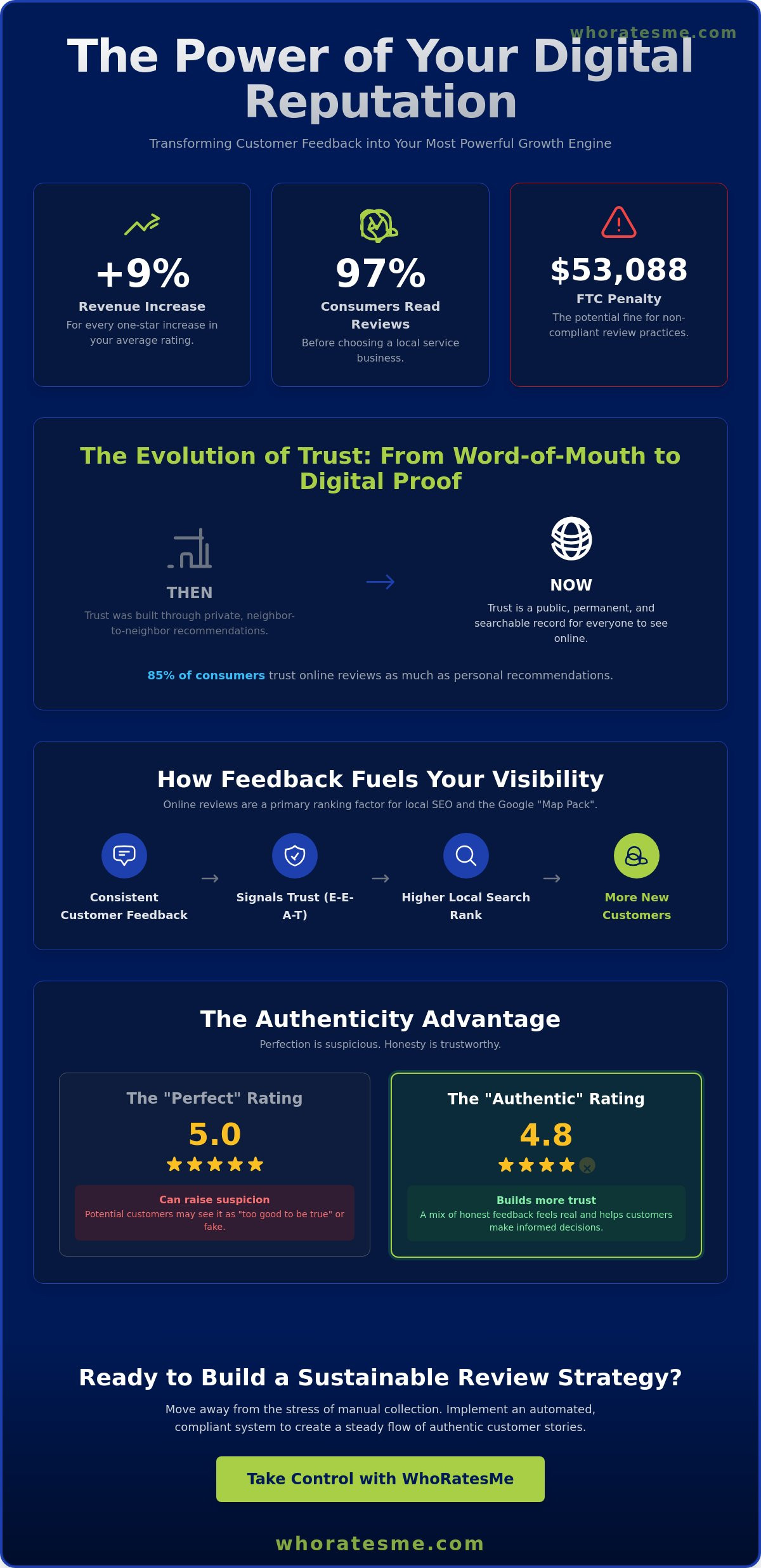
Did you know that a simple one-star rating boost can increase your revenue by up to 9%? It's a clear signal of how much weight your digital reputation carries. Running a local service business is demanding; you're often balancing field work with the constant need to attract new customers. You might find yourself wondering why online reviews are important when your schedule is already packed. The pressure to stay visible while avoiding the FTC's strict $53,088 penalties for non-compliance can feel heavy. It's a lot to manage when you just want to focus on your craft.
You understand that your reputation is your most valuable asset. You've seen how 97% of consumers now read reviews before making a choice. We want to help you move from feeling stressed to feeling in total control. This article will show you how to transform customer feedback into a reliable growth engine that works ethically for your long-term success.
We'll walk through the actual ROI of your digital footprint and provide a clear framework for managing feedback. You'll discover how an Elevate Google-compliant plan and ActivCycle automation can protect your brand while you focus on the work you love.
Key Takeaways
- Understand how your reputation has evolved from private conversations into a permanent, public record that defines your brand's digital heartbeat.
- Explore the direct link between feedback and search visibility to see why online reviews are important for maintaining your position in local search results.
- Learn why a perfect rating isn't always the goal and how the "authenticity tax" makes a mix of honest feedback more trustworthy to modern customers.
- Stay compliant with evolving FTC regulations by identifying the difference between ethical management and risky practices like review gating.
- Move away from the burden of manual review collection by implementing automated systems like ActivCycle to create a steady, natural flow of customer stories.
The Evolution of Trust: Why Online Reviews are the New Word-of-Mouth
Trust used to be built over a backyard fence. A neighbor’s recommendation was the gold standard for finding a reliable local contractor or a trustworthy mechanic. Today, that fence has expanded to include the entire internet. This shift has turned individual experiences into a permanent, searchable record for everyone to see. It’s no longer just a conversation; it’s a public ledger of your business’s integrity. Understanding why online reviews are important starts with recognizing this transition from private whispers to public social currency. Marketing doesn't happen in a vacuum anymore. It happens in the comments section and on the star-rating displays that follow your business name everywhere online.
By 2026, the way people verify quality has fundamentally changed. Traditional ads often feel like noise to a modern consumer. They don't want to hear what you say about yourself; they want to hear what your customers say when you aren't in the room. This creates a high-stakes environment where your reputation is your most visible asset. It’s a transparent, high-stakes dialogue that determines your viability in a post-trust economy. While this change can feel overwhelming, it offers a level of clarity that old-school marketing never could.
From Private Feedback to Public Proof
In the past, a bad experience might stay between a customer and their inner circle. Now, the digital landscape has democratized these opinions. The power has shifted from the business to the consumer. This can feel intimidating for business owners who put their heart into their work every day. However, this transparency is actually a massive opportunity for those who prioritize real service. Most of your customers are likely part of the "silent majority." These are people who are genuinely happy with your work but simply haven't thought to share it yet. Giving them a clear path to participate in the new word-of-mouth allows their positive experiences to become your most effective, long-term growth engine.
The Psychology of the Modern Buyer
Why do we trust people we've never met? Research shows that 85% of consumers trust online reviews as much as personal recommendations from friends or family. This is the "Social Proof" phenomenon in action. When a potential lead finds your business, they are often in what experts call the "Zero Moment of Truth." This is the exact point where they decide whether to call you or click away to a competitor. Seeing recent, authentic feedback reduces their buyer anxiety significantly. It provides the emotional reassurance they need to move forward with confidence. Since 97% of consumers now read reviews for local businesses, your digital reputation is the deciding factor for your growth. We see this play out in the numbers:
- Reviews provide an unfiltered view of your service quality.
- Consistent feedback signals that your business is active and healthy.
- Specific, service-related comments help customers visualize their own success with your brand.
When you focus on gathering authentic feedback, you aren't just chasing stars. You're building a stabilizing force for your business that works on autopilot to bring in new leads.
Beyond the Stars: How Customer Feedback Drives SEO and Visibility
SEO often feels like a puzzle with missing pieces. You spend hours optimizing your website, yet your competitors still seem to appear first in local searches. The missing piece is often hiding in plain sight: your customer feedback. Understanding why online reviews are important goes beyond mere reputation; it is a fundamental pillar of how search engines perceive your authority. When a client leaves a review, they are providing a signal that drives SEO and visibility across the web. This isn't just about stars. It's about data, frequency, and trust.
Google’s algorithms are designed to reward businesses that are active and reliable. For local service providers, this means appearing in the coveted "Map Pack." Reviews are a primary ranking factor here because they verify your E-E-A-T (Experience, Expertise, Authoritativeness, and Trustworthiness). Since 81% of shoppers check Google reviews first, the search engine prioritizes businesses that show a consistent stream of feedback. Freshness is key. According to recent data, 74% of consumers only care about reviews written in the last three months; 32% look for those written in the last two weeks. If your last review was from a year ago, the algorithm may assume your digital heartbeat has slowed down.
Google’s Perspective on Reputation
Google uses reviews to confirm that your business is exactly what you claim it is. When a customer mentions a specific service like "emergency plumbing" or "kitchen remodel," it validates your relevance for those search terms. This transparency helps you climb the rankings without needing to be a technical expert. It's a natural way to build authority. If you're feeling overwhelmed by the technical side of search, implementing an Elevate Google-compliant plan can help streamline this process and ensure your reputation is always working for you.
The Content Engine You Don’t Have to Write
Every review is essentially a piece of free marketing copy. Customers naturally use long-tail keywords that you might never think to include on your website. They describe their problems and your solutions in the exact language other potential clients use. This user-generated content answers questions before they are even asked. It also boosts your click-through rate (CTR). A high volume of positive reviews makes your listing more attractive than a competitor with only a handful of stars. You aren't just gaining a rating; you're building a content engine that runs while you work. This steady flow of information creates a clear, unfiltered view of your business that both humans and algorithms trust.
The "Authenticity Tax": Why Perfection is Less Important than Truth
It’s a common fear for any business owner: the dreaded one-star review. You work hard to maintain high standards; so negative feedback can feel like a personal attack. However, this is where the concept of the "Authenticity Tax" comes into play. Consumers in 2026 are increasingly savvy. They don't expect perfection; they expect honesty. A flawless 5.0-star rating can actually trigger skepticism rather than trust. When every single comment is glowing, people start to wonder if the results are too good to be true. In fact, 67% of consumers consider fake reviews a major issue. They’re looking for signs of a real business, not a curated advertisement.
Understanding why online reviews are important means embracing the idea that a few critical comments can actually help your brand. There is a specific "sweet spot" for conversion that typically sits between a 4.2 and 4.7 rating. This range signals to a potential customer that your business is established and honest. It shows you've handled enough clients to have a diverse range of experiences. While 72% of consumers are unwilling to consider a service with an average rating below four stars, they often find a 4.5-star business more credible than a perfect 5.0. It feels human. It feels real.
The Danger of the "Flawless" Profile
People often look for negative reviews first. They want to see the "worst-case scenario" and, more importantly, how you handle it. A sanitized image can create a barrier between you and your audience. By allowing authentic service-related comments to stand, you create a peer-to-peer feel that makes your brand accessible. Transparency builds a bridge of trust that no marketing budget can buy. It proves that you value the truth of the customer experience over a polished, artificial facade.
Turning Friction into Favor
Negative feedback isn't a dead end: it's an invitation to a dialogue. How you respond to a critique tells a potential customer more about your business than a dozen five-star ratings ever could. Data shows that 80% of consumers are more likely to use a business that responds to all reviews. Conversely, 42% are unlikely to use a business that ignores its feedback. Responding professionally and without defensiveness turns a moment of friction into an opportunity for favor. It shows you're a "Trusted Ally" who cares about the success of the user even when things don't go perfectly. This level of engagement provides peace of mind for future clients, knowing that if an issue arises, you'll be there to fix it. Using a mobile app for multi-review platform management makes it easier to stay on top of these conversations in real-time, ensuring no customer feels ignored.
Ethical Reputation Management: Navigating Compliance and Policy
Running a business involves enough daily pressure without the added worry of legal fine print. You want to grow your reputation, but the rules of the digital road are shifting beneath your feet. In October 2024, the FTC’s Consumer Review Rule took full effect. This regulation brought a sharp focus on integrity to the forefront of business operations. Violations are no longer just a slap on the wrist. They can now result in civil penalties of up to $53,088 per instance. This is why online reviews are important to handle with extreme care. It’s not just about your stars; it’s about protecting the business you’ve built from devastating financial risks.
You might encounter services promising "review removal" or guaranteed five-star ratings. These are often a trap for your brand’s longevity. Most major platforms have strict policies against removing authentic feedback just because it’s critical. Attempting to manipulate your record through these services can lead to permanent bans or a total loss of consumer trust. Paid review generation is equally dangerous. It creates a hollow reputation that can collapse the moment an algorithm update detects a pattern of insincerity. Authenticity is your only sustainable defense in a post-trust economy.
The Hidden Risks of Review Gating
Review gating is the practice of "filtering" your customers. It involves only asking those you know are happy to leave a public review, while steering unhappy clients toward a private feedback form. It feels like a safe way to manage your image. In reality, it violates the core policies of Google and the FTC. This practice distorts the clear, unfiltered view of your business that consumers deserve. When a platform detects gating, they may strip away your existing reviews or suspend your profile entirely. The short-term gain of a higher rating is never worth the long-term risk of losing your digital presence.
Compliance as a Competitive Advantage
The Consumer Review Fairness Act protects the right of your customers to share their honest experiences. Embracing this transparency actually builds a "moat" around your reputation. When you collect feedback ethically, you create a foundation that competitors who take shortcuts simply cannot match. Honesty becomes your competitive edge. You can scale your feedback and grow your ratings aggressively while knowing you are on the right side of the law. This approach provides true peace of mind. If you’re ready to build a reputation based on real service and total integrity, consider starting with an Elevate Google-compliant plan to ensure your growth is both fast and secure.
Building a Sustainable Review Strategy with ActivCycle
Manually asking for reviews is exhausting. You finish a long day of service; the last thing you want to do is send out a dozen text messages or follow-up emails. It's a cycle of high effort that often yields inconsistent results. This is where the shift from manual labor to a streamlined, automated system changes the trajectory of your business. Understanding why online reviews are important is the first step. Building a natural rhythm to collect them is the second. ActivCycle automation creates this steady pulse: a digital heartbeat that grows your brand while you sleep. It turns a manual chore into a quiet, reliable process that feels like a natural extension of your service.
By centralizing your reputation through multi-platform management, you no longer have to jump between different sites to see what people are saying. Everything is accessible through a dedicated mobile app. This gives you a clear, unfiltered view of your business health in real-time. You can see authentic service-related comments as they arrive. This synchronization ensures that your digital footprint remains as professional and organized as the work you do in the field. It moves you away from the "hype" of marketing and toward the quiet confidence of a proven track record.
The Power of the Feedback Loop
Consistency beats a sudden burst of reviews every time. Algorithms and customers alike look for a steady stream of recent feedback to verify your current quality. Automation removes the human friction of "the ask." It eliminates the awkwardness of requesting a favor from a client. Instead, it creates a professional, synchronized touchpoint that feels helpful rather than intrusive. Using a dedicated mobile app allows you to track this growth and gain insights without adding hours to your work week. You get the data you need: the relief you deserve.
Your Next Steps to Control and Clarity
You don't have to feel overwhelmed by your digital reputation. Moving from a state of uncertainty to total control is simply a matter of choosing a system that prioritizes integrity. The peace of mind that comes from a compliant, automated system is invaluable. It protects your reputation while ensuring you stay on the right side of FTC and Google policies. You've worked hard to build your business; you deserve a growth engine that protects that legacy. It's time to replace manual stress with automated clarity. Ready to grow ethically? Explore the Elevate Google-compliant plan.
Mastering Your Digital Reputation with Confidence
Transitioning from the daily grind to a place of digital clarity is a journey worth taking. You've seen how your reputation acts as the new word-of-mouth; it's a permanent record that validates your hard work. It's also a powerful engine for search visibility. Understanding why online reviews are important is the first step toward reclaiming your time and securing your brand's future. By embracing transparency and staying compliant with FTC regulations, you build a foundation that competitors taking shortcuts simply cannot match. You don't need a flawless record to win; you just need to be real.
Our centralized dashboard and mobile app make it easy to manage feedback across multiple platforms without the stress of manual requests. This system provides the relief of knowing your reputation is growing on autopilot. Ready to transform your feedback into a reliable growth engine? Elevate your reputation with our Google-compliant plan. With ActivCycle automation, you can achieve a natural rhythm of feedback that reflects your true service quality. We're here to help you move from feeling overwhelmed to being in total control. Your reputation is in good hands.
Frequently Asked Questions
Is it illegal to filter out negative reviews?
Filtering out negative feedback is illegal under the FTC's current enforcement of the Consumer Review Rule. Businesses must present a transparent record of all customer experiences to avoid being labeled as deceptive. Attempting to suppress criticism can lead to heavy civil penalties. It's better to address the issue openly. This honesty builds more long-term trust with your audience than a sanitized profile ever could.
How do online reviews affect my business’s Google ranking?
Reviews act as a vital signal for Google's local search algorithms. They verify your business's location and the specific services you provide. High volume and consistent "freshness" help you climb the Map Pack. This is a big reason why online reviews are important for your visibility. The more people talk about your work, the more Google trusts your authority and rewards you with better placement.
What should I do if I get a fake negative review?
You should flag the review for a policy violation on the specific platform immediately. Don't engage in a public argument with a bad-faith actor. Instead, post a calm, professional response stating you have no record of their service. This shows future customers that you are attentive and organized. It turns a frustrating situation into a clear demonstration of your business's integrity and commitment to the truth.
Can I offer discounts or incentives in exchange for reviews?
Offering discounts, gift cards, or perks in exchange for reviews is strictly prohibited by both Google and the FTC. This practice is considered "incentivizing sentiment," which can lead to your reviews being stripped or your business facing legal action. Authentic growth comes from real experiences. Focus on providing excellent service; the feedback will follow naturally without the need for risky shortcuts that could damage your brand.
How many reviews do I need before customers start to trust me?
While there is no single magic number, most consumers look for at least five to ten reviews written within the last few months. Quality often matters more than quantity. A few detailed comments about your specific services carry more weight than dozens of generic star ratings. Consistency is the goal. A steady flow of feedback shows your business is active and reliable today.
What is the best way to ask customers for a review without being pushy?
Automation is the most effective way to request feedback without feeling intrusive. By sending a polite, automated follow-up shortly after the service is completed, you catch the customer while their positive experience is fresh. Frame the request as a way to help other community members find reliable service. This peer-to-peer approach feels supportive rather than demanding. It removes the pressure for both you and your client.
Does responding to reviews really help my reputation?
Responding to every review is a powerful way to humanize your brand. It signals to potential clients that you listen and value customer satisfaction. Even a simple "thank you" can make a difference. For negative feedback, a professional response shows you are solution-oriented. This level of engagement is a key reason why online reviews are important for building a loyal community around your business.
What is review gating and why is it dangerous for my business?
Review gating is the practice of pre-screening customers to ensure only happy ones leave public feedback. This is a dangerous tactic because it violates Google's terms of service and FTC guidelines. If caught, your business could lose its entire review history or be removed from search results entirely. It's much safer to use a compliant system that encourages all customers to share their honest, unfiltered experiences.
